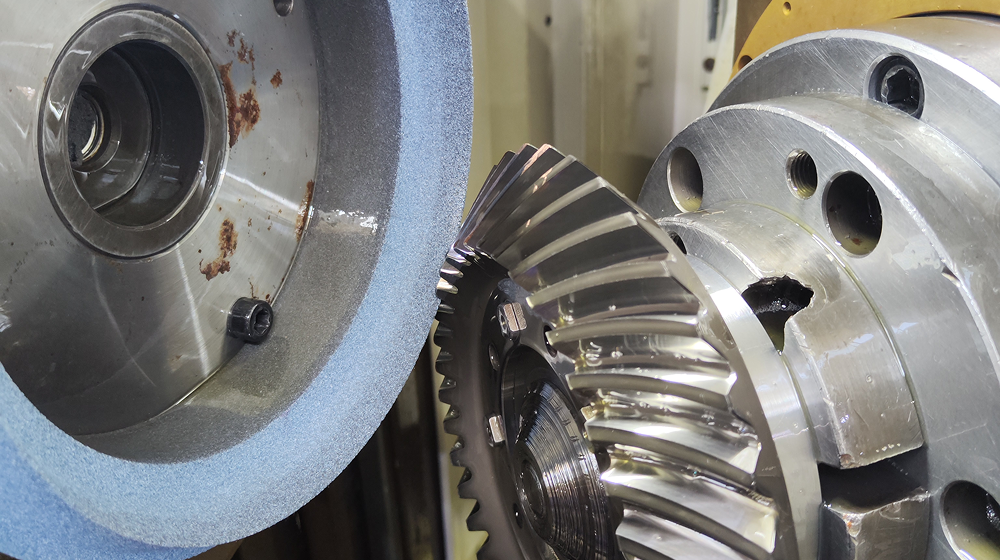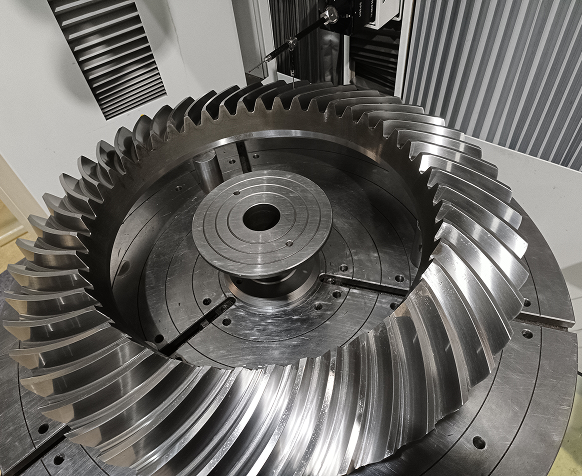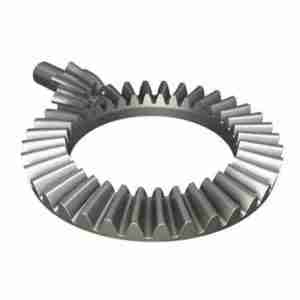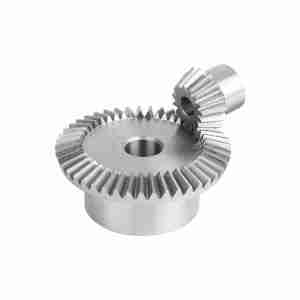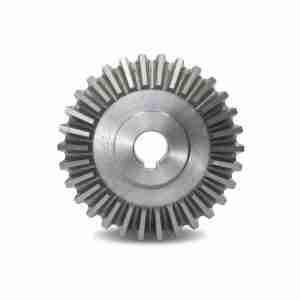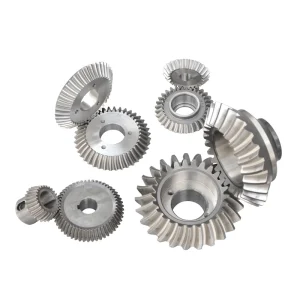

Zero Spiral Angle: This is the defining characteristic of a zero bevel gear. Although its tooth trace is curved (resembling that of a spiral bevel gear), the spiral angle at the midpoint of the face width is precisely zero degrees. It can be understood as a geometrically modified version of a straight bevel gear—its teeth are slightly curved, yet the overall geometry lacks a directional spiral inclination.
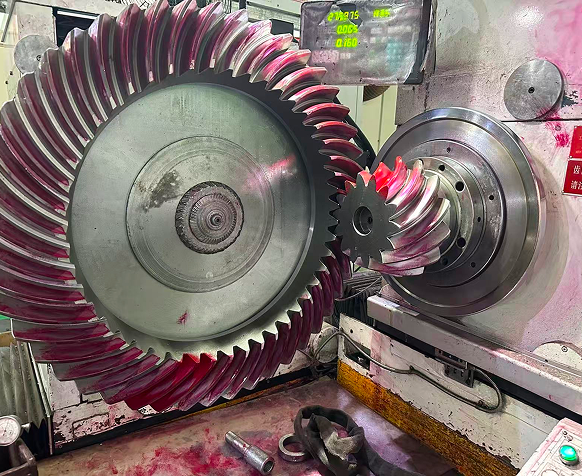
Intersecting Shaft Transmission: These zerol bevel gears for lathes are typically used to transmit power between two shafts whose axes intersect, most commonly at a 90-degree angle, as demonstrated by the meshing pair shown in the image.
Negligible Axial Thrust: Owing to the zero-degree spiral angle, the axial thrust generated during meshing is virtually nonexistent (similar to straight bevel gears). This feature significantly simplifies bearing support design, eliminating the need for large thrust bearings and thereby reducing both manufacturing costs and structural complexity.
Smooth and Quiet Operation: Thanks to the curved tooth form, meshing occurs via progressive “rolling contact” involving multiple teeth simultaneously. Compared to straight bevel gears, this design effectively mitigates impact and “clattering” noises, resulting in smoother and quieter performance.
High Load Capacity and Strength: The curved tooth geometry provides superior contact strength compared to straight bevel gears, placing its load-bearing capacity between that of straight bevel gears and standard spiral bevel gears. Additionally, the robust tooth root structure allows it to withstand substantial impact loads.