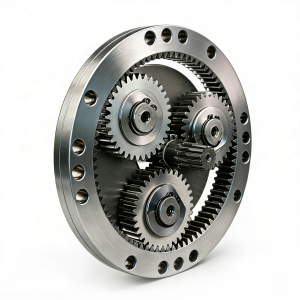
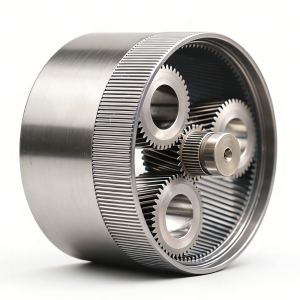
Manufacturing Process of Precision Planetary Gears for Robotics Reducers
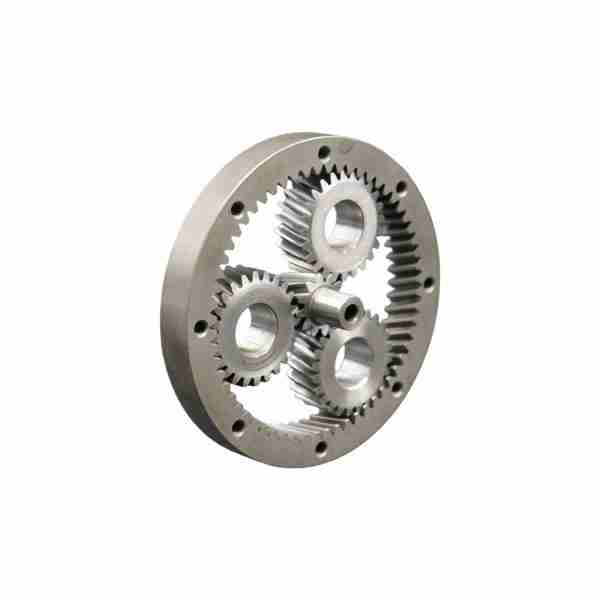
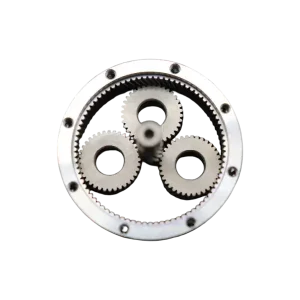
To meet the rigorous requirements for robotic gear reducers, specifically minimal backlash, high torsional rigidity, and reliable operation over millions of cycles, we employ distinct optimized machining strategies for the ring gear, sun gear, and planet gears. Each selected based on the balance bwtween material, accuracy, cost, functional demands.
Ring Gear (Helical Internal Gear) – Power Skiving
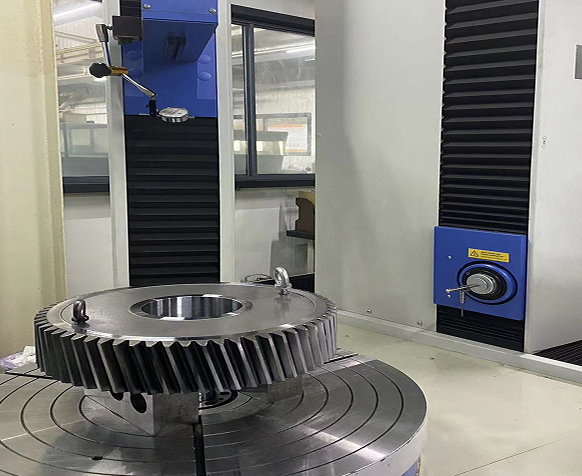
The ring gear features an internal helical tooth profile with a module of 1.0. Machining such a geometry is challenging due to limited tool access and the need for precise helix angle control. We adopt power skiving, a continuous, high-productivity cutting process that combines rotational synchronization between the skiving cutter and the workpiece, with an axial feed that generates the helical tooth flanks.
Why power skiving?
Unlike traditional shaping or broaching, skiving completes roughing and finishing in a single clamping, drastically reducing cycle time. The kinematic synchronisation allows precise helix generation without tool interference, even for small-diameter ring gears, to reach the superior accuracy for internal helicals. And the skived flanks require minimal subsequent honing, reducing overall lead time. One skiving cutter can accommodate a range of tooth counts with the same module, offering production agility.
Power skiving demands a upfront investment in custom designed skiving cutters. Tool wear management and regrinding schedules are critical to maintain consistent quality. However, for medium-to-large batch production of robotics ring gears, the productivity gain and repeatable accuracy far outweigh the tooling cost, delivering a lower cost-per-piece over the product lifecycle.
Sun and Planet Gears – Grinding
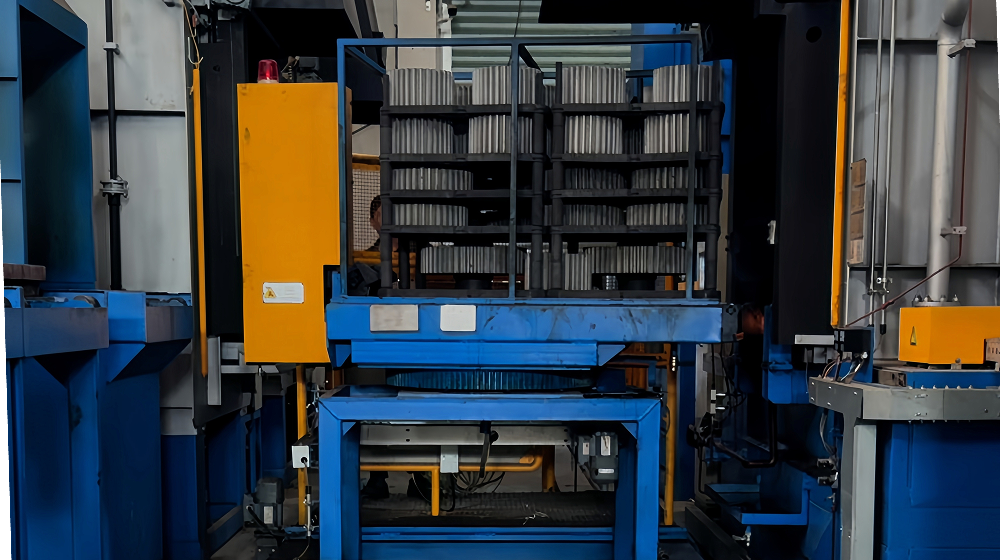
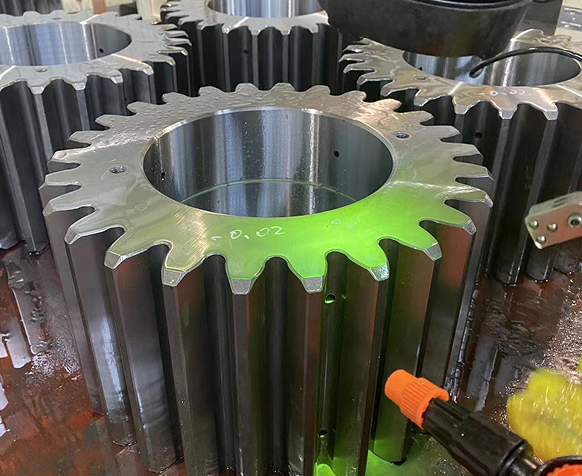
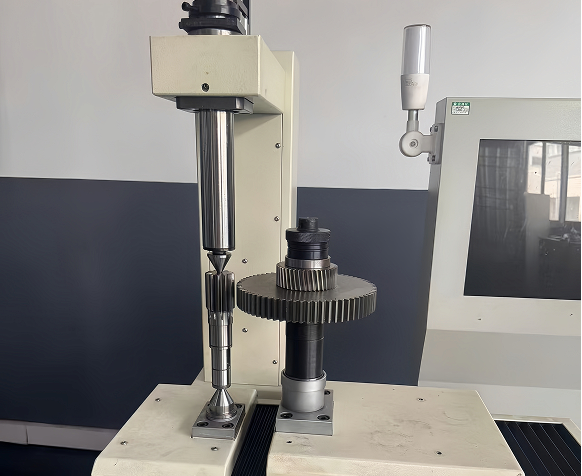
Unlike the internal ring gear, the sun and planet gears are external helical gears. After carburizing and hardening, these components may experience distortion. To reach the required DIN 6 tolerance, we apply profile and lead grinding using CNC grinding machines.
Why grinding?
Grinding corrects heat-treatment distortions to achieve tooth-to-tooth spacing error < 3 µm and total cumulative pitch error within DIN 6 limits. The ground brings a mirror-like finish Ra, reducing friction and noise. We can apply tip relief and root crowning to optimize load distribution under elastic deflection, a feature impossible with skiving alone.
Why these choices matter for robotics?
Robotic gear reducers operate under extreme conditions involving frequent reversals, shock loads, and high-speed intermittent motion. As the largest and most constrained component, the internal ring gear benefits from the power skiving process; this technique produces precise internal helical gear profiles with minimal runout, ensuring uniform load distribution across all planetary gear meshing points. Meanwhile, the sun and planetary gears—which endure the highest contact stresses—undergo grinding to minimize wear and ensure long-term stability. The combination of these processes ensures that every gear set meets DIN Class 6 precision standards, a hallmark of high-end robotics gearing.
Although power skiving requires an investment in specialized tooling, the high productivity and precision it delivers for internal helical gears fully justify the cost. While the grinding process is slower, it guarantees the superior quality required for external gears. Together, these complementary methods form a manufacturing strategy that balances performance with cost-effectiveness, perfectly meeting the rigorous demands of the collaborative and industrial robotics sectors.