
Internal Gear

Why Choose BELON As Your Internal Gear Supplier
As a leading ring gear supplier in China, BELON manufactures custom internal gears with precise tooth geometry and stable quality for diverse transmission applications.
Our production range covers internal gears from Module 0.2 up to heavy-duty Module 45. Leveraging multiple advanced gear machining processes, we deliver professional internal gear solutions for customers worldwide. From prototype sampling to mass production, we enforce stringent controls over machining, heat treatment, gear finishing and inspection to ensure consistent quality and reliable performance across all batches.
Backed by flexible production capacity and strict quality management, BELON strives to be your long-term internal gear manufacturing partner rather than a one-off vendor.
- ISO 9001-Certified Quality Management
- M0.2–M45 Manufacturing Capacity
- 15+ Years of Precision Internal Gear Expertise
- Trusted by Customers in 35+ Countries
- 1,000+ OEM Gear Projects Successfully Delivered Annually
- Responsible “3R” Quality Policy Guarantee
What Internal Gears BELON Can Make
Internal gears belong to cylindrial gears. The difference comparing to spur gears and helical gears are the teeth cut on the inner surface. They typically mesh with a smaller external gear known as a pinion gear or a planet gear. Its greatest advantage is enabling highly efficient, high-torque transmission within a confined space.
Features:
(1) When meshing two external gears, the rotation occurs in the opposite directions. When meshing an internal gear with an external gear the rotation occurs in the same direction.
(2) Care should be taken with regard to the number of teeth on each gear when meshing a large (internal) gear with a small (external) gear, since three types of interference can occur.
(3) Usually internal gears are driven by small external gears.
(4) Allows for a compact design of the machine.
BELON provides precision internal gears ranging from Module 0.2 to Module 45 in order to meet the diverse specifications in different industrial equipment used in many industries.
Internal Gear Size:


Inner Ring Gear
- Material: 42CrMo4
- Heat treatment: Tempering and quenching 285 – 310 HBW
- Accuracy: DIN6


Internal Gear Ring
- Material: 42CrMo4
- Heat treatment: Tempering and quenching 285 – 310 HBW
- Accuracy: DIN 6

Gearbox Ring Gear
- Material: 42CrMo4
- Heat treatment: Quenching + Tempering + Nitriding
- Accuracy: DIN 6

Power Skiving Gear
- Material: 20CrMnTi
- Heat treatment: Quenching + tempering + Carburizing
- Accuracy: DIN6

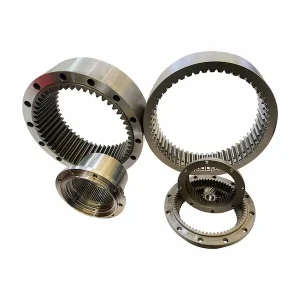
Internal Spur and Helical Gear for Planetary Speed Reducer
- Material: 42CrMo4
- Heat treatment: Case harden+ Nitriding 50±2HRC
- Accuracy: DIN 6
How We Can Make Internal Gears
At BELON, we understand that every internal gear application has unique performance demands. With decades of experience in internal tooth gear manufacturing, BELON provides customers with different internal gear machining solutions covering all sizes and precision requirements including Broaching, Power Skiving, Shaping, Milling, Grinding. The combination of crafts is tailored to your specific module, dia. and required accuracy grade to find the balance between performance and budget.
Internal Gear Broaching
Internal Gear Power Skiving
Internal Gear Shaping
Internal Ring Gear Grinding
How Do We Inpsect Internal Gear
Internal Gear WK Inspection
Proper WK is essential for smooth and reliable gear meshing. Excessive backlash can cause noise, vibration, and impact, while insufficient backlash may lead to interference, overheating, or even gear seizure. That makes WK measurement very important and necessary for custom internal gear inspection.
Before the internal gears are delivered and assembled into your equipment, BELON performs WK inspection according to the specified requirements to help ensure quality aspects.
- Accurate Tooth Thickness
- Proper Backlash
- Reliable Assembly Performance
- Manufacturing Consistency

Internal Gear Accuracy Inspection
The purpose of internal gear accuracy is to ensure that its transmission performance, strength, and service life meet the design requirements. The following data will be shown in the accuracy report.
- Tooth Profile Accuracy
- Tooth Lead Accuracy
- Pitch Accuracy
- Tooth Thickness & Backlash
- Runout & Concentricity
For custom internal gears, inspection requirements can be defined according to your drawings, technical specifications, application requirements, and required Internal gear accuracy grade.
Advantages of Our Internal Gear

Wide Module Range M0.2–M45
Custom OEM Manufacturing
Application-Driven Solutions
Engineering & Reverse Engineering Support
Flexible Production Support
Global OEM Experience
Download to Learn More about Us

ISO Certificate
Company Brochure
Inspection Report
Internal Gear FAQs
Where are internal gears used?
Internal gears are widely used in planetary gearboxes, gear reducers, robotics, automotive transmissions, industrial machinery, and automation equipment. They are particularly valuable where compact size, high torque density, and reliable gear engagement are required.
BELON can provide our customer with different internal gears, like flywheel ring gears, starter ring gear, automatic transmission ring gear, gearbox ring gear and so on.
What is an external vs internal gear?
An internal gear has teeth on its inner circumference, while an external gear has teeth on its outer circumference. Internal gears typically mesh with external gears and can provide a more compact transmission arrangement, especially in planetary gear systems.
What are the main types of internal gears used in machinery?
Internal gears (ring gears) feature teeth cut on the inner surface of a cylinder. The primary types widely used in machinery include:
- Internal Spur Gears Straight teeth parallel to the gear axis. Simple design, no axial thrust. Most commonly used in low-to-medium speed planetary reducers.
- Internal Helical Gears Slanted helical teeth. Deliver smoother meshing, lower noise and higher load capacity than spur internal gears. Generate axial thrust and require proper bearing design. Widely adopted in high-speed, heavy-duty planetary drives and automotive transmissions.
- Internal Herringbone (Double Helical) Gears Two opposite helix tooth sets on one ring gear. Fully cancels axial thrust. Suited for extreme heavy-load, high-torque industrial equipment.
- Internal Bevel Gears Teeth machined on the inner conical surface, for intersecting shaft transmission. Less common, used in specialized compact steering or differential assemblies.
What are the differences between internal spur gears and other gear types?
Internal spur gear vs external spur gear
Internal spur gear teeth face inward; external spur gear teeth face outward. When meshing, internal spur gear has a larger contact area, more compact assembly, and smaller center distance. External spur gears are easier to manufacture and repair, typically used for separate parallel-shaft drives instead of compact planetary sets. Neither creates axial thrust.
Internal spur gear vs internal helical gear
Internal spur gear has straight teeth, simple bearing setup, lower cost, but higher vibration and noise at high speeds. Internal helical gear uses angled teeth for gradual tooth engagement, quieter operation and greater torque capacity, yet produces axial thrust that demands thrust bearings.
Internal spur gear vs planetary pinions
Internal spur ring gear acts as the stationary or rotating outer ring of a planetary system, while planetary pinions are small external gears orbiting around the sun gear. The ring gear forms the outer boundary of the transmission unit.
What are the benefits of using internal gear systems in power transmission?
Internal gear systems offer compact construction, high torque capacity, lower tooth contact stress and large single-stage reduction ratios. They save space and improve transmission stability, especially for planetary gearboxes. The main drawback is higher manufacturing difficulty.
Internal Gear Partner