Herringbone Gear
Why Choose BELON As Your Herringbone Gear Supplier
We produce herringbone gears across a wide module range from M0.2 to M45, with precision grades up to DIN 4, covering miniature precision and large industrial applications. Our available processes include gear hobbing, milling, shaping, power skiving, fine hobbing, gear grinding and 5-axis machining. We deploy suitable process combinations tailored to your project to strike the optimal balance between accuracy, production efficiency and gear performance.
We oversee every critical production stage like tooth geometry design, material selection, heat treatment, precision machining and final inspection, and supply full transparent quality documentation. Whether for prototypes, small runs or mass production, BELON guarantees consistent quality, precise meshing and stable performance for your equipment.
- ISO 9001-Certified Quality
- 15+ Years of Gear Manufacturing Expertise
- Trusted by Customers in 35+ Countries
- Supporting 1,000+ OEM Projects Every Year
- Herringbone Gear Solutions from Prototype to Mass Production
What Herringbone Gears BELON Can Make
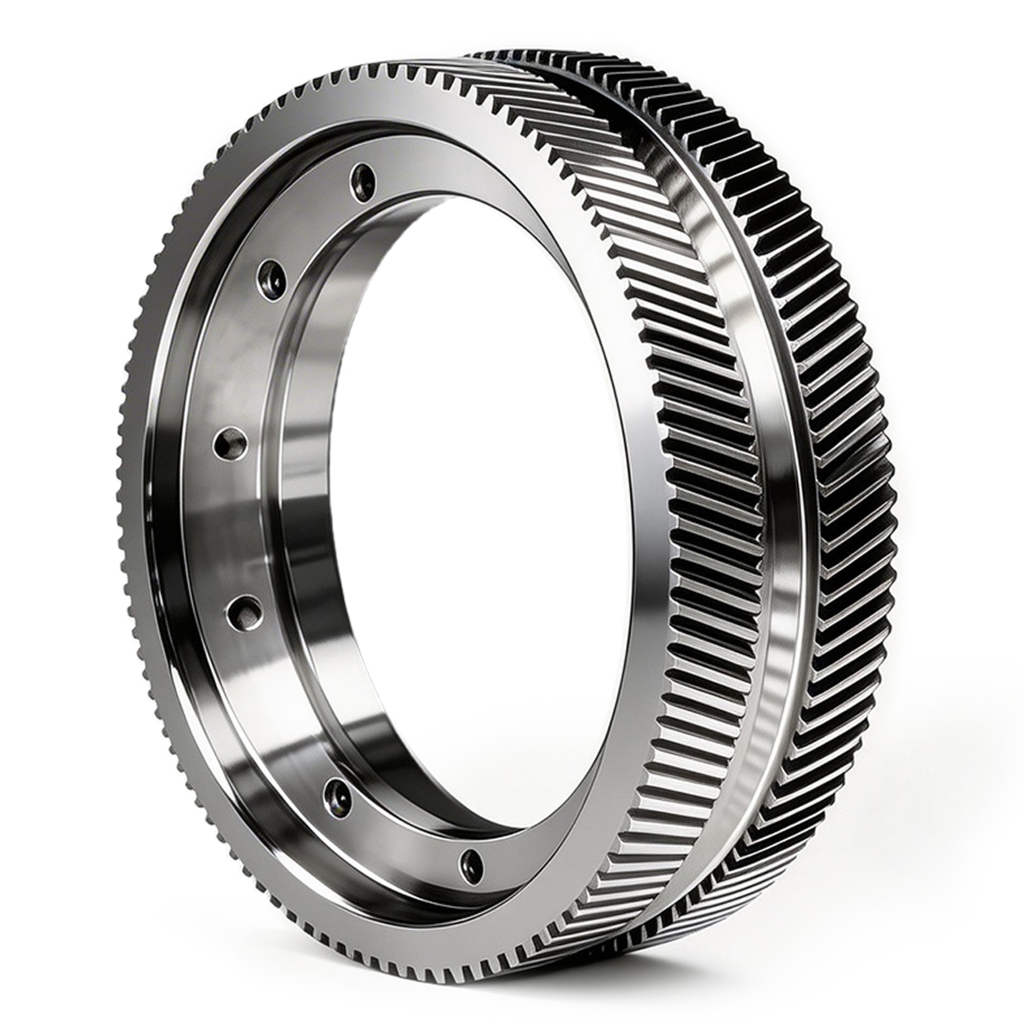
Herringbone gears are a specialized variant of double helical gears featuring a distinctive V-shaped, herringbone tooth profile. Essentially, they consist of two helical gears with opposite hand helixes — one left-handed and one right-handed — integrated side-by-side on a single gear blank, typically with a central undercut between the two tooth sets.
They retain all the benefits of standard helical gears while fully counteracting axial thrust thanks to their symmetrical tooth geometry. The core merit of double herringbone gears lies in zero net axial thrust: axial forces produced by the opposing helixes cancel one another out. This removes the requirement for thrust bearings to absorb axial loads, simplifies bearing arrangements, and enables the gears to handle extremely heavy loads. BELON leverages our professional know-how and rich manufacturing experience to fully unlock the performance advantages of herringbone gears and deliver reliable, satisfactory solutions for your projects.
We manufacture herringbone gears from Module 0.2 to Module 45, covering a wide range of sizes and specifications to meet the diverse requirements of different equipment and transmission applications.
Herringbone Gear Size:
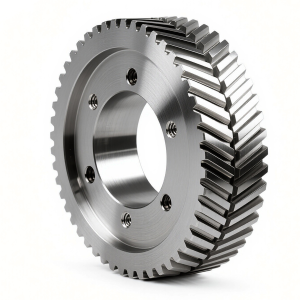
Precision Small Herringbone Gears
- Material: 18CrNiMo7-6
- Heat treatment: Case Carburizing 58-62HRC
- Accuracy: DIN 5
How We Can Make Herringbone Gears
Herringbone gear manufacturing is a high-precision process requiring perfect symmetry of left/right helical teeth at the axis centerline. It starts with forging and rough machining, followed by hobbing (with relief groove) or shaping/milling (without groove) for tooth forming. The teeth are then hardened via carburizing/quenching or nitriding, and finally precision-ground to correct deformation—ensuring contact accuracy and axial force self-balancing. This tightly linked chain, combined with strict NDT and dynamic balancing, delivers a highly reliable, heavy-load, low-noise herringbone gear transmission component.
Herringbone Gear 5 Axis Machining
Herringbone Gear Grinding
How Do We Inspect Herringbone Gear
Herringbone Gear WK Inspection
For herringbone gears, accurate tooth thickness is important for maintaining proper backlash and smooth meshing with the mating gear. WK measurement is used to check the effective tooth thickness and manufacturing consistency. Excessive backlash of herringbone gear may cause noise and vibration, while insufficient backlash may lead to tight meshing, overheating, or gear seizure. BELON uses WK inspection as part of its dimensional quality control to help ensure consistent tooth thickness and reliable gear meshing according to customer specifications.

Herringbone Gear Accuracy Inspection
BELON applies controlled inspection procedures to verify the dimensional accuracy, tooth geometry, alignment, and material properties of custom herringbone gears. Accuracy inspection includes:
- Herringbone gear tooth profile and lead inspection
- Herringbone gear pitch and runout measurement
- Herringbone symmetry inspection
- Tooth thickness and dimensional inspection
For custom herringbone gear, inspection requirements can be defined according to your drawings, technical specifications, application requirements, and required gear accuracy grade. All inspection results can be documented through traceable quality reports according to customer requirements.
Advantages of Our Herringbone Gears

Broad Module Range M0.2–M45
Made‑to‑Order OEM Herringbone Gears
Application‑Driven Manufacturing
Engineering & Reverse Engineering
Prototype to Mass‑Production Flexibility
Proven Global OEM Experience
Download to Learn More about Us

Herringbone Gear FAQs
What materials are used for herringbone gears?
Herringbone gears are commonly manufactured from alloy steels selected according to load, speed, wear resistance, and service conditions. Options may include 20CrMnTi, 18CrNiMo7-6, 8620, and other engineering steels.
BELON can also provide appropriate heat treatment, such as carburizing and hardening, to achieve the required combination of surface hardness, wear resistance, and core toughness.
What are the primary advantages of using a herringbone gear?
Herringbone gears are unique for their high load capacity, smooth and quiet operation, and balanced axial thrust. They are particularly suitable for heavy-duty and high-torque transmission systems.
BELON has the capability to optimize gear geometry, material, heat treatment, and manufacturing accuracy to deliver herringbone gears with reliable performance and long service life.
What is the difference between a herringbone gear and a double helical gear?
Both use two opposing helical tooth sets to balance axial thrust. The main difference is that a true herringbone gear typically has continuous teeth without a center groove, while a double helical gear commonly has a relief groove between the two helix sections.
What are the key differences between herringbone gears and bevel gears?
- Shaft arrangement
Herringbone gears transmit power between parallel shafts. Bevel gears connect intersecting shafts, most commonly at 90°.
- Tooth geometry & thrust load
Herringbone gears have mirrored helical teeth. The axial thrust generated by one helix cancels out the thrust from the opposite helix, so no net axial thrust. Bevel gear teeth are tapered. They create both radial and significant axial thrust forces during operation, requiring heavy thrust bearings.
- Load capacity & speed
Herringbone gears support high torque and high-speed continuous operation with smooth, quiet meshing. Standard bevel gears suit moderate speeds and heavy loads but are less ideal for ultra-high-speed use.
- Manufacturing & cost
Herringbone gears are more complex and expensive to machine. Bevel gears are widely produced and more economical for right-angle drive needs.
- Backlash control
Herringbone designs are harder to adjust for backlash. Bevel gears often allow simple backlash tuning by repositioning the gear along its shaft.
Can you recommend applications where herringbone gears are most suitable?
Herringbone gears are ideal for heavy-load, high-power, continuous-duty parallel-shaft drives where axial thrust must be eliminated. Typical use cases:
- Large industrial gearboxes for heavy-duty rolling mills, steel mills
- Marine main propulsion gearboxes for large ships
- Large compressors, blowers, and turbo-generators
- Mining equipment, large crushers, cement mill drives
- Heavy-duty paper mill machinery
- High-power turbine reduction gears
They are preferred when single helical gears cannot handle the torque and thrust loads, and the layout allows parallel shaft installation.
How do you lubricate a herringbone gear?
Two primary lubrication methods are used, depending on peripheral speed:
Splash lubrication (low to moderate speed)
The gear partially dips into an oil sump in the gearbox casing. Rotation splashes oil onto the tooth surfaces and bearings. Maintain proper oil level; avoid overfilling which causes excess heat and churning loss.
Forced circulating oil lubrication (high speed / heavy load, most common for large herringbone gear units)
An oil pump delivers pressurized, filtered, cooled oil directly onto the gear mesh zone and bearings via nozzles. Oil drains back to a sump or external reservoir.
Herringbone Gear Partner