
Gear Materials
Custom Gear Materials Made to Your Gear Type and Application
Choosing the right material is essential in gear design stage before you start production. At BELON, we help you select materials for custom gears and transmission shafts based on gear type, operating loads, speed, working environment, and required accuracy. Depending on your application, options can include alloy steels for high strength and wear resistance, carbon steels for general transmission requirements, and bronze alloys for worm gear wheels where low friction and good wear characteristics are needed. Material selection is also considered alongside heat treatment, machining processes, and dimensional tolerances to ensure the finished components meet the specific demands of your application.
Worm Gear Materials
Worm gear material selection is one of the most critical decisions for worm drive performance, service life and operational reliability. Worm gear pairs operate under significant sliding friction between meshing teeth, which generates heat, wear and potential scuffing risk. Proper material pairing between the worm and worm wheel matters far more.
Common material options for worm and worm wheel pairs:
- Hardened alloy steel for worms: Grades like 16MnCr5, 20CrMnTi and AISI 8620 are widely used. They feature hard tooth surfaces and tough core to withstand continuous sliding contact stress.
- Phosphor bronze for worm wheels: The most popular standard pairing with steel worms. It offers excellent anti-seizure property and good wear resistance under well-lubricated, medium-speed conditions.
- Aluminum bronze & manganese bronze for worm wheels: Selected for heavy-load, low-speed applications, delivering higher strength and load capacity than phosphor bronze.
- Cast iron for worm wheels: A cost-saving choice for low-speed, light-to-medium load drives, suitable for non-critical general machinery.
- Plastics (POM, Nylon, PEEK) for worm wheels: Ideal for light-duty, low-noise, corrosion-resistant applications, often running without oil lubrication.

Bevel Gear Materials
Bevel gear material selection directly determines load capacity, wear resistance, impact tolerance and service life of bevel gear sets, especially spiral bevel gears and hypoid gears that transmit power between intersecting or offset shafts. These gears endure both rolling contact stress and dynamic shock loads during meshing.
Common material options for bevel gears:
- Alloy steel (16MnCr5, 20CrMnTi, AISI 8620): The most widely used material for high-performance spiral bevel gears. It is ideal for heavy-load, high-speed applications such as vehicle drive axles, mining machinery and gearboxes.
- Medium carbon steel (C45 / 1045 steel): Economical option for low and medium-load straight bevel gears. Suitable for general industrial equipment with moderate impact requirements.
- Cast steel: Used for large-size, heavy-duty bevel gears in crushers and large transmission equipment. It is easier to produce for oversized gear blanks.
- Ductile iron: A cost-effective alternative for low-speed, medium-load scenarios, with decent vibration damping performance and lower machining cost.
- Plastics (Nylon, POM): Adopted for light-duty bevel gears, delivering quiet operation, self-lubricating property and corrosion resistance for small household and garden machinery.

Helical Gear Materials
Helical gears deliver quieter, smoother meshing than spur gears, and their service life, load capacity and noise performance are heavily determined by material selection paired with proper heat treatment.
Common helical gear materials we work with:
- Low-carbon case-hardening alloy steel: 16MnCr5, 8620H, 20CrMnTi, 18CrNiMo7-6. Perfect for your high-speed, heavy-load gearboxes, automotive and industrial reducer applications.
- Through-hardened alloy steel: 4140 / 42CrMo4, 4340, 34CrNiMo6. Widely used for medium-load helical gears where grinding after carburizing is not required.
- Carbon steel: C45 / 1045. Cost-effective option for low-speed, light-load, non-critical transmission parts, often with induction hardening on tooth flanks.
- Ductile iron: Offers excellent vibration damping to reduce running noise, suitable for large-size helical gears under moderate load.
- Stainless steel & non-metallic grades: Stainless for corrosion-prone marine and food machinery; POM / nylon for light-load, low-noise, dry-running transmission scenarios.

Spur Gear Materials
Spur gears are the simplest type of parallel-axis gear, widely used for straightforward power transmission. Their wear resistance, load capacity, impact tolerance and service life depend largely on the spur gear material and corresponding heat treatment.
Common spur gear materials we process:
- Low-carbon carburizing alloy steel: 16MnCr5, 8620H, 20CrMnTi, 18CrNiMo7-6. Ideal for heavy-load, high-speed spur gears in reducers, construction machinery and automotive transmissions.
- Through-hardened alloy steel: 42CrMo4 / 4140, 4340, 34CrNiMo6. A reliable choice for medium-load industrial spur gears.
- Medium carbon steel: C45 / 1045. Economical for light to medium load, low-speed applications.
- Ductile iron: Good vibration absorption, lower cost, suitable for large-size spur gears under stable moderate loads.
- Stainless steel & plastics: Stainless steel for wet, corrosive environments such as food and marine equipment; Nylon, POM for light-load, low-noise, dry-running conditions.

Internal Gear Materials
Internal gears (ring gears) mesh externally with pinion gears inside the gear profile, commonly used in planetary gearboxes, reduction drives and heavy-duty transmission assemblies. Material choice directly determines the internal gear’s contact fatigue strength, resistance to cracking, dimensional stability and service life.
Common internal gear materials we work with:
- Low-carbon case-hardening alloy steel: 16MnCr5, 8620H, 20CrMnTi, 18CrNiMo7-6. Preferred for high-load planetary ring gears in construction machinery, wind power and automotive transmissions.
- Through-hardened alloy steel: 42CrMo4 / 4140, 34CrNiMo6, 4340. Great for medium-load internal gears where deep case hardening is unnecessary.
- Medium carbon steel: C45 / 1045. Budget-friendly option for low-speed, light-load internal gears. Tooth surfaces can be induction hardened to boost wear resistance.
- Ductile iron: Excellent vibration damping capability, lower raw material cost. Suitable for large-diameter internal gears under steady moderate loads.
- Stainless steel & engineered plastics: Stainless grades for humid, corrosive environments like food processing and marine equipment; Nylon, POM for light-load, low-noise, dry-running miniature internal gear drives.

Planetary Gear Materials
Planetary gear assemblies consist of sun gears, planet gears and internal ring gears. Subjected to repeated cyclic contact stress and alternating meshing loads, planetary gears rely heavily on carefully selected materials and matched heat treatment to deliver reliable fatigue resistance, wear resistance and stable service life.
Common planetary gear materials we work with:
- Low-carbon case-hardening alloy steel
- 20MnCr5: Excellent carburizing performance, widely used for planetary gears in general industrial gearboxes.
- 20CrMnTi: Favoured for automotive transmission planetary sets. It achieves high surface hardness together with good core toughness.
- 18CrNiMo7-6: Premium grade for heavy-duty planetary gears. Ideal for mining, construction and wind power reducer applications.
- SAE 8620 / 8620H: The top choice for precision planetary gear sets for robotics and automation. It features good hardenability and machinability, commonly carburized to 58–62 HRC.
- Through-hardening alloy steel
- 42CrMo: Mainly used for planet carriers, ring gears and supporting components. Quenched and tempered (QT) or nitrided, it delivers high strength and impact resistance for stable medium-heavy load scenarios.
- Stainless steel & plastics
- Stainless steel grades: For humid and corrosive working environments such as marine and food machinery.
- Nylon and POM: For miniature, light-load, low-noise planetary drives.

Herringbone Gear Materials
Herringbone gears eliminate axial thrust during meshing, making them ideal for high-torque, heavy-duty industrial transmission systems. Subjected to continuous heavy contact stress, material selection and matched heat treatment directly determine their resistance to pitting, scuffing and tooth root fatigue.
Common herringbone gear materials we work with:
- Case-hardening alloy steel
- 20CrMnTi: Popular carburizing steel for general heavy machinery herringbone gears. Carburizing and quenching creates a hard wear-resistant tooth surface while keeping a tough core, suitable for medium to heavy cyclic loads.
- AISI 8620 / 8620H: Good machinability and hardenability. Typically carburized to 58–62 HRC and ground afterwards for high-precision heavy-duty drive systems.
- 18CrNiMo7-6: Premium high-performance grade with excellent fatigue strength, preferred for large herringbone gears in mining, cement and heavy industrial reducers.
- Through-hardening alloy steel
- 42CrMo / 4140: Suitable for medium-load herringbone gears and gear hubs. Quenched and tempered or nitrided for balanced strength and impact resistance.
- Carbon steel
- C45 / 1045: Cost-effective option for low-speed, light-load herringbone gears. Tooth surfaces can be induction hardened to improve wear resistance.
- Ductile iron
- Offers excellent vibration damping and economic benefits, selected for large-size herringbone gears running under stable moderate loads.
- Stainless steel & plastics
- Stainless steel grades: Applied in humid, corrosive environments including marine and chemical machinery.
- Nylon and POM: Used for small, light-load, low-noise herringbone gear assemblies.

Shaft Materials
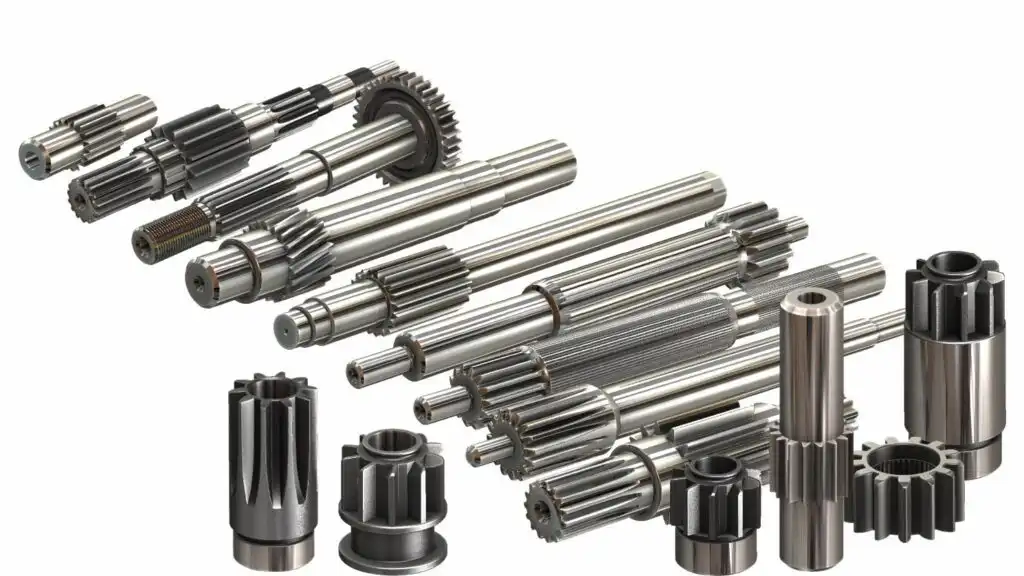
Rotating shafts carry the full burden of power transfer across gearboxes, drive assemblies and mobile machinery, enduring combined torsional stress, bending loads and repeated cyclic fatigue. The right material choice balances rigidity, wear resistance and impact tolerance.
Common shaft materials we work with:
- Case-hardening alloy steel
- 16MnCr5: Widely adopted for main shafts and input shafts. Works well with induction hardening or case hardening, delivering hard wear-resistant bearing journals while retaining a tough core for shock absorption.
- 20MnCr5: Preferred for heavy-duty drive shafts. After case hardening, it achieves balanced surface hardness and core toughness, suited for continuous high-torque transmission.
- 20CrMnTi: Excellent carburizing performance, ideal for integrated gear shafts where meshing teeth and shaft journals both demand high wear resistance.
- 8620: Selected for precision spline shafts. Consistent hardenability supports carburizing to 58–62 HRC, perfect for agricultural and automotive transmission applications.
- Through-hardening alloy steel
- 40Cr: Versatile general-purpose alloy steel with good machinability and balanced strength, widely used for standard industrial transmission shafts.
- 42CrMo: Outstanding fatigue strength and impact resistance, the go-to grade for heavy-load shafts deployed in mining and rugged industrial equipment.
- Carbon steel
- C45 / 1045: Cost-effective option for shaft adapters and light to medium-load shafts. Local induction hardening can be applied on journals to extend wear performance.
- Stainless steel
- 304 / 316: Excellent rust and chemical resistance, engineered for spindle shafts running in food, marine and corrosive wet environments.
Gear Materials Knowledge Center
Browse our related blogs for in-depth technical guidance on gear materials selection for your custom gear projects.

Gear Material: Types, Properties & How to Choose the Right Material
Gear material is significant in determining a gear’s strength, wear resistance, service life, and operating performance. This guide covers the main types of gear materials, including steel, cast iron, bronze, aluminum, and engineering plastics, and explains their key properties, heat treatment options, and makes comparisons.

Worm Gear Materials: A Practical Material Selection Guide
Worm gear material selection can directly affect the wear, lubrication, and its service life in your practical use. This guide covers common worm gear materials, discusses the key factors to consider when selecting materials for different worm gear applications, and tells you common worm gear combinations.
Transmission Partner