

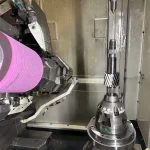
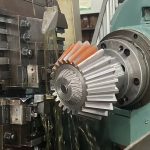
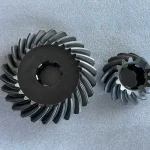
Abstract: In this guide, we’ll explain what gear lapping is, how the gear lapping process works, its advantages and limitations, and how it compares with other gear finishing methods such as grinding.
What Is Gear Lapping?
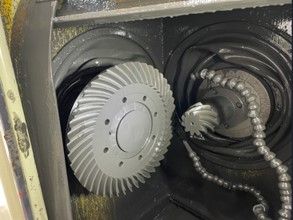
Gear lapping is one of the most widely used gear finishing processes for spiral bevel gears and hypoid gears. In this process a mating gear pair runs together with an abrasive compound to improve tooth contact, surface finish, and meshing performance.
As a precision finishing operation, the bevel gear gear lapping process removes minor tooth surface irregularities and helps establish an optimal contact pattern between mating gears. It is commonly performed after gear cutting and heat treatment.
Gear lapping is widely used for:
- Spiral bevel gears
- Hypoid gears
- Differential gears
The primary purpose of lapping is to reduce noise, improve load distribution, and enhance gear meshing quality. Compared with gear grinding, lapping offers a cost-effective solution for producing high-performance bevel and hypoid gear sets in automotive and industrial gearbox applications.

What Is the Purpose of Gear Lapping?
In high-precision gear manufacturing, gear lapping is a critical post-heat-treatment finishing process. Unlike aggressive material removal methods, the primary purpose of gear lapping is not to reshape the gear radically, but to refine the tooth micro-geometry and harmonize the mating gear pair. By running a matched pinion and gear together with an abrasive lapping compound, this process corrects microscopic imperfections and heat-treatment distortions, ensuring the gear set operates at peak performance.
Improve Tooth Contact Pattern
One of the most important goals of gear lapping is to optimize the tooth contact pattern. The process removes minor surface imperfections and improves load distribution across the tooth surface, reducing localized stress and extending gear life.
Reduce Gear Noise and Vibration
Gear lapping helps minimize transmission noise and vibration by creating smoother tooth engagement. This is particularly important for differential gears, spiral bevel gears, and hypoid gears, where quiet operation and improved NVH (Noise, Vibration, and Harshness) performance are critical.
Enhance Transmission Efficiency
By improving tooth surface matching, lapping reduces friction during meshing and promotes more stable gear engagement. This results in smoother power transfer, improved transmission efficiency, and more consistent gearbox performance.
How Does the Gear Lapping Process Work?
The gear lapping process is performed after gear cutting and heat treatment to improve the meshing quality of a matched gear set. During the process, the mating gears are mounted on a lapping machine and rotated together under controlled conditions while a fine abrasive compound is applied to the tooth surfaces.
As the gears mesh repeatedly, microscopic high spots and minor surface deviations are gradually removed. This controlled wear process helps refine the tooth contact pattern and improve the fit between the mating gears.Lapping primarily aims to optimize the working relationship between the gear pair.
For lapping bevel gears, the process is typically carried out on matched sets. The gears are lapped together, inspected together, and often shipped as a matched pair to ensure consistent contact characteristics and smooth operation in service.
A typical gear lapping process includes:
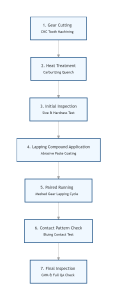
After lapping, the gear set undergoes contact pattern checks and meshing inspection to verify load distribution, backlash, and running performance. This final verification helps ensure reliable operation, lower noise levels, and improved transmission quality in bevel gear and hypoid gear applications.
Lapping Compound and Machine Setup
A key part of the lapped gear process is the use of a specialized lapping machine and abrasive compound. The lapping compound contains fine abrasive particles suspended in oil or paste. This gradually smooths the tooth surfaces during meshing.
During operation, the gear pair is mounted on a dedicated lapping machine and rotated under controlled load and speed conditions. The abrasive compound is continuously applied to the tooth flanks, allowing minor surface imperfections to be removed and the contact pattern to be refined. Proper machine setup is essential to achieve consistent tooth contact, stable backlash, and repeatable lapping results.
Why Lapping Is Performed in Matched Pairs
Unlike ground gears, lapped bevel gears are typically manufactured as matched sets. Because the lapping process improves the meshing relationship between two specific mating gears, the resulting contact pattern is unique to that gear pair.
For this reason, the pinion and gear are:
- Lapped together
- Inspected together
- Marked and shipped together
At Belon, every lapped bevel gear set undergoes contact pattern verification and meshing inspection as a matched pair. This approach helps ensure proper load distribution, lower noise levels, and reliable performance after installation. In practical applications, mixing gears from different lapped sets may affect contact quality and transmission performance, which is why matched-pair management remains an important part of bevel gear manufacturing.
Gear Lapping vs Gear Grinding

Both gear lapping and gear grinding are widely used gear finishing processes, but they serve different purposes. While grinding focuses on achieving the highest possible accuracy, lapping is primarily used to improve tooth contact patterns and meshing performance at a lower manufacturing cost.
For many automotive differential, agricultural, and industrial gearbox applications, gear lapping provides an excellent balance between performance and production efficiency. Gear grinding, on the other hand, is typically selected for high-speed, high-precision transmission systems where tighter tolerances are required.
| Comparison Item | Lapping | Grinding |
| Quality Improvement Capability | Only slight improvement in quality figures possible | Constant high quality figures controlled by closed loop |
| Heat Treatment Deformation Control | Press quenching required for gear body geometry | No press quenching but reasonable gear body geometry |
| Pre-machining Requirement | Good surface finish and spacing before lapping required | Surface finish and spacing not relevant |
| Mesh Smoothness | Inherent smoothening of mesh | Smooth mesh must be designed |
| Operator Skill Requirement | Operator know-how for geometry control and process tuning required (fire check & contact pattern before lapping) | Operator know-how only for geometry control required |
| Post-processing Requirement | Cleaning and preservation after lapping required | No cleaning and no preservation |
| Service Life Cycle Stability | Recalls because of leakages and noise during life cycle | Constant running behavior over life cycle |
| Case Hardening Depth (CHD) | Minimum CHD | Increased CHD |
| Load Carrying Capacity | Protuberance and distortions limit load carrying capacity | Highest load carrying capacity |
| Machining Method for Pinion & Gear | Machining pinion and gear in one operation | Individual machining of pinion and gear |
| Assembly Pairing Requirement | Pairing after lapping and individual mounting distance | No pairing after grinding and constant mounting distance |
Advantages of Gear Lapping
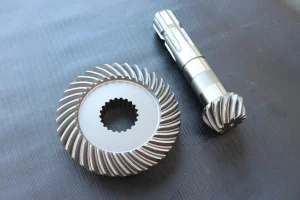 One of the biggest advantages of spiral bevel gear lapping is its ability to improve the tooth contact pattern between mating gears. By refining the meshing surfaces, the process helps distribute loads more evenly across the tooth flank, reducing localized stress and improving running performance.
Gear lapping is also a cost-effective gear finishing method. Compared with gear grinding, it requires less processing time and lower equipment investment, making it well suited for medium- and high-volume production. In addition, the optimized contact pattern often results in quieter operation and smoother gear engagement, which is why lapped bevel gears are widely used in automotive differentials and industrial gearboxes.
Limitations of Gear Lapping
Although lapping improves meshing quality, its dimensional accuracy is generally lower than that achieved through gear grinding. For applications requiring extremely tight tolerances, such as aerospace transmissions, precision robotics, or high-speed machine tool gearboxes, grinding is usually the preferred option.
Another limitation is that lapped bevel gears are normally produced as matched sets. Since the contact pattern is developed between a specific pinion and gear during the lapping process, the components are typically inspected, marked, and used together. Replacing only one gear may affect the original meshing characteristics.
For this reason, gear lapping is best suited for applications that prioritize contact quality, noise reduction, and production efficiency rather than ultra-high geometric accuracy.
Applications of Lapping Bevel Gears
When it comes to bevel gear finishing, the choice of manufacturing process dictates how well a machine handles real-world stress. While grinding is reserved for ultra-high-speed, sub-micron applications, lapping bevel gears remains the dominant and time-tested standard for heavy-duty, high-torque, and impact-heavy industrial sectors.
By running the pinion and gear together as a matched pair under an abrasive slurry, lapping creates a highly compliant, micro-smoothed gear set perfectly adapted to withstand severe field conditions. Below are the primary industries where lapped spiral bevel and hypoid gears are irreplaceable.
| Industry | Why Use Lapped Gears |
| Automotive Differential | Low noise |
| Agriculture | Shock load resistance |
| Mining | Oil retention |
| Industrial Gearbox | Cost-effective |
Video: Thread Milling of a Lapped Bevel Gear
To truly appreciate the precision that goes into high-capacity power transmission, one must witness the micro-geometry taking shape on the factory floor. The following video demonstrates the machining process of a lapped bevel gear, providing a closer look at gear tooth geometry and finishing quality.
How Belon Manufactures Lapped Bevel Gears
At Belon, our custom bevel gears are produced through a precision-driven manufacturing process that ensures superior meshing quality, reduced noise, and extended service life. Belon aims to combine proven machining techniques with rigorous quality control at every stage.
- Face Hobbing: Start production with high-efficiency continuous indexing face hobbing to machine uniform, precise bevel gear tooth profiles with fine surface finish.
- Heat Treatment: Conduct customized controlled heat treatment to balance tooth surface hardness and core toughness for reliable heavy-duty operation.
- Gear Lapping: Finish matched gear pairs via abrasive compound paired running; delivers quieter meshing, better load distribution, shorter break-in period and longer service life.
- Contact Pattern Inspection: Test tooth engagement with marking compound, inspect contact patterns against strict quality criteria for even load and precise alignment.
- Meshing Test: Run full simulation operation tests pre-shipment to check noise, vibration and smoothness, verifying compliance with internal and customer performance standards.
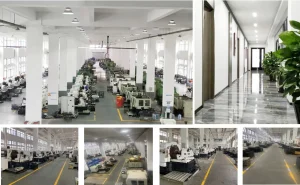
Belon has our own mature lapping bevel gear workshop. Every manufacturing step for our lapped bevel gears is executed with meticulous attention to detail and strict process discipline. Beyond our standard workflow, we tailor the exact production sequence and technical parameters fully according to your real-world operating demands, load conditions and application environments to deliver fully customized bevel gear solutions that perfectly match your project requirements.
Looking for custom lapped bevel gears?
Belon provides precision-manufactured spiral bevel gears, hypoid gears, and matched lapped gear sets for automotive, agricultural, mining, and industrial gearbox applications. Contact our engineering team for technical support and a fast quotation.
FAQ
Q1: What does gear lapping mean?
Gear lapping is a precision finishing process for paired bevel gears. Mating gear sets rotate together with abrasive lapping compound to gently refine tooth surfaces and match meshing geometry after heat treatment and gear cutting.
Q2: What is the purpose of gear lapping?
Its core purpose is to optimize tooth contact patterns, smooth meshing surfaces, and perfectly match paired bevel gears. This post-treatment polishes uneven tooth profiles left from prior machining steps.
Q3: Why is gear lapping used instead of grinding?
Gear lapping excels for matched-pair bevel gear production: it processes pinion and gear in one coordinated run, creates naturally smooth mesh without complex pre-design adjustments, and supports minimal CHD compared to gear grinding, ideal for applications prioritizing paired meshing harmony.
Q4: What are the benefits of lapping bevel gears?
Lapping bevel gears delivers quieter running, more even load distribution across tooth faces, shorter break-in time, and longer gear service life. The inherent mesh smoothening also eliminates rough tooth imperfections for stable low-noise operation.
Q5: What industries use lapped bevel gears?
Lapped bevel gears are widely adopted in agricultural machinery, construction equipment, automotive drivetrains, mining machinery and crane systems—fields that demand reliable, low-noise paired bevel gear performance under variable load conditions.