



China has become one of the world’s leading hubs for precision gear manufacturing, supplying high-performance gears and transmission components for industrial automation, robotics, automotive, mining, marine, agricultural, and heavy equipment industries.
This guide introduces the top 10 precision gear manufacturing companies in China for 2026, compares their product range and strengths, and explains how to choose the right gear manufacturer for your industrial applications. Whether you are sourcing spur gears, helical gears, bevel gears, worm gears, or customized transmission components, this article will help you evaluate the best Chinese gear makers for your business.
What Is Precision Gear Manufacturing
Precision gear manufacturing is the process of producing high-accuracy gears and transmission components designed for smooth power transmission, stable meshing performance, low noise, and long service life. Unlike standard gears, precision gears require strict control over tooth geometry, dimensional tolerances, surface finish, heat treatment, and inspection accuracy throughout the entire manufacturing process.
Modern precision gears are widely used in industrial gearboxes, robotics, automotive transmissions, wind power systems, aerospace equipment, marine propulsion systems, mining machinery, and industrial automation applications where reliable torque transmission and high operational stability are critical.
Quick Comparison of Top Precision Gear Manufacturers in China 2026
|
Company |
Best For |
Core Gear Strength |
Typical Industries |
Production Scale |
Recommended If You Need |
|
Shanghai Belon Machinery Co., ltd |
Precision industrial gears |
Spiral bevel, hypoid, worm gear sets |
Industrial gearbox, mining, marine, agriculture |
Medium–Large |
High-precision custom gears with full in-house manufacturing |
|
PairGears |
Flexible custom machining |
Spur, helical, bevel gears |
Robotics, automation, packaging |
Small–Medium |
Fast prototyping and flexible OEM gear production |
|
NGC Group |
Heavy-duty gearbox systems |
Wind turbine & industrial gears |
Wind energy, rail, marine, mining |
Very Large |
Large industrial gearbox and renewable energy projects |
|
FAST Gear |
Automotive transmission gears |
Truck gearbox and transmission gears |
Commercial vehicles, heavy transport |
Very Large |
Automotive and heavy truck transmission solutions |
|
Shuanghuan Transmission |
EV precision gears |
EV gears, differential gears |
Electric vehicles, robotics |
Large |
High-precision EV and automotive transmission gears |
|
Zhuzhou Gear |
Heavy industrial gears |
Large forged and bevel gears |
Mining, cement, construction |
Large |
Heavy-duty industrial transmission applications |
|
China Gear Motions |
Export OEM gears |
Spur, helical, worm gears |
Automation, agriculture, packaging |
Medium |
Cost-effective OEM gear sourcing for global markets |
|
GGN Gear |
Custom machined gears |
Custom spur, helical, bevel gears |
Industrial machinery, agriculture |
Small–Medium |
Small-batch customized gear manufacturing |
|
Shanghai Automobile Gear Works (SAGW) |
Automotive & NEV transmission systems |
DCT, EV drive gears, differential systems |
Passenger cars, NEV, Tier 1 automotive |
Mega Scale |
High-volume automotive-grade precision gears |
|
Dalian Huarui Heavy Industry Gear Works |
Ultra-large heavy-duty gears |
Wind power, marine, TBM gears |
Wind energy, offshore, mining, rail transit |
Mega Scale |
Extra-large heavy industrial and wind turbine gearbox systems |
Top 10 Precision Gear Manufacturing Companies in China
Shanghai Belon Machinery Co., ltd
 Shanghai Belon Machinery Co., ltd (https://www.belonmachinery.com) is a professional precision gear manufacturing company specializing in high-precision industrial transmission components for global OEM customers. The company provides complete in-house gear manufacturing solutions, from raw material forging and machining to heat treatment, grinding, lapping, and final inspection. Belon serves customers across Europe, North America, and Asia in demanding industrial applications.
Main Products
- Spur gears
- Helical gears
- Spiral bevel gears
- Hypoid gears
- Worm gear sets
- Gear shafts and spline shafts
- Custom gearbox components
Manufacturing Capabilities
- CNC gear hobbing and shaping
- Spiral bevel gear cutting and lapping
- Gear grinding
- Heat treatment and carburizing
- Gear meshing inspection
- CMM inspection systems
Industries Served
- Industrial gearboxes
- Agricultural machinery
- Mining equipment
- Marine transmission systems
- Industrial automation
- Construction machinery
Key Advantages
- Full in-house production process
- Strong OEM/ODM capability
- Precision bevel gear expertise
- International quality standards
- Long-term cooperation philosophy
PairGears
 PairGears (https://www.pairgears.com/) is a Chinese precision gear manufacturer focused on custom gear machining and OEM gear manufacturing services. The company has gained strong international visibility through its advanced CNC gear production and export-oriented manufacturing solutions.
Core Products
- Spur gears
- Helical gears
- Bevel gears
- Worm gears
- Rack and pinion systems
Industries Served
- Robotics
- Automation equipment
- Packaging machinery
- Industrial transmission
Key Advantages
- Flexible production volumes
- Export-oriented manufacturing
- Competitive lead times
- Strong customization capability
NGC Group
 NGC Group (https://www.ngctransmission.com/en/home.html), also known as Nanjing High Accurate Gear Group, is one of China’s largest and most recognized gear manufacturers. The company is globally known for its heavy-duty gearbox systems and precision transmission solutions, especially in the renewable energy sector.
Core Products
- Wind turbine gearboxes
- Industrial reducers
- Rail transit transmission systems
- Marine gears
Industries Served
- Wind energy
- Marine industry
- Cement and mining
- Heavy industrial equipment
Key Advantages
- Advanced heavy-duty gear technology
- Large production capacity
- High engineering capability
- International certifications
FAST Gear
 FAST Gear (https://fast-gear.com/) is a leading Chinese gear manufacturer specializing in automotive transmission systems and commercial vehicle gearbox technologies. The company has extensive experience supplying transmission gears for heavy-duty trucks and industrial vehicles.
Main Products
- Automotive transmission gears
- Heavy truck gearboxes
- Helical gears
- Transmission shafts
Industries Served
- Commercial vehicles
- Industrial transportation
- Heavy-duty equipment
Key Advantages
- Strong automotive transmission expertise
- High-volume manufacturing capability
- Advanced automation systems
- Stable product quality
Shuanghuan Transmission
 Shuanghuan Transmission (https://www.gearsnet.com/) is a well-known precision gear manufacturer focused on high-precision automotive and EV transmission gears. The company is recognized for its advanced gear grinding technologies and precision manufacturing systems.
Main Products
- EV transmission gears
- Ring gears
- Precision automotive gears
- Differential gears
Industries Served
- Electric vehicles
- Automotive transmission
- Robotics and intelligent manufacturing
Key Advantages
- Strong EV market presence
- High-precision manufacturing
- Advanced automation capability
- Large-scale production efficiency
Zhuzhou Gear
 Zhuzhou Gear (http://www.chinese-gear.com/) is a large industrial gear manufacturing company with extensive experience in heavy-duty gear systems and industrial transmission equipment. The company supplies precision gears for various heavy industrial applications.
Main Products
- Spiral bevel gears
- Forged gears
- Heavy-duty transmission gears
- Industrial gear components
Industries Served
- Mining industry
- Cement industry
- Construction machinery
- Heavy industrial equipment
Key Advantages
- Strong heavy-industry experience
- Large gear manufacturing capability
- Stable industrial supply capacity
- Advanced machining equipment
China Gear Motions
 China Gear Motions (https://www.chinagearmotions.com/index.html) is an export-oriented precision gear supplier specializing in custom industrial gears and transmission components for global OEM customers.
Main Products
- Spur gears
- Helical gears
- Worm gears
- Gear shafts
Industries Served
- Industrial automation
- Packaging machinery
- Agricultural equipment
- Power transmission systems
Key Advantages
- International export experience
- Flexible customization
- Competitive pricing
- Stable production quality
GGN Gear
 GGN Gear (https://www.ggn-gear.com/) is a custom gear manufacturing company specializing in precision machined gears and OEM transmission components for industrial applications.
Main Products
- Custom spur gears
- Helical gears
- Bevel gears
- Gearbox components
Industries Served
- Industrial machinery
- Automation equipment
- Construction machinery
- Agricultural systems
Key Advantages
- Strong OEM customization capability
- Flexible engineering support
- Export-oriented services
Shanghai Automobile Gear Works (SAGW)
Shanghai Automobile Gear Works Co., Ltd. (SAGW), established in 1925, operates as a wholly-owned subsidiary of SAIC Motor, a Fortune Global 500 corporation. As a pioneering powerhouse in the Chinese automotive transmission industry, SAGW is headquartered in Shanghai and manages 6 major production bases across China. With an annual production exceeding 3.8 million sets of various transmissions and core gear assemblies, SAGW is a global, mega-scale precision transmission system supplier integrating research and development, manufacturing, and comprehensive testing.
Main Products
- EV drive gears and e-Axles
- DCT and MT transmission gears
- Differential gear systems
- Automotive steering gears
Industries Served
- Passenger vehicles
- New energy vehicles (NEV)
- Tier 1 automotive supply chains
Key Advantages
- Nearly 4 million transmission sets annually
- Advanced automotive-grade smart manufacturing
- IATF 16949 quality management system
- Strong EV transmission R&D capability
Dalian Huarui Heavy Industry Gear Works

Dalian Huarui Heavy Industry Group Co., Ltd. is a backbone enterprise of China’s heavy machinery industry and a publicly traded company on the main stock exchange. DHHI boasts over half a century of R&D and manufacturing heritage in heavy-duty and large-scale precision gear transmission systems.
Main Products
- Wind turbine gearboxes
- Heavy metallurgical reducers
- TBM transmission systems
- Marine propulsion reducers
Industries Served
- Wind energy projects
- Offshore engineering
- Mining and metallurgy
- Rail transit systems
Key Advantages
- Ultra-large gear machining capability
- Heavy-load hardened gear expertise
- World-class large gear grinding equipment
- National standard drafting experience
How to Choose Right Precision Gear Manufacturers
Choosing a precision gear manufacturer among top precision gear manufacturing companies in China is rarely a straightforward procurement decision. The wrong partner doesn’t just delay a project — it introduces tolerance stack-ups, premature wear, and field failures that are expensive and difficult to trace back to source. The right one becomes an extension of your engineering team. Here’s supplier selection checklist:
- Verify gear accuracy standards
- Confirm heat treatment capability
- Review inspection equipment
- Evaluate OEM export experience
- Check supply chain stability
- Request full inspection reports
Step 1: Evaluate Gear Manufacturing Accuracy Standards
The first factor to consider is the manufacturer’s gear accuracy capability. Precision gears are commonly produced according to international standards such as ISO, AGMA, or DIN. Higher precision grades generally provide better tooth contact, lower vibration, reduced noise, and improved transmission efficiency.
A reliable gear manufacturer should clearly specify achievable tolerances for different gear types, including spiral bevel gears, helical gears, spur gears, worm gears, and hypoid gears. For high-speed or heavy-load industrial gearboxes, precision grinding and strict tooth profile correction are especially important to ensure stable meshing performance.
Step 2: Check Heat Treatment and Material Capability
Surface finish and dimensional accuracy get most of the attention, but heat treatment is often where gear failures actually originate. The process window for carburizing and quenching alloy steels like 20CrMnTi, 8620, or 18CrNiMo7-6 is narrow, and deviations in carbon potential, soak time, or quench rate produce subtle microstructural variations that only manifest as fatigue cracks or spalling after thousands of hours of operation.
A qualified manufacturer should be able to speak concretely about case depth targets and how they’re verified, core hardness ranges, retained austenite control, and tempering practice. If heat treatment is subcontracted, find out to whom and how it’s audited. In-house thermal processing with documented process parameters and destructive coupon testing is a meaningful differentiator — not a marketing point.
Step 3: Review Gear Inspection Equipment
Advanced inspection equipment is a key indicator of manufacturing quality. Precision gear production requires strict inspection throughout the machining and finishing process to guarantee dimensional accuracy and tooth consistency.
An experienced gear manufacturing company should utilize professional inspection systems such as:
- Gear measuring centers
- Coordinate Measuring Machines (CMM)
- Gear rolling testers
- Hardness testers
- Runout and concentricity inspection equipment
- Surface roughness measuring instruments
Comprehensive inspection capability helps ensure every gear meets required precision standards before shipment.
Step 4: Evaluate OEM and Export Experience
For global industrial projects, OEM manufacturing experience and export capability are equally important. Manufacturers serving international markets are usually more familiar with industry standards, technical documentation, packaging requirements, and quality traceability systems.
A company with extensive OEM experience can better support custom gear design, reverse engineering, prototype development, and large-scale production. Strong export experience also indicates stable communication, professional project management, and reliable after-sales support for overseas customers.
Step 5: Compare Lead Time and Supply Chain Stability
Quoted lead times are optimistic by nature. The more revealing questions are about what happens when they’re not met: how does the manufacturer handle raw material shortages, machine downtime, or a quality escape late in production? Suppliers with vertically integrated processes — in-house forging or bar stock procurement, heat treatment, machining, and finishing — have more levers to pull when schedules tighten than those who rely on a chain of subcontractors.
For critical applications, it’s also worth understanding minimum order quantities (MOQ), safety stock policies, and whether the supplier has experience managing blanket orders or VMI arrangements. Delivery reliability in steady-state production is as important as capability at the qualification stage.
Common Problems When Sourcing Gears from China
Sourcing precision gears from China offers real cost and capability advantages — but only when the right supplier is chosen. These are the problems that come up most often, and what to watch for.
Inconsistent Gear Accuracy
One of the most common complaints we hear from international buyers is that initial samples pass inspection, but production batches drift. This typically points to a lack of statistical process control rather than a capability problem — the equipment can hold the tolerance, but the process isn’t monitored closely enough to catch when it doesn’t. This means you should ask for batch inspection data, not just first-article reports, and look for suppliers who use gear measuring centers routinely rather than only during qualification.
Heat Treatment Distortion
Improper heat treatment processes may cause gear deformation, tooth distortion, or dimensional changes after carburizing and quenching. This can affect gear contact patterns and transmission efficiency. Professional manufacturers usually apply controlled heat treatment and post-grinding processes to maintain precision.
Poor Communication
Technical misalignment between buyer and supplier often has less to do with language and more to do with engineering depth. A supplier that can only respond to drawings — rather than engage on application requirements, tolerance rationale, or material alternatives — will struggle when specifications are ambiguous or when a problem needs diagnosing. Evaluate communication quality early: precise, technically grounded responses during inquiry are a reliable indicator of how issues will be handled mid-production.
Long Lead Time Risks
Quoted lead times assume smooth production. In practice, raw material delays, machine scheduling conflicts, or a quality escape late in the process can compress your buffer significantly. Suppliers with vertically integrated operations — in-house forging or bar procurement, heat treatment, and finishing — have more control over their own schedules than those coordinating across multiple subcontractors. For critical projects, clarify upfront what contingency capacity exists and how schedule risks are communicated.
Lack of Inspection Reports
Receiving gears without dimensional reports, hardness records, or material certifications is more common than it should be. Without this documentation, there is no basis for incoming inspection, no traceability if a field failure occurs, and no leverage for a quality conversation with the supplier. A professional gear manufacturer should provide full inspection reports as standard — not as a premium service. If a supplier hesitates on documentation, that hesitation itself is informative.
Gear Manufacturing Process
Modern precision gear manufacturing combines multiple machining and finishing processes to achieve high accuracy, durability, and stable transmission performance.
- Gear Forging forms the gear blank under high pressure to improve material strength and internal grain flow.
- Gear Hobbing cuts the gear teeth profile efficiently and is widely used for spur and helical gears.
- Gear Grinding improves tooth accuracy, surface finish, and transmission smoothness after heat treatment.
- Gear Lapping refines the tooth contact pattern to reduce noise and improve meshing performance.
- Heat Treatment increases gear hardness, wear resistance, and fatigue strength for heavy-duty applications.
- Final Inspection verifies gear accuracy, hardness, dimensions, and tooth contact before shipment.

Insights from China’s Precision Gear Manufacturer Belon
After years of working with industrial buyers across Europe, North America, and Asia, certain questions come up consistently. Here are four that get to the heart of what separates reliable gear supply from problematic ones.
Why Some Gear Suppliers Quote Unusually Low Prices
A significantly below-market quote usually means costs have been reduced somewhere in the manufacturing process. The issue is not the low price itself — it is understanding what has been sacrificed to achieve it.
Common Cost-Cutting Areas
Some suppliers reduce costs through:
- Lower-grade steel materials
- Unverified or inconsistent raw material sourcing
- Outsourced or skipped heat treatment
- Reduced inspection coverage
- Lower machining precision
- Faster production cycles with looser tolerances
These compromises are rarely visible in a quotation or basic dimensional drawing.
The Hidden Risk Behind Low-Cost Gears
Low-cost gears may initially appear acceptable and even pass basic incoming inspection. However, problems often emerge only after long-term operation.
Typical long-term failure risks include:
- Tooth surface pitting
- Premature wear
- Gear noise and vibration
- Tooth root cracking
- Poor meshing stability
- Reduced gearbox service life
In industrial gearbox systems, the downstream cost of failure often exceeds the initial savings from a lower unit price.
Why Heat Treatment Is the Step You Cannot Compromise On
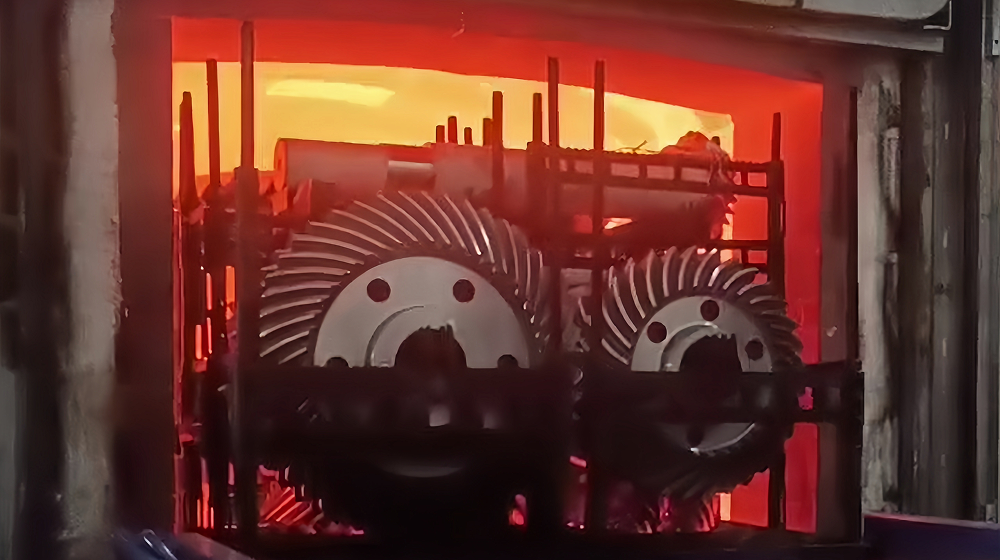
Gear tooth geometry determines how gears mesh. Heat treatment determines whether the gear can survive long-term industrial loading conditions.
During operation, gear teeth experience millions of repeated stress cycles at the tooth root and contact surface. Without proper heat treatment, fatigue damage develops rapidly.
Why Heat Treatment Matters
Professional heat treatment improves:
- Surface hardness
- Wear resistance
- Fatigue strength
- Tooth root durability
- Load carrying capacity
- Long-term transmission reliability
Risks of Poor Heat Treatment
Improper carburizing or quenching may lead to insufficient case depth, unstable hardness distribution, excess retained austenite, heat-treatment distortion, tooth surface cracking, and premature spalling or pitting.
These failures often appear after extended operation and are difficult to trace back to the original process.
Why In-House Heat Treatment Is Important
Manufacturers with controlled in-house heat treatment typically provide:
- Better process consistency
- Controlled carburizing parameters
- Stable quench control
- Improved distortion management
- Traceable process records
- Destructive coupon verification
This is not simply a quality certification issue — it is a core factor affecting actual gear service life.
Why Gear Grinding Determines Long-Term Performance
Gear hobbing creates the tooth geometry, but gear grinding determines whether the gear can operate smoothly after heat treatment.
Heat treatment inevitably introduces distortion. Precision grinding corrects these deviations and restores tooth accuracy.
What Gear Grinding Corrects
Gear grinding helps control:
- Profile deviation
- Lead error
- Pitch variation
- Tooth flank accuracy
- Surface roughness
- Tooth contact consistency
Without grinding correction, gears may operate with excessive vibration, noise, and dynamic load.
Why Surface Finish Matters
Surface finish directly affects gearbox efficiency and operating stability.
Poor tooth flank finish may cause:
- Increased friction
- Higher operating temperature
- Accelerated wear
- Increased transmission noise
- Reduced meshing efficiency
For high-speed helical gearboxes, tooth flank roughness is often controlled below Ra 0.8 μm to achieve stable performance.
Ground vs Unground Gears
|
Factor |
Ground Gears |
Unground Gears |
|
Tooth Accuracy |
Higher |
Lower |
|
Noise Level |
Lower |
Higher |
|
Surface Finish |
Smoother |
Rougher |
|
Wear Resistance |
Better |
Lower |
|
High-Speed Stability |
Excellent |
Limited |
Looking for a reliable Chinese gear maker now?
At Belon, we provide custom OEM gear manufacturing solutions including spur gears, helical gears, straight bevel gears, spiral bevel gears, hypoid gears, and worm gear sets for global industrial customers. Contact BELON today for technical support, manufacturing consultation, and a fast quotation for your next gear project.
If you are looking for a reliable custom worm gear manufacturer, we have published another post related, which might be helpful for you to make the decision: Top 10 Worm Gear Manufacturing Companies in China 2026
FAQ
Q1: What is a precision gear manufacturing company?
A precision gear manufacturing company produces high-accuracy gears used in industrial transmission systems. These companies typically provide gear machining, heat treatment, grinding, inspection, and custom OEM manufacturing for industries such as automotive, robotics, mining, and industrial gearboxes.
Q2: How do I choose a reliable gear supplier in China?
Choose a supplier with stable machining accuracy, complete inspection capability, professional export experience, and in-house heat treatment processes. It is also important to review inspection reports, production capacity, communication efficiency, and previous OEM project experience.
Q3: Which Chinese companies manufacture high precision gears?
China has many professional precision gear manufacturers, including companies focused on industrial gears, automotive transmission gears, wind power gearboxes, and custom OEM gear machining. Suppliers such as Belon, NGC Group, Shuanghuan Transmission, FAST Gear, and some other reputable companies are known for different gear manufacturing strengths and industry applications.
Q4: What industries use precision gears?
Precision gears are widely used in industrial gearboxes, automotive transmissions, robotics, agricultural machinery, mining equipment, marine systems, wind energy equipment, and industrial automation applications where accurate and reliable power transmission is required.
Q5: What is the difference between spur gears and helical gears?
Spur gears have straight teeth and are commonly used for simple, low-speed transmission systems. Helical gears use angled teeth, providing smoother meshing, lower noise, and higher load capacity, which means they are more suitable for high-speed and heavy-duty industrial applications.