

Abstract: This guide compares spur gears and helical gears in terms of design, performance, efficiency, noise, load capacity, manufacturing requirements, cost, and applications. It also provides practical guidance on how to choose between these two gear types and explains how precision manufacturing, material selection, heat treatment, and gear quality influence their service life and performance.
Quick Comparison: Spur Gear vs Helical Gear
Spur gear and helical gear are two of the most widely used cylindrical gear types in industrial power transmission. The main difference lies in their tooth orientation: spur gears have straight teeth parallel to the shaft axis, while helical gears have angled teeth that engage gradually.

The following table provides a quick comparison of spur vs helical gears to help engineers select the right gear type for their transmission system.
Spur Gears vs Helical Gears Comparison Table
| Feature | Spur Gears | Helical Gears |
| Tooth Orientation | Straight teeth parallel to the shaft axis | Angled teeth with a helix angle, typically 15°–30° |
| Gear Efficiency | Typically 95%–99% due to pure rolling contact | Typically 90%–98% due to additional sliding action between teeth |
| Contact Ratio | Usually 1.2–1.8 | Usually 1.5–2.5+, providing smoother engagement |
| Operating Noise | Higher noise, especially above 1,000–1,500 rpm | Lower noise due to gradual tooth engagement, suitable for high-speed operation (>3,000 rpm) |
| Maximum Speed Capability | Generally suitable for low to medium speeds | Better suited for medium to high-speed applications |
| Torque Capacity | Baseline torque capacity (100% reference) | Approximately 20–50% higher torque capacity depending on design |
| Load Capacity | Lower load capacity because fewer teeth share the load simultaneously | Higher load capacity due to increased tooth contact area |
| Axial Force | No axial thrust force generated | Generates axial thrust force: Fa = Ft × tan(β) |
| Helix Angle | 0° | Commonly 15°–30° (up to about 45° for special designs) |
| Pressure Angle | Commonly 20° | Commonly 20° |
| Manufacturing Difficulty | Simple machining process; easier hobbing and inspection | More complex manufacturing due to angled teeth and thrust control |
| Manufacturing Cost | Lower cost, typically 20–40% cheaper than helical gears | Higher cost due to additional machining and bearing requirements |
| Operating Smoothness | Moderate vibration due to sudden tooth engagement | Excellent smoothness due to gradual tooth contact |
| Service Life | Good for moderate loads and speeds | Longer service life under heavy loads and continuous operation |
| Typical Applications | Conveyors, pumps, clocks, simple machinery, low-speed reducers | Automotive transmissions, industrial gearboxes, compressors, heavy machinery |
What Are Spur Gears?
Spur gears are the simplest and most commonly used cylindrical gear type. They consist of straight teeth that are cut parallel to the gear axis and transmit power between two parallel shafts. Spur gears have no helix angle, which means they do not generate axial thrust forces during operation.
Spur Gear Structure
A spur gear mainly consists of the following components:
| Component | Function |
| Gear Teeth | Transfer torque through tooth engagement |
| Gear Rim | Outer section where teeth are manufactured |
| Hub | Connects the gear to the shaft |
| Bore & Keyway | Provides shaft mounting and torque transmission |
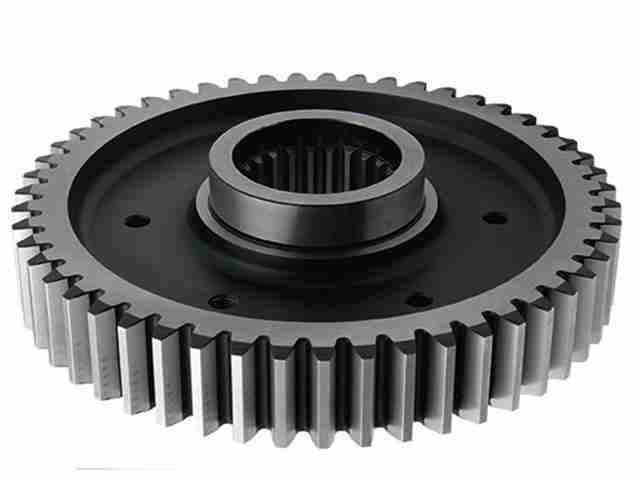
The key feature of a spur gear is its 0° tooth angle, meaning the teeth are completely parallel to the shaft axis. This design eliminates axial thrust force during operation.
How Spur Gears Work
Spur gears operate by meshing two gears with parallel shafts. When the driving gear rotates, its teeth push against the mating gear teeth, transferring rotational motion and torque.
The gear ratio determines the relationship between speed and torque:
Gear Ratio = Driven Gear Teeth / Driver Gear Teeth
For example, a larger driven gear reduces output speed while increasing output torque.
Advantages of Spur Gears
- High efficiency: Typically 95–99% due to low sliding friction.
- Cost-effective manufacturing: Simple tooth design reduces production complexity.
- No axial force: Eliminates the need for additional thrust bearings.
- Easy maintenance: Simple structure makes inspection and replacement easier.
- High accuracy: Suitable for precision transmission systems.
Disadvantages of Spur Gears
- Higher noise: Sudden tooth engagement creates more impact noise at high speeds.
- Lower load capacity: Handles less torque compared with helical gears of similar size.
- Limited high-speed performance: Dynamic loads increase at higher rotational speeds.
- More vibration: Tooth impact can affect smoothness during operation.
What Are Helical Gears?
Helical gears belong to cylindrical gears with angled teeth cut at a helix angle relative to the gear axis. Their teeth engage gradually, creating smoother and quieter power transmission.
Because of their increased tooth contact ratio, helical gears can handle higher loads, higher speeds, and greater torque capacity compared with spur gears of similar size. However, the angled teeth generate axial thrust forces, requiring additional bearing support.
Helical Gear Structure
A helical gear has a similar structure to a spur gear but with angled teeth.
| Component | Function |
| Helical Teeth | Transfer torque through angled tooth engagement |
| Gear Rim | Outer section containing the teeth |
| Hub | Connects the gear to the shaft |
| Bore & Keyway | Provides shaft mounting and torque transmission |
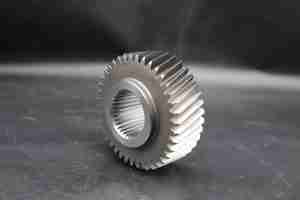
The main feature of a helical gear is its helix angle, typically between 15° and 30°. This angled tooth design increases contact between mating gears and improves load distribution.
How Helical Gears Work
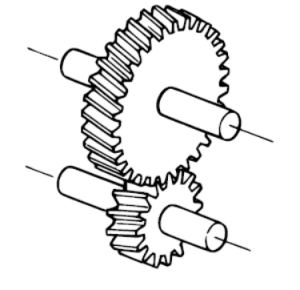
Helical gears transmit motion between parallel shafts through gradually engaging angled teeth.
As the driving gear rotates, the helical teeth enter contact progressively rather than all at once. This gradual engagement reduces impact, vibration, and noise while allowing more teeth to share the transmitted load.
The gear ratio is calculated the same way as spur gears:
Gear Ratio = Driven Gear Teeth / Driver Gear Teeth
Compared with spur gears, helical gears provide smoother operation and higher torque transmission but generate axial forces due to the helix angle.
Advantages of Helical Gears
- Lower noise and vibration: Gradual tooth engagement provides smoother operation.
- Higher load capacity: Increased contact ratio allows greater torque transmission.
- Better high-speed performance: Suitable for continuous operation at higher speeds.
- Improved durability: Reduced impact loading helps extend service life.
- Smooth power transmission: Ideal for precision and heavy-duty gear systems.
Disadvantages of Helical Gears
- Higher manufacturing cost: More complex machining and inspection are required.
- Axial thrust force: Requires thrust bearings or stronger bearing arrangements.
- Lower efficiency than spur gears: Sliding action between angled teeth increases friction losses.
- More complex maintenance: Bearing selection and alignment are more critical.
Spur Gears vs Helical Gears: Key Differences
Spur gears and helical gears both can be used to transmit power between parallel shafts, but their tooth design creates significant differences in performance. Spur gears use straight teeth for simple and efficient transmission, and helical gears use their angled teeth to achieve smoother engagement and higher load capacity.
The following table summarizes the key differences between spur and helical gears.
| Comparison Factor | Spur Gears | Helical Gears |
| Tooth Geometry | Straight teeth parallel to the gear axis (helix angle = 0°) | Angled teeth with a typical helix angle of 15°–30° |
| Tooth Engagement | Teeth contact suddenly across the full tooth width | Teeth engage gradually with overlapping contact |
| Contact Ratio | Lower contact ratio, typically around 1.2–1.8 | Higher contact ratio, typically 1.5–2.5+ |
| Load Capacity | Lower load capacity because fewer teeth share the load simultaneously | Higher load capacity due to increased tooth contact area |
| Noise & Vibration | Higher noise and vibration, especially at high speeds | Quieter and smoother operation due to gradual engagement |
| Efficiency | Typically 95–99% efficiency with minimal sliding friction | Typically 90–98% efficiency due to sliding between angled teeth |
| Axial Thrust | No axial thrust force generated | Generates axial thrust force requiring thrust bearings |
| Torque Transmission | Suitable for moderate torque applications | Handles higher torque and heavier loads of similar size |
| Speed Capability | Best suited for low to medium-speed applications | Better for high-speed and continuous operation |
| Shock Load Resistance | Lower resistance to sudden impact loads | Better ability to absorb shock and dynamic loads |
| Manufacturing Complexity | Simple design; easier hobbing, shaping, and inspection | More complex machining due to angled tooth geometry |
| Manufacturing Cost | Lower production cost due to simpler processing | Higher cost due to additional machining and bearing requirements |
| Maintenance | Easier maintenance with simpler bearing arrangements | Requires more careful bearing selection and alignment |
| Size & Weight | May require larger gears for the same load capacity | Can achieve higher power density with a more compact design |
| Typical Applications | Conveyors, pumps, simple gearboxes, automation equipment, low-speed machinery | Automotive transmissions, industrial gearboxes, compressors, heavy machinery |
Why Are Helical Gears Quieter Than Spur Gears?
Helical gears are quieter than spur gears mainly because of their progressive tooth engagement and higher contact ratio. This is different from spur gears, where the entire tooth width contacts suddenly. Helical gears engage gradually along the tooth surface, reducing impact, vibration, and transmission noise.
1. Higher Contact Ratio Reduces Tooth Impact
The contact ratio describes how many gear teeth are sharing the transmitted load at the same time.
- Spur gears: Typically have a contact ratio of about 2–1.8, meaning fewer teeth are engaged simultaneously.
- Helical gears: Usually achieve a higher contact ratio of 5–2.5+ because the angled teeth create additional overlap.
A higher contact ratio allows the load to be distributed across multiple teeth, reducing the impact force when teeth enter and leave contact.
2. Progressive Tooth Engagement
The biggest difference between spur gears and helical gears is how the teeth make contact.
Spur Gear Engagement
Spur gear teeth contact almost instantly across the entire tooth width.
This sudden engagement creates:
- Impact forces
- Gear mesh vibration
- Higher operating noise
Helical Gear Engagement
Helical gear teeth enter contact gradually from one side of the tooth to the other.
The overlapping tooth action creates a smoother transfer of load:
- Tooth tips begin contact gradually.
- Contact area increases progressively.
- Multiple teeth share the load.
- Contact decreases smoothly as teeth disengage.
This progressive engagement significantly reduces sudden force changes.
3. Rolling Contact and Reduced Vibration
Both spur and helical gears rely on rolling and sliding contact between mating teeth. However, helical gears provide a smoother transition because the angled tooth geometry creates continuous overlap.
The gradual contact pattern helps reduce:
- Sudden changes in transmission force
- Gear mesh excitation
- Structural vibration
As a result, helical gears operate more smoothly, especially at high rotational speeds.
4. Noise Generation Mechanism in Gear Operation
Gear noise mainly comes from tooth impact and vibration during meshing.
For spur gears:
- Teeth enter contact simultaneously
- Load changes occur suddenly
- Vibration is transferred directly to shafts and housings
- Higher noise is produced
For helical gears:
- Teeth engage progressively
- Load changes occur gradually
- Vibration amplitude is reduced
- Operating noise is lower
The difference becomes more noticeable as speed increases because higher rotational speeds amplify gear mesh impacts.
Spur Gear vs Helical Gear Tooth Contact Comparison
| Feature | Spur Gear | Helical Gear |
| Tooth Contact | Sudden full-width contact | Gradual diagonal contact |
| Contact Ratio | Lower (1.2–1.8) | Higher (1.5–2.5+) |
| Load Sharing | Fewer teeth carry the load | Multiple teeth share the load |
| Impact Force | Higher | Lower |
| Vibration | Higher vibration level | Reduced vibration |
| Operating Noise | Louder, especially at high speed | Quieter and smoother |
When Should You Choose Spur Gears?
Spur gears are the preferred choice when low cost, high efficiency, and simple maintenance matter much more than quiet operation. Their straight-tooth design makes them easy to manufacture and highly efficient.
Choose Spur Gears If You Need:
- Low Cost– Simple manufacturing results in lower production and replacement costs.
- High Efficiency– Typically 95–99% efficiency with minimal power loss.
- Easy Maintenance– No axial thrust force, requiring simpler bearings and easier installation.
- Low-Speed Systems– Best suited for applications where noise is not a major concern.
- Timing Applications – Provides accurate and reliable motion transmission for positioning systems.
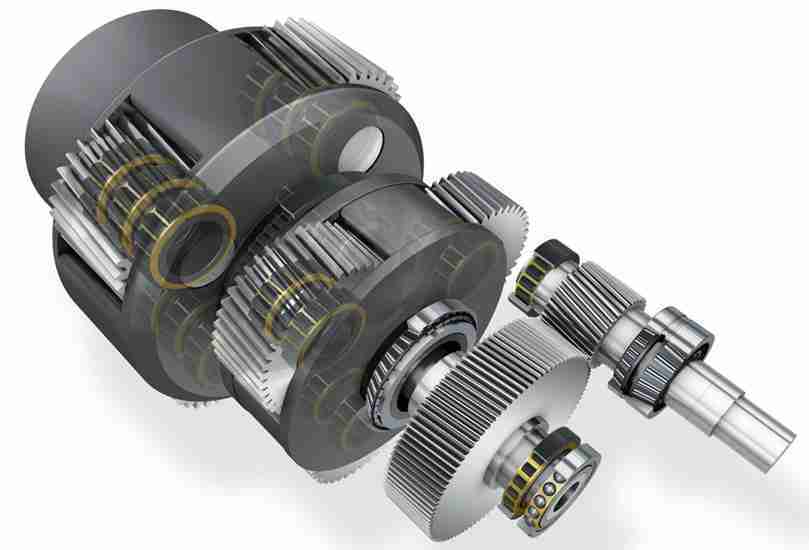
Spur Gear For Wind Power
Typical Applications
| Application | Why Spur Gears? |
| Conveyor Systems | Cost-effective and reliable for continuous operation |
| Agricultural Equipment | Simple, durable, and easy to maintain |
| Printing Machines | Accurate speed and motion transmission |
| Indexing Mechanisms | Precise positioning and repeatable movement |
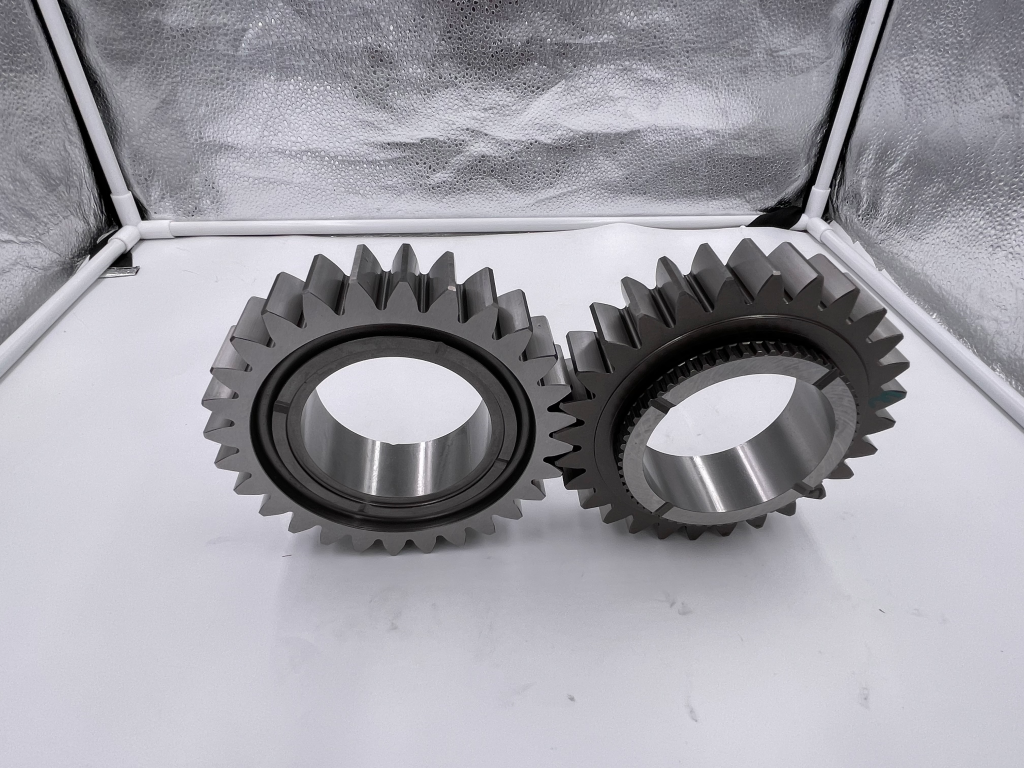
Spur gear used in agriculture tractors
When Should You Choose Helical Gears?
Helical gears are the preferred choice for applications requiring high speed, high torque, and quiet operation. Their angled teeth provide smoother engagement, allowing them to transmit heavier loads with less vibration than spur gears.
Choose Helical Gears If You Need:
- High-Speed Operation– Ideal for medium- to high-speed transmissions with reduced vibration.
- High Torque Capacity– Higher tooth contact ratio allows greater load-carrying capability.
- Quiet Operation– Progressive tooth engagement minimizes gear mesh noise.
- Heavy-Duty Performance– Suitable for continuous operation under demanding conditions.
- Smooth Motion Control – Delivers stable and reliable power transmission for precision equipment.
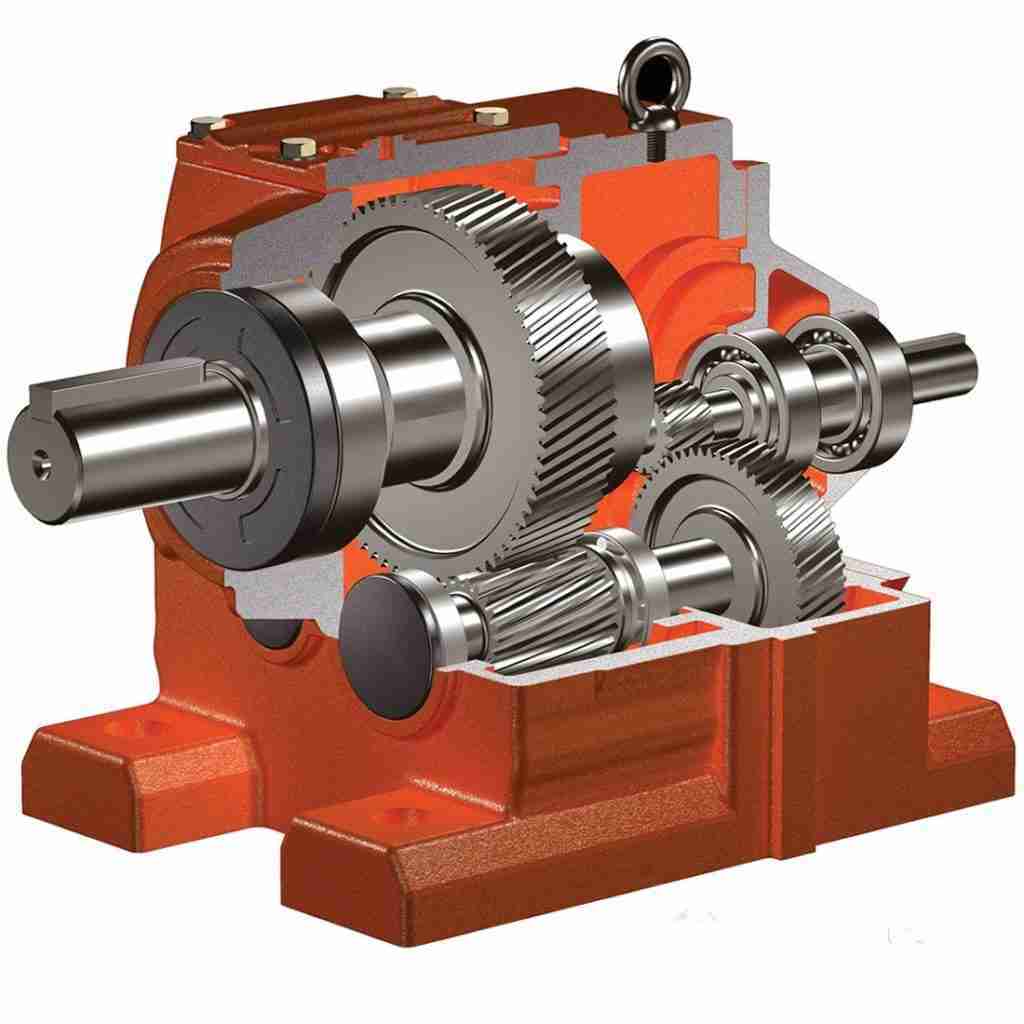
Helical gear for helical gearbox
Typical Applications
| Application | Why Helical Gears? |
| Automotive Transmissions | Quiet operation and high torque capacity |
| Industrial Gearboxes | Reliable performance under heavy loads and continuous duty |
| Robotics | Smooth, accurate motion with reduced vibration |
| Compressors & Pumps | Stable high-speed power transmission |
| Mining & Construction Equipment | High durability for demanding operating conditions |
Spur Gears vs Helical Gears: Application Comparison
The choice between spur and helical gears depends on the operating requirements of each industry. Spur gears are typically selected for their simplicity and cost-effectiveness, but helical gears are usually preferred for high-speed, heavy-load, and low-noise applications.
| Industry | Spur | Helical | Typical Reason |
| Automotive | △ | ✓ | Smooth shifting, high speed, and low noise are critical. |
| Mining | △ | ✓ | Heavy loads and continuous operation require higher load capacity. |
| Agriculture | ✓ | ✓ | Spur gears are common in simple machinery, while helical gears are used in high-performance equipment. |
| Robotics | △ | ✓ | Precise, quiet, and smooth motion is essential for automation. |
| Packaging | ✓ | ✓ | Spur gears suit standard machines; helical gears are preferred for high-speed production lines. |
| Marine | △ | ✓ | High torque, durability, and quiet operation are important for marine gearboxes. |
| Material Handling | ✓ | ✓ | Spur gears are used in conveyors, while helical gears are selected for heavy-duty drive systems. |
| Industrial Gearboxes | △ | ✓ | Helical gears provide higher power density and smoother transmission. |
Legend:
- ✓= Recommended choice
- △= Suitable for selected applications or operating conditions
Quick Selection by Industry
- Choose spur gears for cost-sensitive, low- to medium-speed equipment where efficiency and easy maintenance are priorities.
- Choose helical gears for high-speed, high-torque, or low-noise applications requiring smoother and more reliable power transmission.
Note: In many industries, both gear types are used. The final selection depends on factors such as load, speed, noise limits, available installation space, and budget, rather than the industry alone.
Manufacturing Considerations
The performance of both spur and helical gears depends not only on their design but also on material selection, heat treatment, manufacturing accuracy, and quality inspection.
Materials
Selecting the appropriate gear material depends on load, operating speed, wear resistance, and environmental conditions.
| Material | Key Characteristics | Typical Applications |
| 20CrMnTi | Excellent carburizing steel with high surface hardness and fatigue strength | Automotive transmissions, industrial gearboxes |
| AISI 8620 | Tough alloy steel with good machinability and wear resistance | Heavy-duty gears, construction and mining equipment |
| 18CrNiMo7-6 | Premium alloy steel offering exceptional core toughness and contact fatigue strength | High-performance industrial and wind power gearboxes |
| Stainless Steel | Corrosion-resistant and hygienic | Food processing, marine, and medical equipment |
| Brass | Low friction, quiet operation, and corrosion resistance | Instruments, light-duty drives, and worm gear sets |
| Nylon (Engineering Plastic) | Lightweight, self-lubricating, and low noise | Robotics, office equipment, and light-load mechanisms |
Heat Treatment
Heat treatment improves gear hardness, wear resistance, and fatigue life. The appropriate process depends on the material and service conditions.
| Process | Main Benefit | Typical Use |
| Carburizing | Produces a hard wear-resistant surface with a tough core | High-load spur and helical gears |
| Nitriding | Improves surface hardness with minimal distortion | Precision gears requiring dimensional stability |
| Induction Hardening | Hardens selected tooth surfaces quickly and efficiently | Medium-duty gears and replacement components |
Precision Grades
Gear accuracy directly affects transmission efficiency, noise, vibration, and service life.
Common international standards include:
| Standard | Purpose |
| ISO | International gear accuracy classification (e.g., ISO 1328) |
| DIN | German standard widely adopted in European industries |
| AGMA | American standard for gear quality and performance |
Higher precision grades are generally required for high-speed gearboxes, automotive transmissions, robotics, and aerospace applications, where smooth operation and low vibration are critical.
Quality Inspection
Comprehensive inspection ensures that every gear meets dimensional, mechanical, and performance requirements before delivery.
| Inspection Method | Purpose |
| Coordinate Measuring Machine (CMM) | Verifies critical dimensions and geometric accuracy |
| Gear Tester | Measures gear profile, lead, pitch, and runout accuracy |
| Hardness Test | Confirms surface and core hardness after heat treatment |
| Magnetic Particle Inspection (MPI) | Detects surface and near-surface cracks in ferromagnetic materials |
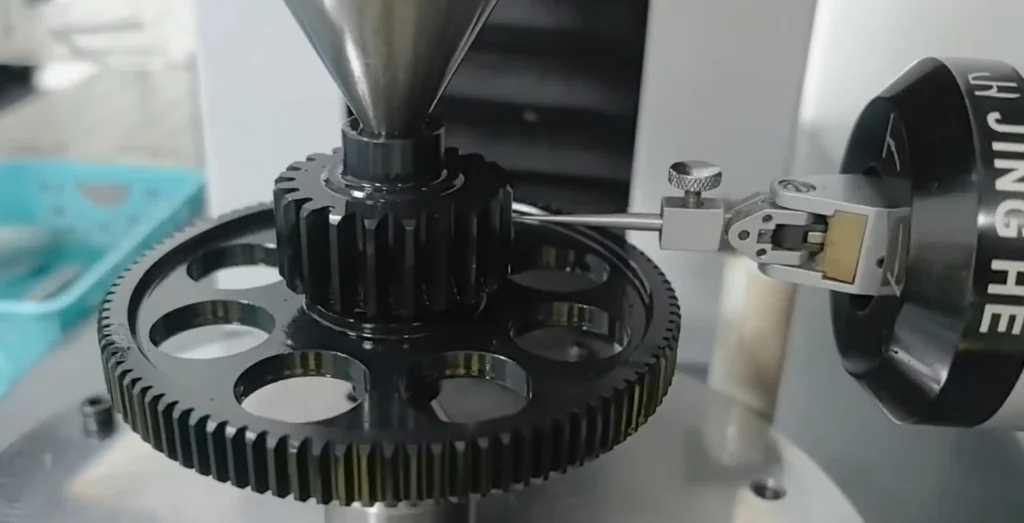
Spur gear accuracy inspection
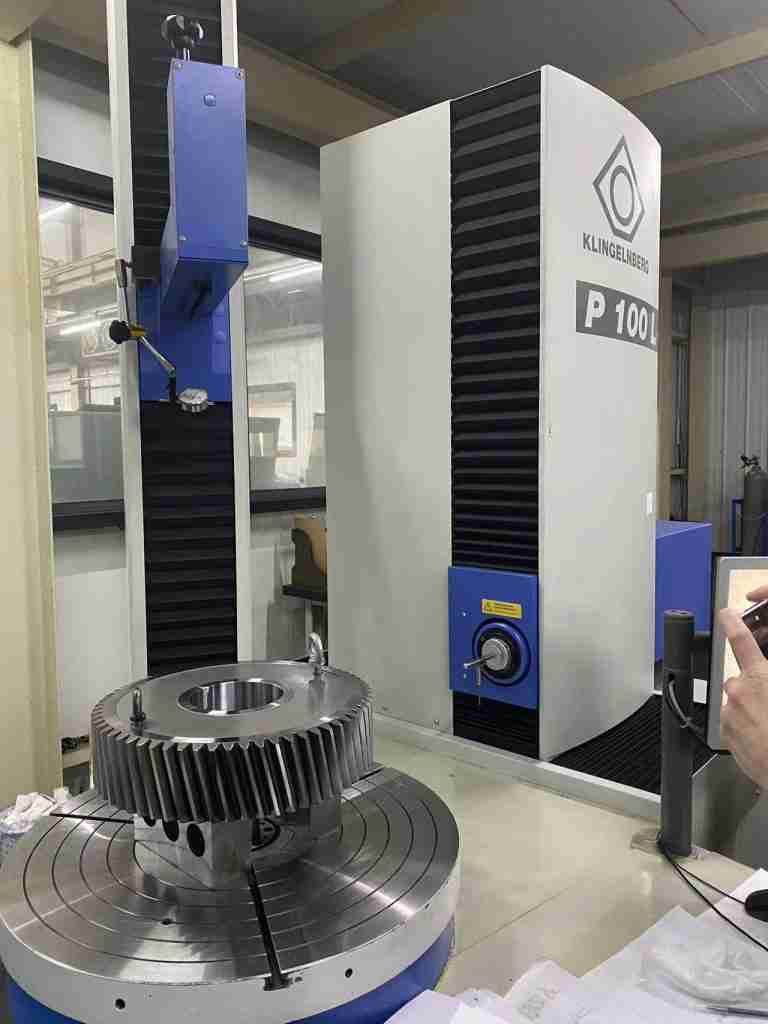
Helical gear inspection
Why Choose BELON for Custom Spur and Helical Gears
Whether you need standard gears or fully customized transmission components, BELON provides end-to-end manufacturing solutions for OEMs and industrial equipment manufacturers worldwide. From engineering support to final inspection, we help customers achieve a reasonable gear solution featuring reliable performance, consistent quality, and on-time delivery.
Our Capabilities
| Capability | What We Offer |
| Custom Design | Customized spur and helical gears based on your drawings, samples, or performance requirements. |
| OEM Manufacturing | Flexible production for OEM, ODM, and private-label projects across multiple industries. |
| Gear Grinding | High-precision gear grinding for improved accuracy, efficiency, and low-noise operation. |
| Gear Lapping | Precision lapping for bevel and helical gear sets to optimize tooth contact and reduce vibration. |
| Heat Treatment | In-house carburizing, nitriding, and induction hardening to enhance wear resistance and service life. |
| Full Inspection | Comprehensive quality control using CMM, gear testers, hardness testing, and MPI before shipment. |
| ISO Quality Management | Manufacturing processes operated under an ISO-certified quality management system with full production traceability. |
| Prototype to Mass Production | From prototype development and small batches to high-volume production with consistent quality. |
Why Manufacturers Work with BELON
- Precision gears manufactured to international quality standards
- Complete in-house production from machining to heat treatment and final inspection
- Engineering support for custom gear design and optimization
- Fast prototype development and scalable production capacity
- Reliable global supply for automotive, industrial, agricultural, robotics, marine, and mining applications
Request a Custom Gear Solution
Whether you’re designing a new transmission system or replacing an existing gear, BELON’s engineering team can help you select the right spur or helical gear for your application.
Contact us today to discuss your project requirements, request a technical consultation, or get a customized quotation. From prototype to mass production, we’re ready to support your next gear manufacturing project.
FAQs
Are helical gears better than spur gears?
Not necessarily. Neither gear type is universally better—the right choice depends on the application’s requirements. Helical gears are better suited for high-speed, high-load, and low-noise environments because their angled teeth engage gradually, providing smoother power transmission and greater load capacity. Spur gears, on the other hand, offer higher mechanical efficiency, lower manufacturing costs, and a simpler design. They also generate no axial thrust, making them easier to install and maintain. If your priority is quiet operation and heavy-duty performance, choose helical gears. If cost, efficiency, and simplicity are more important, spur gears are often the better solution.
What is the disadvantage of helical gears?
The main disadvantage of helical gears is that their angled teeth generate axial thrust during operation. This additional force requires thrust bearings or more robust bearing arrangements, increasing system complexity and cost. Helical gears are also more expensive to manufacture because the tooth geometry requires more precise machining and inspection.
In addition, the sliding action between mating teeth produces slightly higher friction than spur gears, resulting in marginally lower transmission efficiency. Despite these drawbacks, their smooth operation and higher load capacity make them the preferred choice for many high-performance applications.
Is a helical gear noisier than a spur gear?
No. In most applications, helical gears are significantly quieter than spur gears. Their angled teeth engage progressively rather than making full-width contact at once, reducing impact forces during meshing. This gradual engagement minimizes vibration and distributes the transmitted load across multiple teeth, resulting in smoother operation. Spur gears, by comparison, experience sudden tooth engagement, which generates more noise, especially at higher rotational speeds. For applications such as automotive transmissions, industrial gearboxes, and precision machinery where low noise is important, helical gears are generally the preferred option.
Do helical gears last longer?
In many applications, yes. Helical gears often have a longer service life because their higher contact ratio allows multiple teeth to share the load simultaneously. This reduces contact stress, minimizes wear, and improves fatigue resistance. However, gear life depends on more than tooth geometry. Factors such as material selection, heat treatment, lubrication, alignment, manufacturing accuracy, operating speed, and load conditions all play a critical role. A properly designed and maintained spur gear can also provide excellent durability. Regular inspection and proper lubrication are essential for maximizing the lifespan of either gear type.
Are helical gears more expensive than spur gears?
Yes. Helical gears generally cost more because their angled tooth profile is more difficult to manufacture. Production typically requires more advanced machining, longer processing times, and stricter quality inspection. In addition, the axial thrust generated during operation often requires stronger bearings and more complex gearbox designs, increasing overall system costs. Although the initial investment is higher, helical gears can deliver lower noise, higher load capacity, and longer service life, making them a cost-effective solution for demanding industrial applications.