

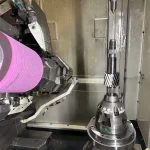
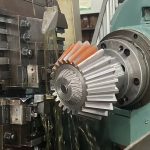
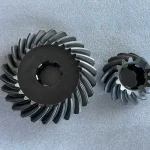
Abstract: When comparing miter gears vs bevel gears, the most important distinction is that a miter gear is a special bevel gear with a fixed 1:1 ratio, while bevel gears can be designed with various gear ratios to change speed and torque. This guide explains what miter gears and bevel gears are, their key differences, advantages and disadvantages, common applications, and how to choose the right gear for your transmission system.
What Is a Bevel Gear?
A bevel gear is a conical-shaped gear designed to transmit power between intersecting shafts, most commonly at a 90-degree angle. Compared with spur or helical gears that operate on parallel shafts, bevel gears change the direction of rotation while allowing different speed and torque ratios at the same time.
Bevel gears are widely used in automotive, industrial, agricultural, and aerospace applications because they provide efficient power transmission in compact mechanical systems. Depending on the design and tooth geometry, bevel gears can be configured to increase torque, reduce speed, or simply redirect motion.
Main Types of Bevel Gears
Several bevel gear designs have been developed to meet different performance requirements for users in different fields:
- Straight Bevel Gears: the simplest form of bevel gears. Contact on the driven gear begins at the top of the tooth and progresses toward the root. They have straight and tapered teeth which, if extended inward, would intersect in a common point at the axis.
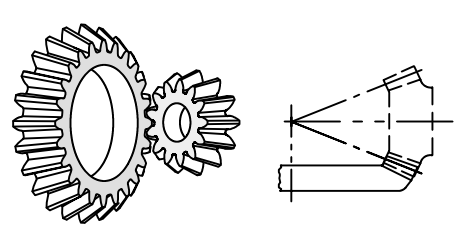
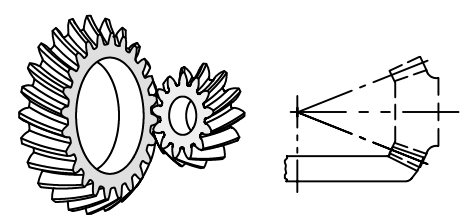
- Spiral Bevel Gears: Featuring curved, oblique teeth, these gears experience a progressive meshing action that initiates at one tip and advances seamlessly to the other. While their contact mechanism resembles that of straight bevel gears, the integrated overlapping tooth action ensures a significantly smoother power transmission than both straight and zerol bevel variants.
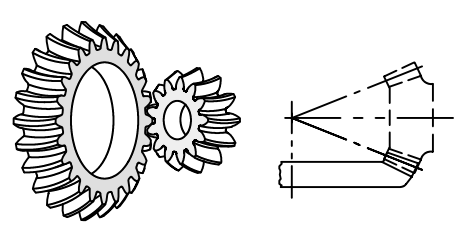
- Zerol Bevel Gears: (and other 0° spiral variants) feature curved teeth aligned with straight bevel types, sharing their mounting configurations and bearing thrust loads. However, they offer the smooth operation and manufacturing compatibility (including precision finishing) of spiral bevel gears. Additionally, gears with spiral angles under 10° are often classified as Zerol.
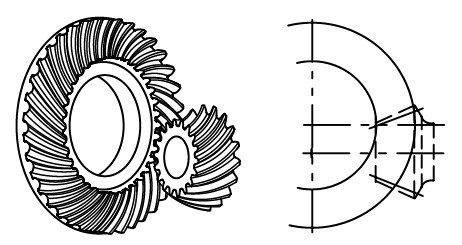
- Hypoid Gears: mirror spiral bevel gears but introduce an offset pinion axis. A large enough offset lets the shafts cross without intersecting, allowing for space-saving straddle mountings. Like spiral variants, hypoid teeth can be precision-finished.
- Miter Gears: a special type of bevel gear designed with a 1:1 gear ratio and an equal number of teeth on both gears. Their primary function is to change the direction of power transmission without altering speed or torque.
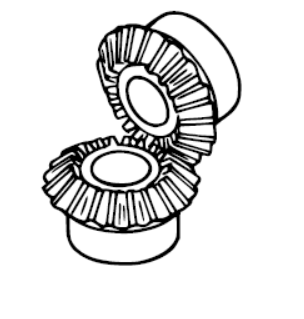
Among these types, miter gears are unique because they always operate with a 1:1 gear ratio, making them a specialized subset of bevel gears. This distinction might be the key to understanding the difference between miter gears and bevel gears.
What Is a Miter Gear?
As mentioned above, a miter gear (or mitre gear) is a specialized type of bevel gear with an equal number of teeth on both gears. It always operates at a 1:1 bevel gear ratio, allowing power to be transmitted between intersecting shafts—typically at a 90° angle—without changing speed or torque.

Key Characteristics of Miter Gears
Miter gears are easily distinguished from other bevel gears by the following features:
- Equal number of teeth on both gears
- Fixed 1:1 gear ratio
- No speed increase or reduction
- No torque multiplication
- Primarily used to change shaft direction
- Usually operate at a 90° shaft angle
- Compact, simple, and cost-effective design

Because miter gears only redirect motion, engineers often select them when they need a reliable and economical solution for transmitting power between perpendicular shafts.
Common Applications of Miter Gears
Miter gears are among the most common 90-degree gear solutions used in industrial machinery. They are commonly found in machinery that requires a change in rotational direction without altering operating speed. Typical applications include:
- Packaging and processing equipment
- Conveyor and material handling systems
- Agricultural machinery
- Printing and labeling machines
- Food processing equipment
- Manual power transmission mechanisms
- Light-duty industrial machinery
Compared with other bevel gears, miter gears are generally preferred for simpler transmission systems where maintaining the same input and output speed is more important than achieving gear reduction or torque amplification.
Is a Miter Gear a Bevel Gear?
The answer is undoubtedly Yes. But note that a miter gear is a type of bevel gear, but not all bevel gears are miter gears.
The term bevel gear refers to an entire family of gears designed to transmit power between intersecting shafts. Miter gears belong to this family but represent a specialized category characterized by an equal number of teeth and a fixed 1:1 gear ratio.
In other words, every miter gear is a bevel gear, but many bevel gears are designed with different tooth counts and gear ratios to increase or decrease speed and torque. This is the fundamental distinction between miter gears and other bevel gear types.

Miter Gear vs Bevel Gear: Key Differences
Although miter gears belong to the bevel gear family, they are designed for different purposes. A miter gear is intended solely to change the direction of power transmission, whereas bevel gears can be engineered to modify speed, torque, and rotational direction. Understanding these distinctions is essential when selecting the right gear for an application.
| Feature | Miter Gear | Bevel Gear |
| Gear Type | Special bevel gear | General gear family |
| Shaft Angle | Usually 90° | Various angles |
| Gear Ratio | Always 1:1 | 1:1 and other ratios |
| Tooth Count | Equal | Equal or different |
| Speed Change | No | Possible |
| Torque Multiplication | No | Yes |
| Design Complexity | Simple | Varies |
| Cost | Lower | Depends on design |
| Applications | Direction change only | Direction, speed, and torque change |
The biggest difference is that miter gears only change the direction of rotation, while bevel gears can also change speed and torque. Because miter gears always operate at a 1:1 ratio, they maintain the same input and output speed. Standard bevel gears, on the other hand, can be designed with different tooth counts to achieve speed reduction, speed increase, or torque multiplication.

Another important distinction is flexibility. Miter gears are limited to applications requiring equal shaft speeds, while bevel gears offer a much wider range of design possibilities for automotive, aerospace, mining, marine, and industrial power transmission systems.
As a result, miter gears are often chosen for simple, cost-effective direction changes, whereas bevel gears are preferred when transmission performance must be optimized for specific speed or torque requirements.
When Should You Use a Miter Gear Instead of a Bevel Gear?
The choice between a miter gear and a bevel gear depends primarily on whether your application requires a change in speed or torque. If the goal is simply to redirect power between intersecting shafts, a miter gear is often the most practical and economical solution. However, if transmission performance must be optimized through gear reduction or torque multiplication, another type of bevel gear is usually the better choice.
Choose a Miter Gear When
A miter gear is typically the best option when:
- A fixed 1:1 bevel gear ratio is required
- Input and output shafts must rotate at the same speed
- Only a change in shaft direction is needed
- Installation space is limited
- A simple and cost-effective design is preferred
- Moderate loads and operating speeds are involved
Typical applications include conveyors, packaging machinery, printing equipment, and other systems where power must be transferred between perpendicular shafts without changing speed or torque.
Choose Other Bevel Gears When
Standard bevel gears are generally more suitable when:
- Speed reduction or speed increase is required
- Torque multiplication is needed
- Heavy-duty or high-load conditions are involved
- Higher transmission efficiency is required
- The application is part of a differential system
- Precision positioning and motion control are critic
- Precision gearboxes or industrial transmissions are used
For example, spiral bevel gears are commonly found in automotive differentials, aerospace gearboxes, mining equipment, and other demanding applications where smooth operation, high load capacity, and optimized performance are essential.
In short, if you only need to change the direction of rotation, a miter gear is usually sufficient. If your application requires changes in speed, torque, or overall transmission performance, a standard bevel gear design will provide greater flexibility.
Quick comparison
| Application Requirement | Recommended Gear |
| Change direction only | Miter Gear |
| Maintain 1:1 speed ratio | Miter Gear |
| Speed reduction | Bevel Gear |
| Torque increase | Bevel Gear |
| High-load transmission | Bevel Gear |
| Differential systems | Bevel Gear |
| Precision gearbox | Bevel Gear |
Advantages and Disadvantages of Miter Gears
Miter gears are valued for their simplicity and cost-effectiveness. Because they operate with a fixed 1:1 ratio, they provide an efficient solution for changing the direction of power transmission without altering speed or torque. However, this same characteristic also limits their flexibility compared to other bevel gear types.
| Advantages | Disadvantages |
| Simple design | Limited to a 1:1 ratio |
| Easy installation | Cannot increase or reduce torque |
| Cost-effective | Less flexible than other bevel gears |
| Compact size | Limited application range |
| Efficient power transmission | Not suitable for speed reduction |
| Lower manufacturing cost | Limited load optimization options |
Miter gears are ideal for applications where only directional power transfer is required. When speed variation, torque multiplication, or specialized transmission performance is needed, other bevel gear designs are usually better choice.
Advantages and Disadvantages of Bevel Gears
Bevel gears are widely used given that they offer greater design flexibility and can be engineered to meet a wide range of speed, torque, and load requirements. This versatility makes them a preferred choice for demanding industrial and automotive applications, although it often comes with higher manufacturing and installation requirements.
| Advantages | Disadvantages |
| Flexible gear ratios | More expensive than miter gears |
| High transmission efficiency | Sensitive to alignment errors |
| High load capacity | More complex manufacturing process |
| Wide application range | Requires precise installation |
| Can increase or reduce speed | Higher maintenance requirements in some applications |
| Can multiply torque | Specialized designs may increase production costs |
Engineers typically choose bevel gears when a transmission system requires speed reduction, torque multiplication, or optimized performance under heavy loads. Their versatility makes them suitable for applications ranging from automotive differentials and aerospace gearboxes to mining and industrial machinery.
Common Applications of Miter Gears and Bevel Gears
Although miter gears and bevel gears both transmit power between intersecting shafts, they are typically used in different types of equipment depending on the transmission requirements. Miter gears are preferred for simple directional power transfer, while bevel gears are often selected when speed reduction, torque multiplication, or high-load performance is required.
Typical Miter Gear Applications
Miter gears are commonly used in systems where the primary objective is to change the direction of rotation while maintaining the same speed and torque.
Typical applications include:
- Conveyor systems– redirect power between perpendicular shafts in material handling equipment.
- Packaging machinery– provide compact and efficient motion transfer in automated production lines.
- Printing machines– synchronize rotating components while maintaining a constant speed ratio.
- Agricultural equipment– transmit power between intersecting shafts in light-duty farm machinery.
- Food processing equipment– support reliable motion transfer in compact machine designs.
- Manual power transmission systems– used in hand-operated mechanisms and mechanical drives.
These applications benefit from the simplicity, compact design, and cost-effectiveness of miter gears.
Typical Bevel Gear Applications
Bevel gears are widely used in applications that require greater transmission flexibility, including speed changes, torque multiplication, and high-load operation.
Typical applications include:
- Automotive differentials– transfer power from the driveshaft to the wheels while changing the direction of rotation.
- Aerospace gearboxes– provide high-precision power transmission under demanding operating conditions.
- Mining machinery– handle heavy loads and high torque requirements in rugged environments.
- Marine propulsion systems– transmit power efficiently between engines and propeller shafts.
- Industrial transmissions– support speed reduction and torque optimization in manufacturing equipment.
- Construction and heavy equipment– provide durable power transfer in high-load applications.
Because of their versatility, bevel gears are often the preferred choice for complex transmission systems where performance and load capacity are critical.
How to Choose Between Miter Gears and Bevel Gears
Choosing between a miter gear and a bevel gear depends on the specific performance requirements of your transmission system. While miter gears offer a simple and economical solution for changing shaft direction, bevel gears provide greater flexibility for controlling speed, torque, and load capacity.
The following table can help you quickly determine which gear type is most suitable for your application:
| Requirement | Recommended Gear |
| 1:1 Ratio | Miter Gear |
| Speed Reduction | Bevel Gear |
| Torque Increase | Bevel Gear |
| Low-Cost Solution | Miter Gear |
| Heavy-Duty Application | Bevel Gear |
| High-Precision Transmission | Spiral Bevel Gear |
As a general rule, choose a miter gear when you only need to redirect power between intersecting shafts while maintaining the same speed and torque. If your application requires speed reduction, torque multiplication, smoother operation, or higher load capacity, a bevel gear—particularly a spiral bevel gear—will usually provide better performance.
For custom industrial transmissions, engineers should evaluate several key factors before selecting a gear type, including:
- Shaft angle and installation space
- Required gear ratio
- Torque and load requirements
- Operating speed
- Noise and vibration expectations
- Lubrication conditions
- Service life and maintenance requirements
By carefully considering these factors, gear manufacturers can select the most efficient and cost-effective solution for their application. When in doubt, consulting an experienced gear supplier can help ensure optimal gear design, material selection, heat treatment, and production accuracy.
Need Custom Miter Gears or Bevel Gears?
Belon manufactures custom miter gears, straight bevel gears, spiral bevel gears, zerol bevel gears and hypoid gears for your specific industrial transmission applications. Our engineering team has the full capabilities to support your gear design, prototyping, heat treatment, grinding, and volume production according to your performance requirements and actual cost.
Contact Belon today to discuss your custom gear project with us directly.
FAQ
Q1: Is a miter gear a bevel gear?
Yes. A miter gear is a special type of bevel gear. It belongs to the bevel gear family but is distinguished by having an equal number of teeth on both gears and a fixed 1:1 gear ratio. While all miter gears are bevel gears, many bevel gears are designed with different gear ratios to change speed and torque.
Q2: What is the difference between bevel gears and miter gears?
The main difference is that miter gears always operate at a 1:1 ratio and only change the direction of rotation. Bevel gears, on the other hand, can be designed with various gear ratios to increase or decrease speed and torque. As a result, bevel gears offer greater flexibility for industrial power transmission applications.
Q3: When should I use a miter gear?
A miter gear is the best choice when you need to transmit power between intersecting shafts while maintaining the same input and output speed. They are commonly used in conveyors, packaging equipment, printing machinery, and other systems where directional power transfer is required without speed reduction or torque multiplication.
Q4: Can miter gears change speed or torque?
No. Miter gears always operate with a 1:1 gear ratio, meaning the input and output shafts rotate at the same speed. They are designed to redirect motion rather than modify transmission performance, so they cannot increase torque or reduce speed like other bevel gear types.
Q5: Which is better: miter gears or bevel gears?
Neither is inherently better—the right choice depends on your specific application. Miter gears are ideal for simple, cost-effective directional power transfer, while bevel gears are better suited for applications requiring speed reduction, torque multiplication, high load capacity, or precision transmission. Choosing the correct gear depends on factors such as gear ratio, operating conditions, load requirements, and available installation space.