

Abstract: This guide explains how planetary gears work, understand planetary gear sets, gear ratios, manufacturing processes, applications, advantages, disadvantages, and how to choose a custom planetary gear manufacturer.
What Is a Planetary Gear?
A planetary gear is a gear mechanism in which multiple planet gears revolve around a central sun gear while meshing with an internal ring gear.
Definition of a Planetary Gear
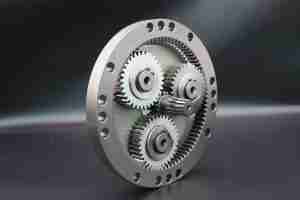
Planetary gear, also known as an epicyclic gear, is a compact gear system consisting of a central sun gear, multiple planet gears, an internal ring gear, and a planet carrier. Unlike conventional gear trains, the planet gears rotate on their own axes while simultaneously revolving around the sun gear, enabling high torque transmission, multiple gear ratios, and excellent load sharing within a compact space.
Why Is It Called an Epicyclic Gear?
The term “epicyclic” comes from the Greek words epi (“upon”) and kyklos (“circle”). It describes the motion of the planet gears, which rotate around their own axes while simultaneously revolving around the central sun gear—similar to the way planets orbit the sun.
Because of this orbital motion, planetary transmission gears are commonly referred to as epicyclic gears, epicyclic gear trains, or planetary gear systems. Although the terminology differs, these names describe the same transmission mechanism.
Today, planetary gear is the most widely used term in industrial manufacturing, while epicyclic gear is more common in engineering textbooks, technical standards, and academic literature.
Main Components of a Planetary Gear Set
A standard planetary transmission gear set consists of four primary components that work together to transmit power and generate different speed and torque ratios.

Sun Gear
Located at the center of the planetary gear set, the sun gear engages simultaneously with every planet gear. Depending on the transmission design, it may function as the input, output, or stationary member. Its size and tooth count play a major role in determining the gear ratio.
Planet Gears
The planet gears are evenly distributed around the sun gear and mounted on pins attached to the planet carrier. Each planet rotates on its own axis while revolving around the sun gear, allowing transmitted loads to be shared across multiple gear meshes. This load-sharing capability is one of the primary reasons planetary gear systems achieve higher torque density than conventional gear trains.
Ring Gear
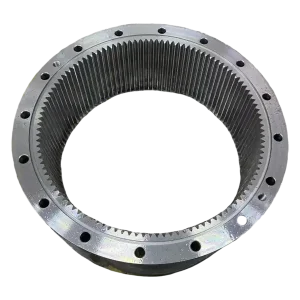
The ring gear, also known as the annulus or internal gear, surrounds the entire gear set and contains internal teeth that mesh with the planet gears. Depending on which component is fixed, driven, or used as the output, the ring gear directly influences the transmission ratio, rotational direction, and power flow.
Planet Carrier
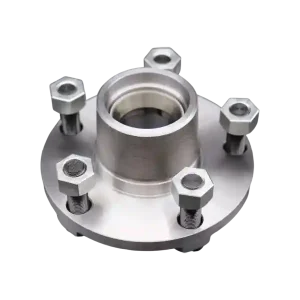
The planet carrier supports the planet gears and ensures they remain equally spaced during operation. As the carrier rotates, it causes the planet gears to orbit the sun gear while maintaining proper meshing with both the sun and ring gears. In many planetary gearboxes, the carrier serves as the output member, transmitting torque to the driven equipment.
How Does a Planetary Gear Work?
A planetary gear works by transmitting power through four interconnected components: the sun gear, planet gears, ring gear, and planet carrier. As the sun gear rotates, the planet gears spin on their own axes while revolving around the sun together with the carrier. At the same time, they remain engaged with the internal ring gear, allowing power to flow through multiple gear meshes simultaneously.
In fact, a planetary gear set can produce different speed ratios simply by fixing one of its three main members—the sun gear, ring gear, or carrier. This flexibility enables one compact mechanism to deliver speed reduction, torque multiplication, or reverse rotation.
Basic Working Principle
The working principle of a planetary transmission gear is based on simultaneous rotation and revolution. When the input gear rotates, the planet gears not only spin about their own shafts but also orbit the central sun gear with the planet carrier. Meanwhile, the planet gears continuously mesh with the internal ring gear to ensure smooth and uninterrupted power transmission. See the following video to better understand how a planetary gear set works:
Because several planet gears share the transmitted load at the same time, the force is distributed across multiple tooth contacts rather than a single gear pair.
Different Fixed Members and Power Flow
A planetary gear set can generate different transmission characteristics by fixing one of its three main members.
| Fixed Member | Input | Output | Result |
| Ring Gear | Sun Gear | Carrier | Speed reduction & torque increase |
| Sun Gear | Ring Gear | Carrier | Different reduction ratio |
| Carrier | Sun Gear | Ring Gear | Reverse rotation or internal gear drive |
Fixed Ring Gear
With the ring gear fixed, the sun gear drives the planet gears, causing the carrier to rotate at a lower speed but with higher torque. This is the most common arrangement used in planetary gearboxes.
Fixed Sun Gear
When the sun gear is stationary, the rotating ring gear drives the planet gears and carrier, producing an alternative reduction ratio commonly found in automatic transmissions.
Fixed Carrier
If the carrier is fixed, the planet gears cannot orbit and instead function as intermediate gears between the sun and ring gears. This arrangement is mainly used in compound planetary transmission systems.
How Torque and Speed Change
In a planetary gear set, output speed and torque are inversely related. When the output speed decreases, the transmitted torque increases yet power remains nearly constant.
Another key advantage is load sharing. Since multiple planet gears mesh simultaneously with both the sun and ring gears, the transmitted force is distributed across several contact points. Compared with a conventional gear train, this design reduces tooth stress, improves durability, minimizes vibration, and enables planetary gearing to achieve much higher torque density within the same installation space.
Planetary Gear Ratio Explained
The gear ratio of a planetary gear set depends on which component is fixed and which members act as the input and output. To differ from a conventional gear train, the same set of gears can produce multiple transmission ratios simply by changing the fixed member. This flexibility allows planetary gearing to provide speed reduction, torque multiplication, or reverse rotation without altering the gear geometry.
For the most common arrangement—fixed ring gear, sun gear input, and carrier output—the reduction ratio is determined by the number of teeth on the sun and ring gears. A higher gear ratio produces lower output speed but greater output torque, making planetary gear systems ideal for compact, high-torque transmissions.
Gear Ratio Formula
For a simple planetary gear set with a fixed ring gear, the reduction ratio can be calculated using the following equation:
i = 1 + Nr/Ns
Where:
- i= Gear ratio
- Nr= Number of teeth on the ring gear
- Ns= Number of teeth on the sun gear
This equation shows that increasing the number of ring gear teeth or reducing the number of sun gear teeth results in a higher reduction ratio and greater torque output.
Example Calculation
Assume a planetary gear set has:
- Sun gear teeth (Ns) = 30
- Ring gear teeth (Nr) = 90
The gear ratio is:
i=1+90/30=4
This means the input shaft rotates four times for every one revolution of the output carrier. The carrier therefore rotates at one-quarter of the input speed while delivering approximately four times the output torque, excluding transmission losses.

Torque Multiplication
One of the greatest advantages of planetary gearing is its ability to multiply torque within a compact space. As the gear ratio increases, the output speed decreases while the available output torque increases proportionally, assuming constant input power and high transmission efficiency.
The simultaneous engagement of multiple planet gears also distributes the transmitted load across several tooth contacts instead of a single gear pair. This load-sharing mechanism reduces tooth stress, improves durability, and enables planetary gear sets to transmit significantly higher torque than conventional gear trains of similar size.
| Gear Ratio | Output Speed | Output Torque | Typical Applications |
| 3:1 | Medium | Medium | Servo drives |
| 5:1 | Lower | Higher | Industrial gearboxes |
| 10:1 | Low | High | Robotics, EV reducers |
| 20:1+ | Very low | Very high | Heavy machinery, mining equipment |
Types of Planetary Gear Systems
Planetary gear systems can be classified according to their structural arrangement and the number of gear stages. Each type offers different transmission characteristics in terms of gear ratio, torque capacity, efficiency, and application. [Request A Quote]
Simple Planetary Gear Set
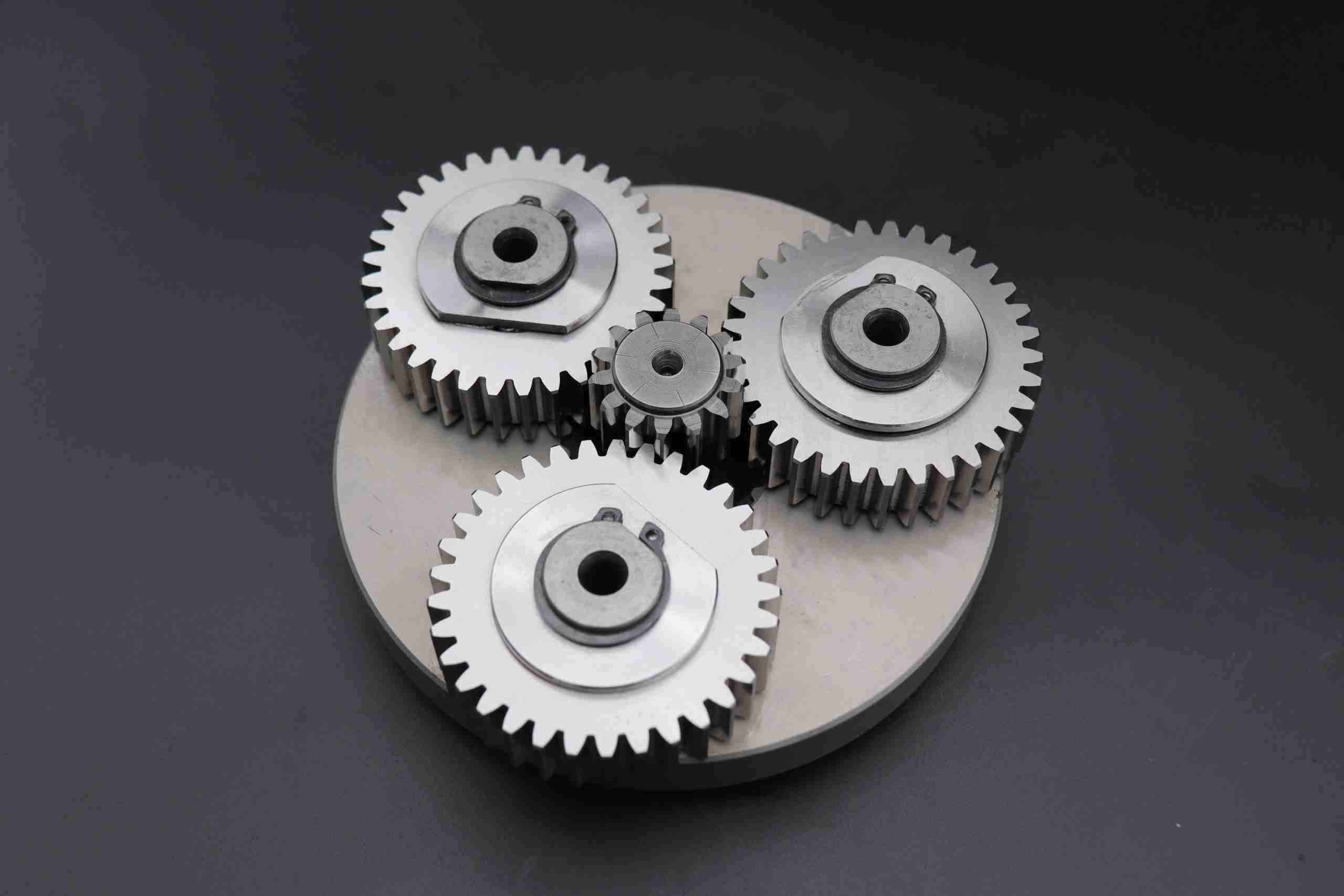
A simple planetary gear set consists of one sun gear, one ring gear, several identical planet gears, and a single planet carrier. It is the most common configuration used in industrial gearboxes, servo reducers, and automatic transmissions. Its compact design, high efficiency, and balanced load sharing are the reason why it is suitable for most standard power transmission applications.
Compound Planetary Gear
A compound planetary gear uses two or more gears rigidly connected on the same planet shaft. This arrangement provides greater design flexibility and enables much higher reduction ratios than a simple planetary gear set without significantly increasing gearbox size. Compound planetary systems are commonly used in heavy-duty industrial equipment, wind turbines, and automatic transmissions.
Double Planetary Gear
A double planetary gear combines two simple planetary gear sets in series within a single gearbox. Power is transmitted through two reduction stages, allowing higher torque output and larger gear ratios while maintaining a compact structure. This design is widely used in robotics, construction machinery, and precision industrial gearboxes.
Differential Planetary Gear
A differential planetary gear allows two output members to rotate at different speeds while distributing torque between them. Instead of providing only speed reduction, it controls power flow between multiple shafts. Differential planetary gears are commonly found in automotive differentials, hybrid vehicle transmissions, and power-splitting mechanisms.
Multi-stage Planetary Gearbox
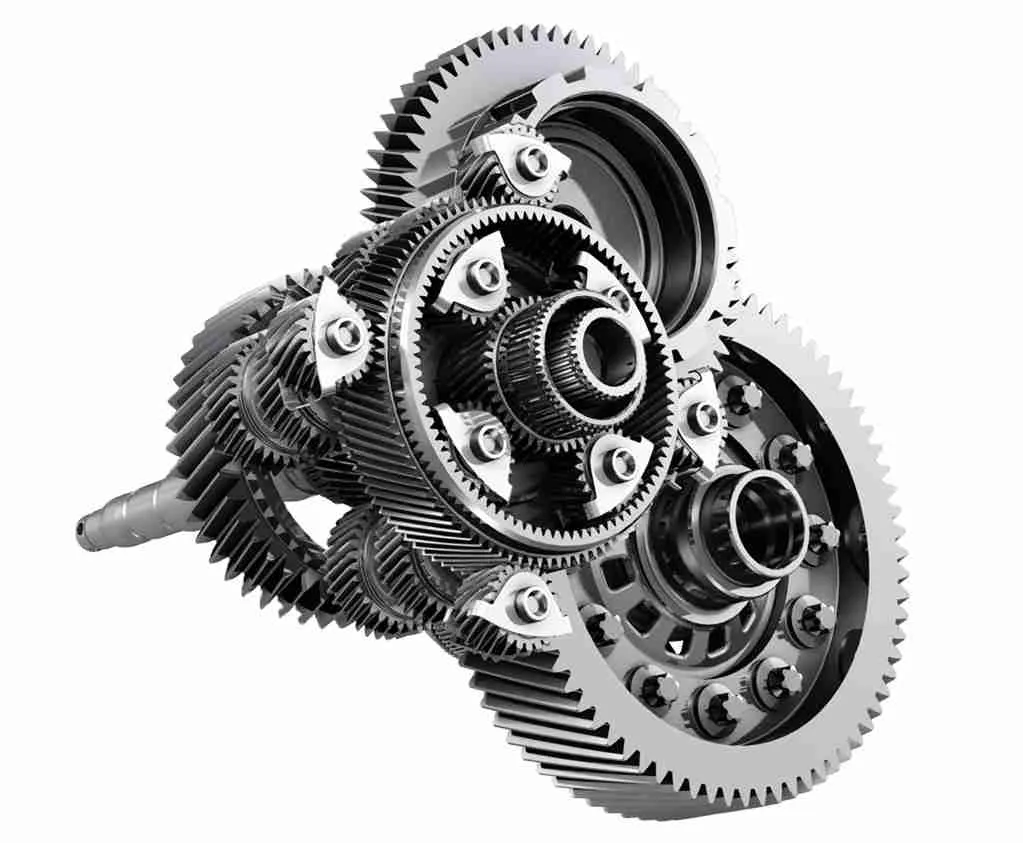
A multi-stage planetary gearbox integrates three or more planetary gear sets to achieve extremely high reduction ratios, often exceeding 100:1. Although additional stages slightly reduce transmission efficiency, they provide exceptional torque density within a compact footprint. Multi-stage planetary gearboxes are widely used in robotic joints, mining equipment, lifting systems, and high-precision servo drives.
Comparison of Common Planetary Gear Types
| Type | Structure | Typical Gear Ratio | Main Advantages | Typical Applications |
| Simple Planetary | Single gear set | 3:1–10:1 | Compact, efficient, economical | Servo gearboxes, industrial machinery |
| Compound Planetary | Multiple gears per planet shaft | 10:1–30:1 | Higher reduction ratio, compact design | Wind turbines, heavy machinery |
| Double Planetary | Two planetary stages | 10:1–100:1 | Higher torque, greater flexibility | Robotics, construction equipment |
| Differential Planetary | Dual-output power split | Variable | Power distribution and differential motion | Automotive, hybrid transmissions |
| Multi-stage Planetary | Three or more stages | 30:1–1000:1+ | Extremely high reduction, high torque density | Mining, lifting equipment, precision reducers |
Advantages and Disadvantages of Planetary Gearing
Planetary gearing has become one of the most widely used transmission systems because it combines high torque capacity with a compact design. By distributing the transmitted load across multiple planet gears, it delivers higher efficiency and durability. However, its more sophisticated structure also brings manufacturing complexity and assembly requirements.
Advantages
Planetary gear systems offer several performance advantages over traditional parallel-shaft gear trains.
- High torque density– Multiple planet gears share the transmitted load, allowing the gearbox to transmit more torque within a smaller size.
- Compact size– The coaxial arrangement of the sun gear, planet gears, and ring gear provides a high reduction ratio in a space-saving design.
- Coaxial input and output– Input and output shafts are aligned on the same axis, simplifying equipment layout and installation.
- High efficiency– Precision gear meshing and balanced load distribution typically achieve transmission efficiencies of 95–98% in a single stage.
- Load sharing– Multiple planet gears simultaneously transmit power, reducing tooth stress and extending gear life.
- Smooth and quiet operation– Continuous gear engagement minimizes vibration and noise, making planetary gearboxes suitable for high-speed and precision applications.
Disadvantages
Despite their advantages, planetary gear systems also present several engineering challenges.
- Higher manufacturing cost– The internal ring gear, planet carrier, and precision components require advanced machining and tighter tolerances than conventional gear trains.
- More complex assembly– Accurate alignment of multiple gears, shafts, bearings, and pins is essential to achieve proper load sharing and long service life.
- Difficult maintenance– The compact internal structure makes inspection, repair, and component replacement more complicated than in standard gearboxes.
- Lubrication requirements– Multiple gear meshes and bearings require effective lubrication to reduce friction, dissipate heat, and prevent premature wear, especially in high-speed or heavy-load applications.
Planetary Gear Manufacturing Process
The performance of a planetary gear system depends not only on its design but also on the precision of every manufacturing step. At Belon, we provide a complete in-house production process—from material selection and gear cutting to heat treatment, precision finishing, and final inspection—to assure each of our customers with gears of high load capacity, smooth transmission, and long service life. Our manufacturing capabilities support custom planetary gears for industrial gearboxes, robotics, mining equipment, agricultural machinery, and automotive transmission systems.
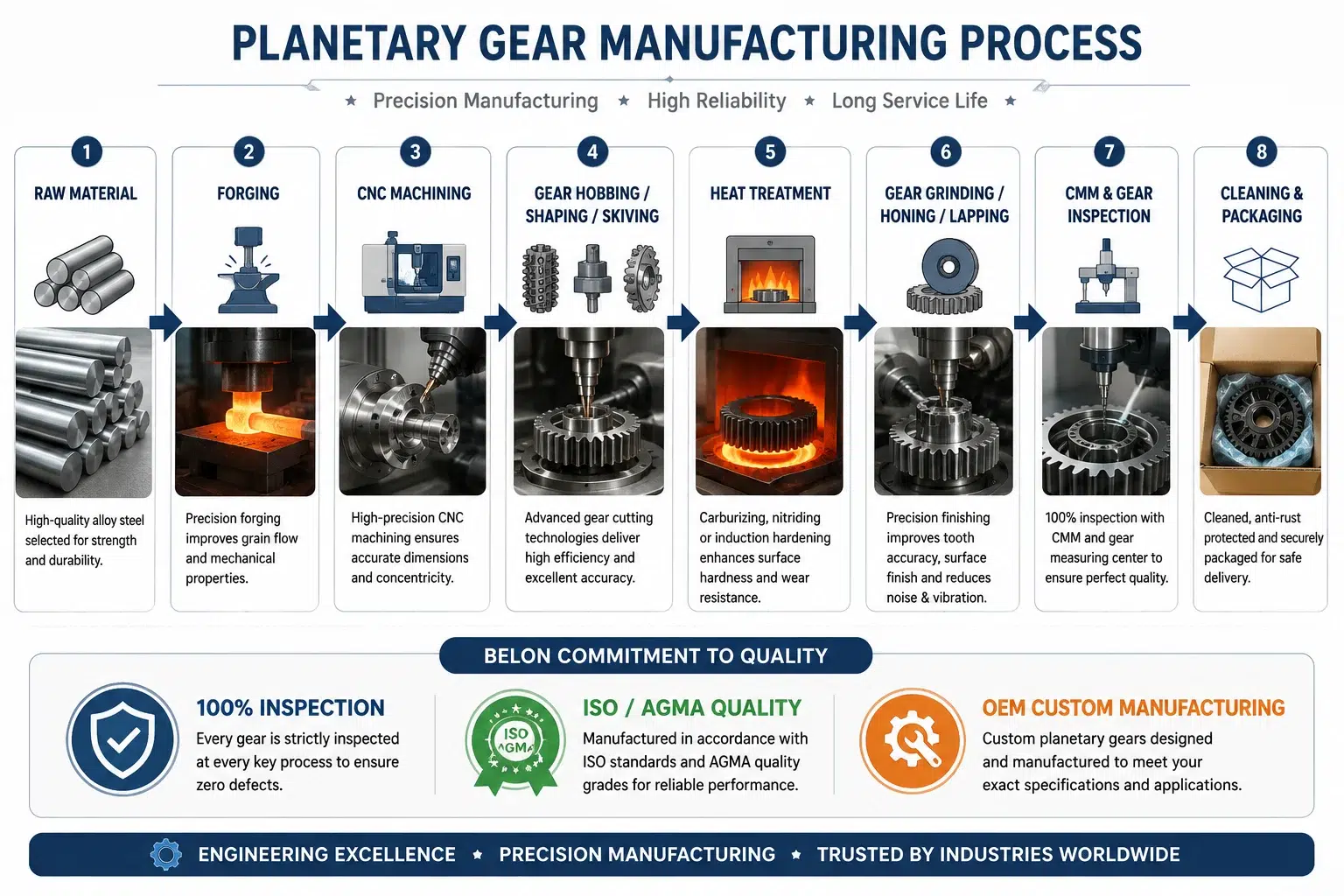
Material Selection
Selecting the right planetary gear material is essential for achieving the required strength, wear resistance, and fatigue life. Belon recommends different alloy steels based on your specific application requirements.
| Material | Typical Applications | Key Advantages |
| 20MnCr5 | Industrial gearboxes | Excellent carburizing performance |
| 20CrMnTi | Automotive transmissions | High surface hardness and toughness |
| 18CrNiMo7-6 | Heavy-duty planetary gears | Superior fatigue and load capacity |
| SAE 8620 | Precision gear sets | Excellent hardenability and machinability |
| 42CrMo | Planet carriers and shafts | High strength and impact resistance |
Gear Cutting
Belon selects the most suitable cutting process according to the gear geometry and accuracy requirements.
- Gear Hobbing– Efficient for external spur and helical gears with high productivity.
- Gear Shaping– Ideal for internal gears such as ring gears used in planetary gear sets.
- Power Skiving– A high-efficiency process capable of machining both internal and external gears with excellent precision, especially for compact planetary transmissions.
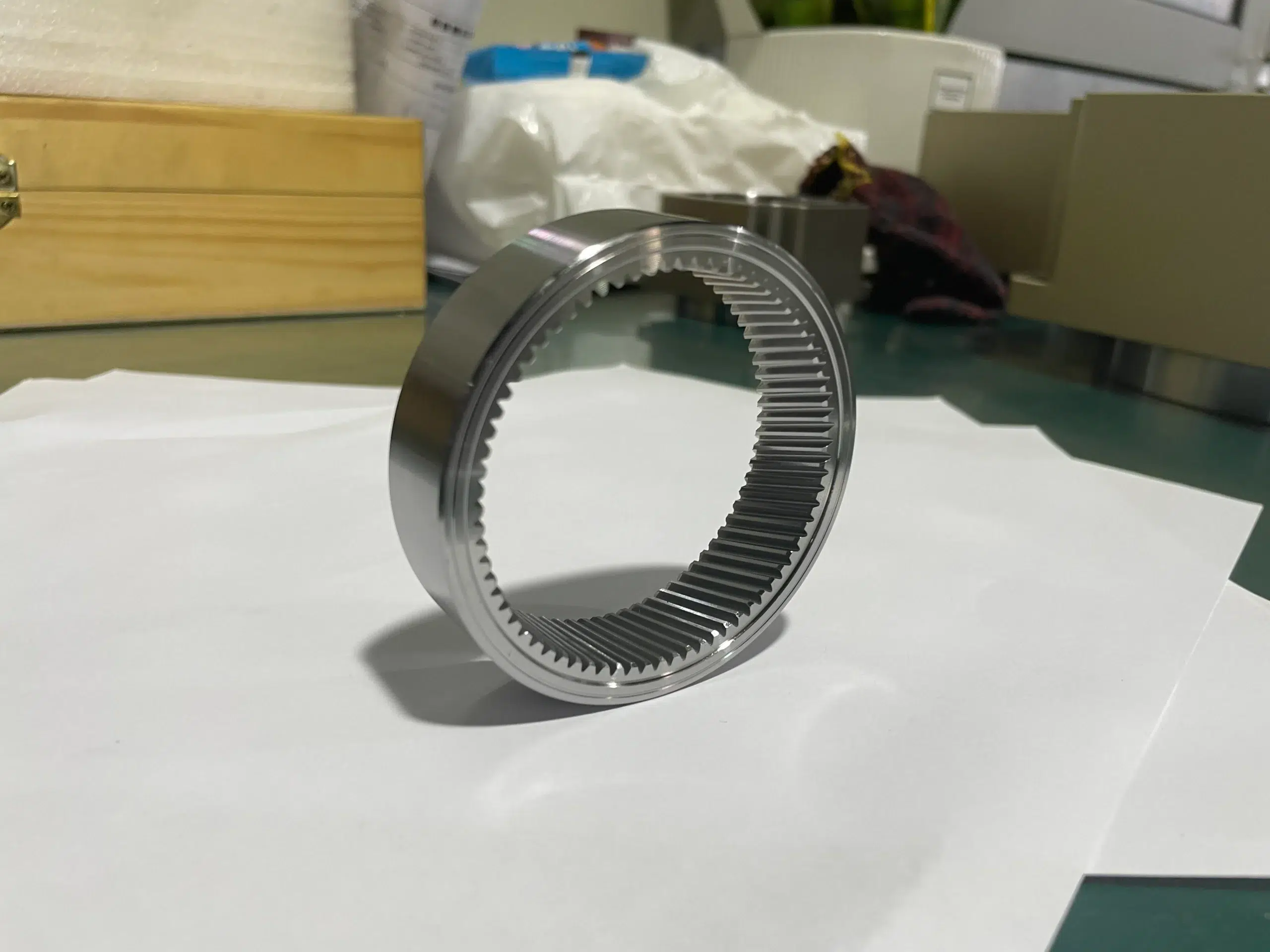
Advanced CNC gear-cutting machines ensure accurate tooth profiles and consistent dimensional quality before heat treatment.
Heat Treatment
Proper heat treatment significantly improves the durability and load-carrying capacity of planetary gears.
- Carburizing and Quenching– Produces a hard, wear-resistant surface while maintaining a tough core, making it the preferred choice for high-load planetary transmission gears.
- Nitriding– Provides excellent surface hardness with minimal distortion, suitable for precision applications.
- Induction Hardening– Localized hardening for selected gear teeth or shafts requiring enhanced wear resistance.
Belon optimizes heat treatment parameters according to material grade, gear size, and operating conditions to achieve consistent hardness and dimensional stability.
Precision Finishing
After heat treatment, precision finishing ensures the gear meets the required accuracy, noise, and contact performance.
- Gear Grinding– Achieves high gear accuracy and excellent tooth profile consistency.
- Gear Honing– Improves surface finish while reducing transmission noise.
- Gear Lapping– Optimizes tooth contact patterns for smoother meshing and extended service life, particularly for high-precision transmission systems.
These finishing processes enhance transmission efficiency, reduce vibration, and increase gear reliability under demanding operating conditions.
Quality Inspection
Every planetary gear manufactured by Belon undergoes comprehensive quality inspection before delivery.
Our inspection capabilities include:
- Coordinate Measuring Machine(CMM) for dimensional verification
- CNC Gear Measuring Centerfor profile, lead, pitch, and runout inspection
- Tooth Profile and Tooth Lead analysis
- Radial Runout measurement
- Surface Roughness testing
- Hardness testing after heat treatment
- Gear meshing and contact pattern verification (when required)
Supported by a strict quality management system, Belon manufactures planetary gears to ISO and AGMA accuracy standards, ensuring reliable performance for demanding industrial applications worldwide.
Where Are Planetary Gears Used?
Thanks to their high torque density, compact structure, excellent load-sharing capability, and high transmission efficiency, planetary gears are widely used across industries requiring reliable power transmission. Their coaxial design allows large reduction ratios within a limited installation space, making them ideal for both high-speed precision systems and heavy-duty industrial equipment.
From automotive transmissions to robotic joints and mining machinery, planetary gear systems improve efficiency, increase torque output, and extend equipment service life. The following are some of the most common applications.
Common Applications of Planetary Gears
| Industry | Typical Equipment | Why Use Planetary Gears |
| Automotive | Automatic transmissions | Compact design, multiple gear ratios |
| Electric Vehicles (EVs) | Reduction gearboxes | High torque, high efficiency |
| Industrial Automation | Servo gearboxes, CNC machines | High precision, low backlash |
| Mining | Heavy-duty gearboxes, conveyors | High load capacity and durability |
| Robotics | Robot joints, robotic arms | Compact size, precise positioning |
| Wind Energy | Wind turbine gearboxes | High torque transmission and reliability |
| Marine | Propulsion and steering systems | Reliable power transmission in harsh environments |
| Construction Machinery | Excavators, cranes, winches | Compact high-ratio reduction for heavy loads |
| Agricultural Machinery | Harvesters, seeders, tractors | Durable transmission under variable loads |
| Aerospace | Aircraft actuators, helicopter transmissions | Lightweight design with high power density |
Why Planetary Gears Are Preferred Across Industries
Although application requirements differ, the reasons for selecting planetary gearing are remarkably consistent. Multiple planet gears share the transmitted load, enabling higher torque capacity without increasing gearbox size. The coaxial input and output arrangement simplifies equipment design, while precision gear meshing delivers smooth, quiet operation with high transmission efficiency.
For applications requiring high torque, compact dimensions, precise motion control, or long service life, planetary gear systems remain one of the most effective transmission solutions available.
How to Choose the Right Planetary Gear
Selecting the right planetary gear requires more than matching a gear ratio. Factors such as torque, precision, material, heat treatment, lubrication, and manufacturing quality all influence performance, efficiency, and service life.
Torque
Determine the required continuous and peak output torque before selecting a planetary gear. The gear set should provide sufficient load capacity with an appropriate safety factor to withstand shock loads, overloads, and long-term operation without premature wear or tooth failure.
Ratio
Choose a gear ratio that provides the required balance between output speed and torque. Lower ratios are suitable for high-speed applications, while higher ratios deliver greater torque for heavy-duty equipment. Multi-stage planetary gearboxes are recommended when very high reduction ratios are required.
Precision
The required gear accuracy depends on the application. Servo systems, robotics, and CNC machines typically require low backlash and high positioning accuracy, while heavy industrial machinery generally prioritizes load capacity and durability. Planetary gears are commonly manufactured to ISO, AGMA, or DIN accuracy standards.
Material
Material selection should match the operating environment and load conditions. Alloy steels such as 20CrMnTi, 20MnCr5, 18CrNiMo7-6, and SAE 8620 are widely used for carburized gears, while 42CrMo is commonly selected for carriers and shafts requiring high strength.
Heat Treatment
Appropriate heat treatment improves hardness, wear resistance, and fatigue life. Carburizing is preferred for heavy-duty transmission gears, nitriding minimizes distortion for precision components, and induction hardening is suitable for localized surface strengthening.
Lubrication
Proper lubrication reduces friction, dissipates heat, and extends gear life. The lubricant type, viscosity, and maintenance interval should be selected according to operating speed, load, temperature, and environmental conditions to ensure reliable long-term performance.
Manufacturer Capability
A reliable manufacturer is just as important as the gear design itself. When selecting a planetary gear supplier, consider:
- OEM and custom gear designtailored to your application
- Complete in-house manufacturing process, from raw material to final inspection
- Production to ISO, AGMA, and DINquality standards
- Advanced gear cutting, heat treatment, grinding, and inspection capabilities
- Support for both prototype, small-batch, and mass production
- Engineering assistance for design optimization and material selection
At Belon, we provide end-to-end manufacturing solutions for custom planetary gears and gear sets. With comprehensive production capabilities and strict quality control, we help global OEM customers achieve reliable, high-performance transmission solutions across automotive, robotics, industrial machinery, mining, agriculture, and marine applications.
Why Choose Belon as Your Planetary Gear Manufacturer?
Precision manufacturing, material quality, heat treatment, and inspection all directly affect transmission efficiency, load capacity, and service life. At Belon, we combine advanced manufacturing technologies with strict quality control to deliver reliable, custom-engineered planetary gear solutions for customers worldwide.
Whether you need a prototype for product development or high-volume OEM production, our engineering team works closely with you throughout the entire project—from design optimization to final inspection.
Belon has extensive experience supplying precision gears for industries including industrial gearboxes, robotics, automotive, mining, agriculture, marine, and construction machinery. Our products are exported to customers across Europe, North America, Asia, and other international markets, supporting demanding applications where reliability and precision are essential.
Contact us today to get a free quote of your specific gear solutions!
FAQs
Q1: What is a planetary gear in a transmission?
A planetary gear in a transmission is a compact gear system consisting of a sun gear, multiple planet gears, and a ring gear. The planet gears rotate around the sun gear while also engaging with the internal teeth of the ring gear, similar to planets orbiting the sun, which gives the system its name.
In automatic transmissions, planetary gear sets are widely used to achieve multiple gear ratios, smooth shifting, and high torque capacity within a compact space. By controlling which component is held, driven, or connected to the output shaft through clutches and brakes, a single planetary gear set can provide different speed ratios, including forward gears, reverse gear, and overdrive.
Due to their high power density and reliability, planetary gears are commonly found in automotive automatic transmissions, industrial gearboxes, wind turbines, robotics, construction equipment, and aerospace systems.
Q2: What are the disadvantages of planetary gears?
Although planetary gears offer many advantages, they also have some limitations:
- Complex design and manufacturing: Planetary gear systems require precise alignment between the sun gear, planet gears, and ring gear. Manufacturing and assembly tolerances are critical to ensure proper load distribution.
- Higher production cost: Compared with simple spur or helical gear systems, planetary gear sets involve more components and require advanced machining and inspection processes.
- Difficult maintenance: Due to their compact and integrated structure, repairing or replacing individual components can be more complicated.
- Lubrication requirements: Multiple meshing points create high contact stresses, requiring proper lubrication to reduce wear and improve service life.
- Limited load sharing if improperly designed: Uneven planet gear loading can lead to premature wear, noise, and reduced efficiency.
However, with advanced gear manufacturing technologies such as gear grinding, precision heat treatment, and CNC inspection, high-quality planetary gear sets can achieve excellent performance, durability, and efficiency.
Q3: Does a CVT use planetary gears?
It depends on the type of CVT. Traditional belt-type CVTs (Continuously Variable Transmissions) generally do not use planetary gears as the main variable-speed mechanism. Instead, they use a pair of variable-diameter pulleys connected by a steel belt or chain to provide continuously adjustable gear ratios.
However, some hybrid vehicle CVTs, especially power-split hybrid transmissions, do use planetary gear sets. For example, planetary gears can combine power from an internal combustion engine and electric motors while controlling energy flow between different driving modes.
Therefore, while most conventional CVTs do not rely on planetary gears, planetary gear systems are widely used in hybrid transmissions and e-CVT architectures because of their compact size and ability to manage multiple power sources.
Q4: Why is it called a planetary gear?
A planetary gear is named because its movement resembles the motion of planets around the sun.
The system contains:
- Sun gear:Located at the center, similar to the sun.
- Planet gears:Smaller gears that rotate around the sun gear while also spinning on their own shafts.
- Ring gear:An outer gear with internal teeth that surrounds the planet gears.
This unique arrangement allows several gears to share the transmitted load simultaneously, creating a compact mechanism with high torque capacity and excellent power density. The planetary motion principle makes it possible to achieve different transmission ratios within a small space.
Q5: How long do planetary gears last?
The service life of planetary gears depends on factors such as load conditions, operating speed, lubrication quality, material selection, heat treatment, manufacturing accuracy, and maintenance practices.
A properly designed and manufactured planetary gear set can typically operate for 10,000–50,000+ operating hours in industrial applications. In automotive transmissions, planetary gears are often designed to last the entire vehicle service life, commonly exceeding 200,000–300,000 kilometers under normal operating conditions.
To maximize planetary gear lifespan, manufacturers typically use:
- High-strength alloy steels such as 20CrMnTi, 18CrNiMo7-6, or 8620 steel
- Carburizing or nitriding heat treatment for improved wear resistance
- Precision gear grinding for higher accuracy and lower noise
- Proper lubrication systems to control friction and temperature
- Regular inspection of tooth wear, backlash, and surface damage
For custom planetary gear applications, selecting the right material, gear accuracy grade, and manufacturing process is essential to achieving long-term reliability and stable transmission performance.