

Abstract: Gears are critical power transmission components subjected to diverse and severe mechanical loads. Gear heat treatment is a process that modifies the microstructural characteristics of materials through controlled heating and cooling cycles. Because as-manufactured gear steels rarely provide both high surface wear resistance and core impact toughness, choosing a suitable heat treatment is vital for enhancing bending fatigue strength, contact load capacity, and service life.
This guide systematically examines the features of major heat treatment methods, suitable materials, defect control, and how to select the optimal manufacturing path for specific operating conditions.
What Is Gear Heat Treatment?
Gear heat treatment is a manufacturing process that alters the internal metallographic structure of steel gears through controlled heating, soaking, and cooling at specific rates to achieve targeted mechanical and physical properties.
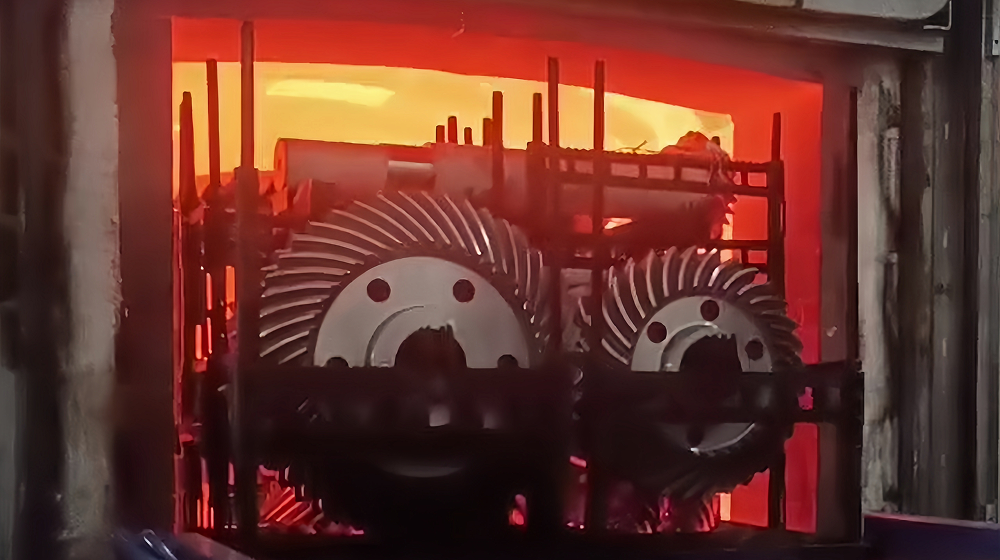
As-manufactured steel gear structures generally consist of ferrite and pearlite, which are highly susceptible to premature wear, pitting, and bending fatigue failure under meshing loads. Heat treatment creates a high-hardness case on the gear surface while maintaining a tough, tempered core. This establishes the desirable “hard case, tough core” characteristic.
Difference Between Untreated and Heat Treated Gears
| Characteristic | Untreated Gears | Heat Treated Gears (e.g., Carburized/Nitrided) |
| Surface Hardness | Low (typically < 25 HRC) | High (typically 58–64 HRC or 65–70 HRC equivalent) |
| Wear & Scuffing Resistance | Poor, highly vulnerable to adhesive damage under sliding friction | Excellent, resilient to high sliding wear even under boundary lubrication |
| Fatigue Life | Prone to fatigue crack initiation under cyclic loading | Surface compressive residual stresses effectively delay crack propagation |
| Load-Bearing Limit | Restricted to low-speed, light-duty applications | Suitable for high-power-density transmissions |

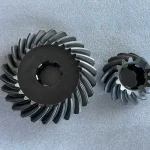
Heat treated bevel gears
Why Is Heat Treatment Important for Gears?
In modern drivetrain design, manipulating metallurgy and stress distribution through heat treatment is a primary focus. This enables the development of compact gear designs with high power density, reduced friction, lower transmission noise (NVH), and excellent reliability in harsh environments.
Key Benefits of Heat Treated Gears
- Increase surface hardness: Prevents premature pitting and adhesive scuffing under high-speed, heavy-load conditions.
- Improve wear resistance: Increases resistance to sliding wear, maintaining gear profile precision even under boundary lubrication.
- Enhance fatigue strength: Introduces high compressive residual stresses (typically 300–500 MPa) on the surface, significantly delaying bending and contact fatigue crack initiation and propagation.
- Increase load capacity: Enables gears to safely transmit higher torque under cyclic and shock loads.
- Extend service life: Minimizes premature component failure caused by wear or tooth breakage, satisfying demands for tens of thousands of operating hours in automotive, wind, and aerospace applications.
- Reduce maintenance costs: Decreases unexpected drivetrain downtime and associated maintenance expenses.
Common Gear Heat Treatment Methods
Selecting the proper heat treatment process involves balancing gear performance, dimensional distortion control, and manufacturing cost.
Process Characteristics Summary Table
| Method | Typical Surface Hardness | Typical Case Depth | Core Toughness | Distortion Control | Typical Applications |
| Carburizing | ★★★★★
(58–64 HRC) |
0.5–3.0 mm | ★★★★★ | ★★☆
(conventional oil quenching has higher distortion) |
Automotive drive gears, wind turbine planetary gears, heavy-duty mining gears |
| Induction Hardening | ★★★★☆
(55–62 HRC) |
0.5–3.0 mm | ★★★★☆ | ★★★☆
(localized hardening, moderate distortion) |
Large-diameter open gears, crane swing gears, agricultural drive shafts |
| Nitriding | ★★★★★
(65–70 HRC eq.) |
0.1–0.6 mm | ★★★☆☆ | ★★★★★
(<0.02 mm, exceptional dimensional stability) |
Precision robot actuators, machine tools, aerospace actuators |
| Through Hardening | ★★★☆☆
(~50 HRC) |
Through-hardened | ★★★☆☆ | ★★☆☆
(higher overall distortion risk) |
General industrial speed reducers, low-stress mechanical gearing |
| Flame Hardening | ★★★★☆ | 1.0–3.0 mm | ★★★☆☆ | ★★★☆☆ | In-situ maintenance, localized hardening of heavy equipment open gears |
Carburizing
- Process:
Low-carbon alloy steel gears are heated above their austenitizing temperature (typically 850–950°C, or up to 1000–1050°C for accelerated cycles) in a carbon-rich atmosphere or vacuum. Carbon potential is maintained between 0.8% and 1.1% to allow carbon diffusion into the surface. This is followed by oil quenching or high-pressure gas quenching (HPGQ, up to 20 bar) to produce a martensitic case. - Advantages:
Surface carbon enrichment produces a hard martensite case with controlled retained austenite, while the low-carbon core retains excellent impact toughness. The gradual carbon gradient provides favorable transition properties and introduces deep compressive residual stresses (300–500 MPa). Compared to conventional gas carburizing, Low-Pressure Vacuum Carburizing (LPC) eliminates intergranular oxidation (IGO), improves consistency, and reduces dimensional distortion by 40–60% when paired with HPGQ. - Applications:
Heavy-duty automotive transmissions, wind turbine main gearboxes, aerospace planetary gear systems.
Induction Hardening
- Process:
Using electromagnetic induction, the gear teeth are rapidly heated to their austenitizing temperature (typically 1–15 seconds with a power density of 0.5–5 kW/cm²), followed immediately by quenching with water or a polymer solution. - Advantages:
Heating is highly localized, meaning the core remains unaffected and retains its prior quenched-and-tempered toughness. This method requires minimal furnace floor space, enables short cycle times, and is easily integrated into automated production lines. Advanced techniques like Dual-Frequency or Contour Hardening produce uniform case depths along both the tooth flanks and roots. - Applications:
Selective hardening of large module gears, excavator swing ring gears, and tractor final drive shafts.
Nitriding
- Process:
Nitrogen is diffused into the gear surface at sub-Ac1 temperatures (typically 480–580°C) beneath the steel’s transformation range. This produces a thin surface compound layer (mainly Fe4N and Fe2−3N) and an underlying diffusion zone. - Advantages:
Because nitriding is conducted at low temperatures and does not involve phase transformations (austenite-to-martensite), dimensional distortion is exceptionally low (typically under 0.02 mm). Finish-machined gears can be nitrided directly, reducing or eliminating the need for post-heat treatment grinding. Processes like pulsed plasma nitriding enable precise control of compound layer thickness and phase composition. - Applications:
Precision robotic gear systems (e.g., harmonic or RV reducers), high-precision machine tool gearing.
Through Hardening
- Process:
Generally applied to medium-carbon steels or alloys (such as 4140 or 1045). The entire gear is heated above its austenitizing temperature, held to ensure a uniform temperature throughout the cross-section, quenched (in oil or water), and tempered at relatively high temperatures. - Advantages:
Provides a uniform distribution of hardness and strength across the entire gear cross-section. The process is simple, economical, and has a shorter processing cycle with low capital equipment requirements. - Applications:
Moderate-load gearing for general industrial applications, gear blanks requiring tempering before selective surface treatment.
Flame Hardening
- Process:
An oxygen-gas (acetylene, natural gas, etc.) flame is applied directly to the gear teeth, followed immediately by water quenching. - Advantages:
High flexibility and low equipment costs. It enables localized surface hardening of single teeth or specific flanks on very large gears without requiring large furnaces. - Applications:
On-site repair or localized hardening of massive open gear rings in heavy industrial machinery.
Carburizing vs. Nitriding vs. Induction Hardening
Selecting the right heat treatment is one of the most important decisions in gear manufacturing. While carburizing, nitriding, and induction hardening all improve surface hardness and wear resistance, they achieve these goals through different metallurgical mechanisms and are designed for different operating conditions. Rather than asking which process is universally “better”, engineers should determine which method best matches the gear material, load characteristics, dimensional tolerance, production volume, and expected service life.
In general, carburizing is the preferred solution for heavily loaded transmission gears that require deep case hardening and excellent fatigue strength. Nitriding is ideal for precision gears where dimensional stability is critical, while induction hardening offers a fast and economical solution for selectively hardening large gears or specific tooth surfaces without affecting the entire component.
Comparison of Common Gear Heat Treatment Methods
| Feature | Carburizing | Nitriding | Induction Hardening |
| Typical Surface Hardness | 58–64 HRC | 65–70 HRC (equivalent) | 55–62 HRC |
| Effective Case Depth | 0.5–3.0 mm | 0.1–0.6 mm | 0.5–3.0 mm |
| Core Toughness | Excellent | Excellent | Good |
| Dimensional Distortion | Moderate | Very Low | Low to Moderate |
| Fatigue Performance | Excellent | Very Good | Good |
| Processing Time | Long | Long | Very Short |
| Typical Materials | Low-carbon alloy steels | Nitriding steels | Medium-carbon alloy steels |
| Best Applications | Automotive transmissions, wind turbine gearboxes, mining equipment | Robotics, machine tools, aerospace precision gears | Large industrial gears, cranes, construction machinery |
| Relative Manufacturing Cost | High | Medium to High | Medium |
When Should You Choose Each Method?
Choose carburizing if…
- The gear is subjected to heavy cyclic loads or shock loading.
- Maximum bending fatigue and contact fatigue resistance are required.
- A deep hardened case is needed for long service life.
- Minor heat-treatment distortion can be corrected by finish grinding.
- Typical applications include automotive transmissions, wind turbine gearboxes, mining equipment, and other heavy-duty drivetrains.
Choose nitriding if…
- Tight dimensional tolerances must be maintained after heat treatment.
- Post-heat-treatment grinding should be minimized or eliminated.
- The gear operates at high speed with moderate torque and requires excellent wear resistance.
- Suitable nitriding steels are available.
- Typical applications include robotic reducers, precision machine tools, aerospace actuators, and measuring equipment.
Choose induction hardening if…
- Only the gear teeth or selected areas require surface hardening.
- Production efficiency and short cycle times are priorities.
- Large gears cannot be economically furnace treated.
- Existing quenched-and-tempered core properties need to be retained.
- Typical applications include large ring gears, crane slewing gears, agricultural machinery, and construction equipment.
Engineering Considerations Beyond Hardness
Surface hardness alone should never be the deciding factor when selecting a heat treatment process. The final gear performance depends on a combination of effective case depth, residual compressive stress, core toughness, microstructural stability, and dimensional accuracy. For example, nitriding generally provides the highest surface hardness with minimal distortion, but its relatively shallow diffusion layer makes it less suitable for gears subjected to extremely high impact loads. Conversely, carburized gears develop a deeper hardened case and favorable compressive residual stresses, making them better suited for high-power transmissions despite requiring additional finishing operations after quenching.
For this reason, experienced gear manufacturers evaluate the complete operating environment—including material selection, gear geometry, load spectrum, rotational speed, lubrication conditions, precision requirements, and production volume—before recommending the most appropriate heat treatment route. In practice, the best heat treatment is not the hardest one, but the one that provides the optimal balance between durability, dimensional stability, manufacturing efficiency, and lifecycle cost.
Gear Materials and Suitable Heat Treatment Methods
Selecting the appropriate material chemistry based on target case depth, core properties, and geometric constraints is key to heat treatment success:
| Material | Alloy Type | Recommended Heat Treatment | Expected Metallurgical & Performance Outcomes |
| 20CrMnTi | Low-carbon alloy steel | Gas Carburizing + Oil Quench | Surface hardness of 58–62 HRC, good core impact toughness for automotive transmissions. |
| 18CrNiMo7-6 | High-hardenability heavy-duty alloy steel | Vacuum Carburizing (LPC) + HPGQ | Case depths exceeding 2.0 mm, fine grain size, excellent rolling contact and bending fatigue strength for wind/heavy gearboxes. |
| 42CrMo / 4140 | Medium-carbon alloy steel | Quenched & Tempered + Selective Induction Hardening | Core hardness of 28–34 HRC, induction-hardened tooth surface of 53–58 HRC for heavy-duty power transmissions. |
| 31CrMoV9 | Nitriding steel (with strong nitride formers) | Gas or Pulsed Plasma Nitriding | Hardness of 900–1000 HV1 in the diffusion zone, superior scuffing resistance and wear stability. |
| AMS 6265 (52100) | Ultra-clean vacuum-induction remelted steel | Vacuum Hardening or Through Hardening + Deep Cryogenic Treatment | Maximum microstructural cleanliness, uniform hardness, and long rolling contact fatigue life under critical aerospace operating conditions. |
How to Choose the Right Gear Heat Treatment?
Selecting the proper process involves balancing performance requirements, mechanical processability, and economic constraints.
Decision Matrix
| Design Requirement | Key Constraint | Recommended Method | Primary Reason |
| High wear resistance & dynamic load capacity | High shock/vibration loads | Carburizing | Gradual case-to-core hardness transition and superior surface compressive residual stress patterns. |
| Minimal dimensional distortion | Post-heat treatment machining must be avoided | Nitriding | Low-temperature sub-Ac1 processing without microstructural phase transformations. |
| Selective gear tooth hardening | High-volume production & large dimensions | Induction Hardening | Fast localized electromagnetic heating with seconds-level cycles. |
| Critical aerospace & weight-sensitive gears | Extreme structural reliability | Vacuum Carburizing (LPC) + HPGQ | Complete elimination of IGO, minimized distortion, and outstanding grain-size consistency. |
| Lower-cost, general-purpose gearing | Moderate loads and budget constraints | Through Hardening | Simple process path and lowest capital equipment investment. |
Key Considerations:
- Material Chemical Composition: Carbon and alloying elements control hardenability and grain growth behavior.
- Component Geometry: Complex shapes or thin-walled gears are highly susceptible to quenching distortion.
- Service Load and Speed: Determines whether the gear primarily needs deeper contact fatigue resistance (carburizing) or higher wear resistance (nitriding).
- Dimensional Tolerance (Precision): Determines whether post-treatment hard finishing (grinding) is necessary, or if nitriding can be directly used.
- Economic Factors: Capital investment for advanced technologies (like LPC systems) vs. operating costs and production volumes.
Common Problems After Gear Heat Treatment
Gear Distortion
- Cause: Uneven thermal contraction (thermal stress) and volume expansion during phase transformation (transformation stress), particularly during liquid quenching.
- Prevention: Implement Low-Pressure Vacuum Carburizing (LPC) with High-Pressure Gas Quenching (HPGQ); optimize fixture designs; utilize coupled multiphysics modeling to predict dimensional changes and apply pre-distortion compensation during machining.
Cracking
- Cause: Overly rapid cooling in the quenching stage, causing residual tensile stresses to exceed the material’s strength limits, or stress concentrations triggered by high inclusion content (non-compliance with AMS 2301 cleanliness requirements).
- Prevention: Optimize quenchant temperature and agitation; utilize ultra-clean steels; perform immediate stress-relief tempering after quenching.
Uneven Hardness
- Cause: Non-uniform carbon potential distribution in atmosphere furnaces, or poor inductor design in induction hardening, leading to variations in case depth and surface hardness.
- Prevention: Implement precise closed-loop atmosphere control systems or use electromagnetic simulation to optimize induction coil design.
Excessive Residual Stress
- Cause: Sudden phase changes and volume differences between the case and core can leave unstable residual tensile stresses, which may cause grinding cracks or early in-service fatigue failure.
- Prevention: Ensure proper low-temperature tempering; incorporate deep cryogenic processing to transform retained austenite; integrate shot peening to generate a stable, compressive residual stress profile.
Heat Treated Gears Applications
Modern heat treatment processes have achieved digital, high-precision integration, offering tailored gearing solutions across various fields:
- Automotive Transmission: Multi-speed automatic transmissions (such as 8–10 speed gear systems typically using 20MnCr5/SAE 8620 with LPC) and EV drivetrains requiring low NVH, high wear resistance, and long-term durability.
- Industrial Gearboxes: Standard speed reducers and power transmissions using carburizing for high load capacity or precision nitriding for gear-profile stability.
- Mining Equipment: Severe load and abrasive environments (e.g., Caterpillar 7495 crowd/hoist gears using heavy carburizing with case depths exceeding 3.0 mm).
- Wind Turbines: Megawatt-class wind turbine main gearboxes (planetary stages >1.0m diameter using 18CrNiMo7-6 or 20MnCr5 with case depths >2.0 mm) designed for a 20+ year operating life.
- Construction Machinery: Excator and loader travel drives that demand a tough core for impact resistance and a wear-resistant case.
- Marine Gear Systems: Large cargo ship propulsion gearboxes transmitting high power (carburized case >2.0 mm) and naval CODAG gearboxes requiring optimized noise mitigation.
Why Choose Belon for Heat Treated Gears?
Rather than recommending a single heat treatment for every project, Belon works with customers during the design stage to optimize material selection, heat treatment route, gear grinding allowance, and inspection plans according to application requirements.
- Integrated Precision Machining and Heat Treatment:
We manage the entire process chain—from material procurement and rough machining to final heat treatment—ensuring quality control and component consistency. We have detailed heat treatment report for your reference as follows:

Heat treatment report for one of Belon’s customers
- Advanced Distortion and Metallurgical Control:
We employ precisely controlled carburizing, induction, and nitriding processes. For complex gear geometries, we design custom fixtures and utilize process simulation to mitigate thermal and phase-transformation distortions. - High-Precision Gear Grinding:
Any minor dimensional changes after heat treatment are corrected using advanced gear profile grinders, ensuring gears conform to strict AGMA or DIN precision classifications. - Comprehensive Testing & Quality Assurance:
We comply with international standards (such as SAE AMS 2750, AMS 2759, and AGMA standards). In addition to metallographic analysis and hardness profiling, we provide advanced non-destructive testing (such as Eddy Current Testing and Barkhausen Noise Analysis) and complete process documentation.
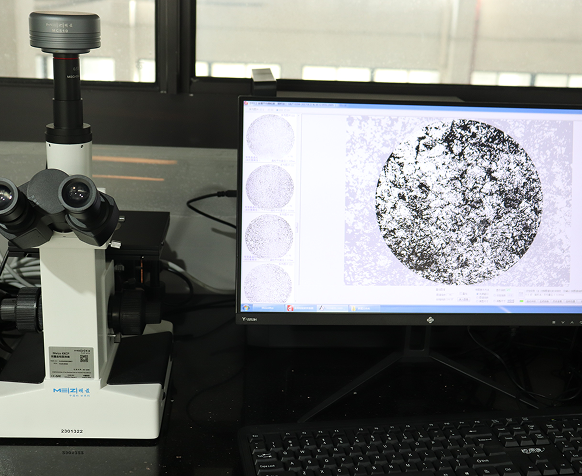
Heat treatment testing process
Contact Belon team today to send your true request and inquiry and we will get back to you as soon as possible.
FAQ
Q1: What is gear heat treatment?
Gear heat treatment is a controlled thermal process of heating and cooling designed to modify the internal microstructure of gear steels (such as transforming ferrite/pearlite to martensite or bainite), thereby enhancing surface hardness, wear resistance, bending fatigue strength, and load capacity.
Q2: Which heat treatment is best for gears?
No single method is universally superior; selection depends entirely on the application. For heavy-duty gearing subjected to high contact stress, carburizing is typically the benchmark process. For precision gears requiring minimal distortion (such as robotic joints), nitriding is preferred. For selective hardening of large-module gears, induction hardening offers the most cost-effective solution.
Q3: What is the difference between carburizing and nitriding?
The key differences are:
- Temperature & Mechanism:Carburizing occurs at high temperatures (850–950°C) and requires quenching to transform austenite to hard martensite. Nitriding occurs at lower temperatures (480–580°C) below the steel’s Ac1 range, diffusing nitrogen without structural phase transformation, which minimizes distortion.
- Case Properties:Carburizing achieves deeper cases (0.5–3.0 mm) with a surface hardness of 58–64 HRC. Nitriding produces shallower cases (0.1–0.6 mm) but yields a higher surface hardness (equivalent to 65–70 HRC).
Q4: Can all gears be heat treated?
Not all gears can or should undergo the same heat treatment. The feasibility depends on the steel grade (e.g., low-carbon steels require carburizing, whereas medium-carbon steels are suited for induction hardening) and the specific load requirements of the mechanical system. Non-ferrous alloys (like bronze) or polymers are not suitable for conventional steel heat treatments.
Q5: Why do gears crack after heat treatment?
Cracking is typically caused by extreme thermal or phase-transformation stresses during rapid quenching, the presence of excessive non-metallic inclusions in low-cleanliness steels (violating standards like AMS 2301), or a failure to perform immediate and adequate tempering after quenching.
Q6: How does heat treatment improve gear life?
It develops a hard, wear-resistant surface microstructure (such as martensite or nitrides) to resist wear and pitting. Simultaneously, it introduces deep compressive residual stresses in the surface layer, which physically impedes both bending and rolling contact fatigue crack initiation and propagation, thereby significantly extending the service life of the gear.