

Abstract: A gear blank is the foundation of every gear, directly affecting its strength, service life, and manufacturing cost. Among the available options, forged gear blanks and machined gear blanks are the two most widely used solutions, each suited to different production requirements and applications. In this guide, we’ll compare their gear manufacturing process, materials, mechanical properties, costs, and applications to help you choose the right gear blank for your project.
What Are Forged Gear Blanks?
Forged gear blanks are preformed gear workpieces produced through the gear forging process before gear teeth are machined. Instead of removing large amounts of material from a solid steel bar, forging reshapes a heated steel billet under high pressure to create a near-net-shape blank with improved internal grain structure.
How Forged Gear Blanks Are Manufactured
The manufacturing process may vary depending on the gear size, material, and production volume. For most industrial gears, closed die forging is preferred because it provides excellent dimensional consistency and high production efficiency, while open die forging is commonly used for large gear blanks or low-volume production.
The process typically includes:
Manufacturing Flow Diagram
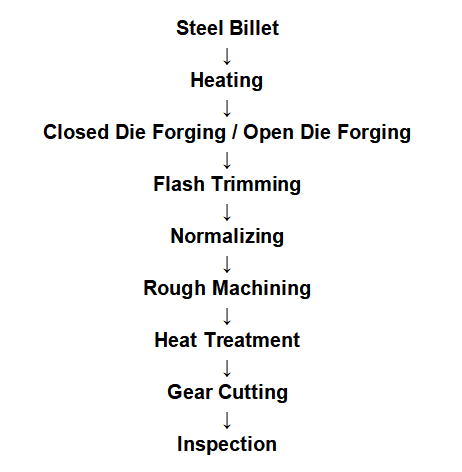
During hot forging, the heated billet is formed using a high-capacity forging press, allowing the material to flow into the die cavity. After flash trimming and normalizing, the forged blank undergoes rough machining before subsequent heat treatment and gear cutting operations. In some applications, warm forging may be selected to improve dimensional accuracy while reducing machining allowance.
Advantages of Forged Gear Blanks
Forging changes not only the external shape of a gear blank but also its internal microstructure. The continuous grain flow follows the contour of the component, helping reduce stress concentration and improving the gear’s ability to withstand cyclic loading.
Key advantages include:
- Higherbending fatigue for long service life under repeated loading.
- Improved impact resistancefor shock-load applications.
- Increased tooth strengthand load capacity compared with blanks machined directly from bar stock.
- Better material utilization through a near net shapeforging process, reducing machining time and material waste.
- Lower residual stress, resulting in improved dimensional stability during subsequent machining and heat treatment.
- Suitable for high-volume production with consistent quality and repeatable mechanical properties.
As for these advantages, forged gear blanks are commonly selected for high-torque power transmission systems where strength, reliability, and long-term durability are critical.
What Are Machined Gear Blanks?
Machined gear blanks are gear preforms manufactured by removing material from solid round bars, forged stock, or steel plates through CNC machining operations. Unlike forged gear blanks, they are produced without plastic deformation. This makes them an ideal choice for prototypes, custom designs, and low-volume production where tooling costs for forging cannot be justified.
How Machined Gear Blanks Are Produced
The production of machined gear blanks typically begins with a steel bar or plate that is cut to size and processed through a series of CNC machining operations. Depending on the gear design and dimensional requirements, the manufacturing process may include turning, milling, drilling, and deburring to prepare the blank for gear tooth machining.

CNC machining
A typical manufacturing process is shown below:
Manufacturing Flow Diagram
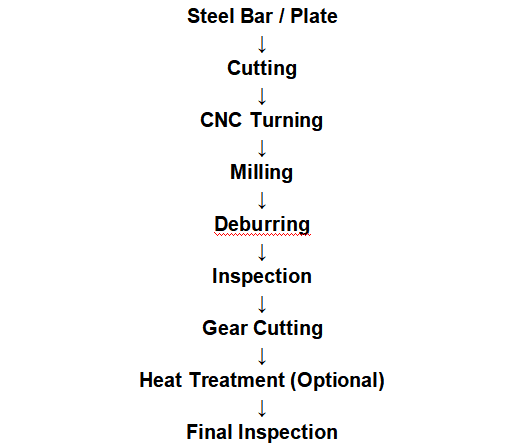
During machining, sufficient machining allowance is retained to ensure the required dimensions and tolerances can be achieved after finishing operations. Advanced CNC equipment provides excellent surface finish as well, in order to make machined gear blanks suitable for precision applications and custom components.
Advantages and Limitations of Machined Gear Blanks
Machined gear blanks offer flexibility in manufacturing, especially for customized or small-batch orders. Since no forging dies are required, design changes can be implemented quickly, making them well suited for prototype development and low-volume production.
Advantages
- Excellent dimensional accuracy and tight machining tolerances.
- Ideal for prototypes, custom gears, and small production runs.
- No dedicated forging tooling required, reducing initial investment.
- Shorter development cycle for new gear designs.
- Suitable for complex geometries that require extensive CNC machining.
Limitations
- Higher material waste because excess material is removed during machining.
- Lower material utilization compared with near-net-shape forging.
- Mechanical properties depend on the original bar stock rather than optimized grain flow.
- Less suitable for high-volume production due to longer machining time and higher unit cost.
- May offer lower fatigue performance than forged gear blanks in high-load applications.
Overall, machined gear blanks are an excellent solution when precision, design flexibility, and rapid production are more important than the enhanced mechanical properties and material efficiency provided by forging.
Forged Gear Blanks vs Machined Gear Blanks: A Side-by-Side Comparison
Although forged gear blanks and machined gear blanks are widely used in gear manufacturing, they differ quite significantly in manufacturing methods, mechanical performance, production cost, and ideal applications. Understanding these differences can assist you in selecting the most suitable solution based on load requirements, production volume, budget, and expected service life.
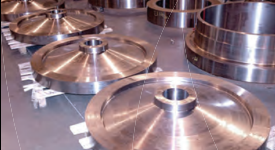
The table below compares the two types of gear blanks across the most important selection criteria.
| Property | Forged Gear Blanks | Machined Gear Blanks |
| Image |  |
 |
| Manufacturing Process | Produced by hot or warm forging followed by finish machining | Produced entirely through CNC machining from bar stock or plate |
| Grain Structure | Continuous grain flow aligned with the part geometry | Original grain structure remains unchanged and may be interrupted by machining |
| Strength | Higher strength due to forged microstructure | Depends on raw material properties |
| Fatigue Strength | Excellent fatigue strength for repeated heavy loads | Lower fatigue strength under cyclic loading |
| Wear Resistance | High wear resistance after proper heat treatment | Good wear resistance but relies mainly on material selection and heat treatment |
| Hardness | Uniform hardness after carburizing, quenching, or tempering | Can achieve similar surface hardness after heat treatment, but core properties depend on the base material |
| Material Utilization | High, thanks to near-net-shape forging | Lower due to greater material removal during machining |
| Machining Allowance | Small machining allowance, reducing machining time | Larger machining allowance required |
| Dimensional Accuracy | High after finish machining | Excellent dimensional accuracy directly achievable through CNC machining |
| Production Volume | Best suited for medium- to high-volume production | Ideal for prototypes and low-volume production |
| Lead Time | Longer initial lead time because forging dies are required | Shorter lead time with no tooling preparation |
| Tooling Cost | Higher initial tooling cost | Minimal tooling cost |
| Manufacturing Cost | Lower unit cost in large production runs | Higher unit cost due to longer machining time and material waste |
| Best Applications | Heavy machinery, mining equipment, wind turbines, industrial gearboxes, automotive transmissions | Prototypes, custom gears, robotics, repair parts, and small-batch production |
Key Takeaways
- Choose forged gear blanks when high strength, load carrying capacity, and long service life are necessary. Although the initial tooling cost is higher, the lower unit cost and superior mechanical performance make forging the preferred option for medium- and high-production volume
- Choose machined gear blanks when design flexibility, rapid delivery, and excellent dimensional accuracy are the priorities. They are especially suitable for prototypes, custom components, and low-volume production where investing in forging dies is not economical.
Overall, the best choice depends on the balance between performance requirements, manufacturing cost, production quantity, and project timeline. Evaluating these factors early in the design stage will optimize both gear quality and total production cost.
Why Are Forged Gear Blanks Stronger Than Machined Gear Blanks?
The superior performance of forged gear blanks is not simply the result of their manufacturing process—it is primarily due to the metallurgical changes that occur during gear forging. Unlike machined gear blanks, which are produced by removing material from bar stock, forging plastically deforms heated steel under high pressure. During hot forging, recrystallization occurs simultaneously with deformation, refining the microstructure while preventing strain hardening. This produces a dense, homogeneous material with improved mechanical properties and structural reliability.
Continuous Grain Flow Improves Strength
One of the most significant advantages of forging is the formation of directional grain flow. During deformation, a controlled forging ratio causes the metal grains to flow and align with the contour of the gear blank. Rather than cutting across the grain structure as in conventional machining, forging preserves continuous grain flow throughout the component.
This optimized grain orientation provides several engineering benefits:
- Higher resistance to fatigue crackinitiation and propagation under cyclic loading.
- Improved impact resistancefor applications subjected to shock loads and sudden torque fluctuations.
- Better load distribution throughout the gear blank, reducing local stress concentration.
- Increased bending strength and tooth root strength, extending service life in heavy-duty power transmission systems.
Enhanced metallurgical integrity with fewer internal discontinuities, improving structural reliability under high stress.

Near-net-shape forging produces a continuous grain structure that follows the geometry of the component rather than cutting across it. This optimized grain flow enhances impact toughness, directional strength, ductility, and fatigue performance. In contrast, machined components are produced by removing material from bar stock, interrupting the original grain orientation and exposing grain ends. As a result, they are generally more susceptible to fatigue failure and stress corrosion cracking under cyclic loading.
Heat Treatment Compatibility
Another important advantage of forged gear blanks is their excellent response to heat treatment. The dense and uniform microstructure produced during forging provides a stable foundation for subsequent processes such as carburizing, quenching, and tempering. These treatments increase surface hardness while maintaining sufficient core toughness, allowing gears to resist both wear and impact loading.
The combination of forging and heat treatment offers several performance benefits:
- Higher surface hardness for improved wear resistance and longer gear life.
- Excellent core toughness to absorb shock loads without brittle fracture.
- More uniform mechanical properties throughout the gear blank.
- Improved dimensional stability during heat treatment and finish machining.
- Greater reliability in high-speed, high-load, and long-term operating environments. Secondary operations such as heat treatment, machining, and non-destructive testing can further optimize the final mechanical properties and quality of the forged component.
As a result, forged components consistently demonstrate superior tensile strength, yield strength, fatigue strength, impact toughness, and fracture toughness compared with components manufactured from bar stock or other alternative processes. This combination of optimized grain flow, refined microstructure, and heat treatment compatibility makes forged gear blanks the preferred choice for demanding applications such as wind turbines, mining equipment, industrial gearboxes, and heavy-duty transmission systems.
Common Materials for Forged and Machined Gear Blanks
The material selected for a gear blank has a direct impact on its strength, wear resistance, heat treatment response, and service life. Both forged gear blanks and machined gear blanks can be manufactured from various grades of alloy steel and carbon steel, with the final selection depending on the required load capacity, operating environment, and manufacturing cost.
For high-performance forged steel gears, alloy steels are generally preferred because they offer excellent hardenability, fatigue resistance, and toughness after heat treatment. Carbon steels, on the other hand, are commonly used for light-duty gears where cost is a primary consideration. Material chemistry is also an important factor influencing forging performance and overall production cost.
Common Materials for Gear Blanks
| Material | Typical Use | Main Advantages |
| 4140 Alloy Steel | Industrial gears, shafts, construction equipment | High strength, good toughness, excellent heat-treat response |
| 4340 Alloy Steel | Heavy-duty transmission gears, aerospace, mining equipment | Superior fatigue strength, impact resistance, and hardenability |
| 8620 Alloy Steel | Automotive transmission gears, industrial gearboxes | Excellent carburizing performance with a hard surface and tough core |
| 20CrMnTi | Automotive gears, reducers, precision transmission systems | High surface hardness after carburizing, good wear and fatigue resistance |
| 18CrNiMo7-6 | Wind turbine gears, heavy-duty gearboxes, mining equipment | Outstanding core toughness, high load capacity, excellent fatigue performance |
| Carbon Steel (e.g., 1045) | Light-duty gears, agricultural machinery, general industrial applications | Economical, easy to machine, suitable for moderate load conditions |
Material Selection Considerations
When selecting a material for forged or machined gear blanks, engineers typically evaluate several factors:
- Load requirements– Higher loads generally require high-strength alloy steel.
- Heat treatment compatibility– Materials such as 8620, 20CrMnTi, and 18CrNiMo7-6 are widely used for carburized gears because they combine excellent surface hardness with a tough core.
- Wear and fatigue resistance– Heavy-duty forged steel gears benefit from alloy steels with superior fatigue strength and hardenability.
- Manufacturing cost– Carbon steel provides a cost-effective solution for gears operating under moderate loads.
- Application environment– Corrosive environments, shock loading, or continuous heavy-duty operation may require premium alloy grades with enhanced toughness and durability.
In practice, the optimal material depends not only on the gear’s mechanical requirements but also on the manufacturing process, heat treatment method, and expected service life. Selecting the right material at the design stage helps achieve the best balance between performance, reliability, and cost.
Material selection guide
| Application | Recommended Material |
| Automotive Transmission | 8620 / 20CrMnTi |
| Wind Turbine Gearbox | 18CrNiMo7-6 |
| Mining Equipment | 4340 / 18CrNiMo7-6 |
| Industrial Gearbox | 4140 / 8620 |
| Agricultural Machinery | 1045 Carbon Steel |
| Prototype & General Machinery | 4140 or Carbon Steel |
Manufacturing Process Comparison: Forging VS Machining
Although both forged and machined gear blanks serve as the starting point for gear production, their manufacturing approaches differ significantly. Forging forms a gear blank through controlled plastic deformation, while machining removes material from solid stock to achieve the required geometry. These different processes directly affect material utilization, production efficiency, tooling investment, and the final mechanical performance.
Forged vs. Machined Manufacturing Process
| Comparison Item | Forged Gear Blanks | Machined Gear Blanks |
| Raw Material | 
Steel billet or forging stock |

Steel bar or plate |
| Primary Process | Hot forging using a forging press | CNC turning and milling |
| Material Flow | Plastic deformation | Material removal |
| Material Utilization | High (near-net shape) | Lower due to machining waste |
| Grain Structure | Continuous grain flow | Original bar-stock structure |
| Tooling Requirement | Forging dies required | No dedicated dies |
| Production Efficiency | Best for medium to high volumes | Best for prototypes and small batches |
| Initial Investment | Higher tooling cost | Lower startup cost |
| Unit Cost | Lower in mass production | Higher in large production runs |
Key Manufacturing Differences
The biggest distinction between the two processes is how the material is shaped. Forging redistributes the metal through plastic deformation, preserving continuous grain flow and minimizing material waste. In contrast, machining removes excess material from solid stock, offering greater design flexibility but resulting in longer machining time and lower material utilization. As production volume increases, forging generally becomes more cost-effective because the tooling cost is distributed across more parts, while machining remains the preferred option for prototypes and low-volume production.
When Should You Choose Forged Gear Blanks?
The choice between forged gear blanks and machined gear blanks depends on several factors, including load requirements, production volume, lead time, and budget. While both manufacturing methods can produce high-quality gear blanks, each is better suited to different applications.
Best Applications for Forged Gear Blanks
Forged gear blanks are the preferred choice for high-load, safety-critical, and large-volume applications where strength, durability, and long service life are essential. Their optimized grain flow, superior fatigue resistance, and excellent response to heat treatment make them ideal for demanding power transmission systems.
Typical applications include:
- Mining equipment operating under heavy impact and continuous loading.
- Wind turbine gearboxes requiring exceptional fatigue resistance and long service life.
- Industrial gearboxes used in steel mills, cement plants, and power generation equipment.
- Marine gearboxes that must withstand high torque and harsh operating environments.
- Heavy machinery, including construction, agricultural, and material handling equipment.
These industries often require medium- to high-volume production, making forging a cost-effective solution despite the higher initial tooling investment.
Best Applications for Machined Gear Blanks
Machined gear blanks are better suited to applications where flexibility, rapid production, and precision machining are more important than maximum mechanical strength. Since they do not require dedicated forging dies, they are ideal for engineering changes and small production runs.
Typical applications include:
- Robotics requiring customized transmission components with tight tolerances.
- Prototypes for design validation and performance testing before mass production.
- Low-volume production where the cost of forging tooling cannot be justified.
- Precision equipment, including automation systems, measuring instruments, and specialized machinery.
For these applications, CNC machining provides excellent dimensional accuracy, short lead times, and greater design flexibility, making machined gear blanks an efficient and economical choice.
Decision Guide: Which Gear Blank Should You Choose?
| If your priority is… | Recommended Choice |
| Maximum strength and durability | Forged Gear Blanks |
| High fatigue resistance | Forged Gear Blanks |
| Heavy-load industrial applications | Forged Gear Blanks |
| Medium- or high-volume production | Forged Gear Blanks |
| Fast prototyping | Machined Gear Blanks |
| Low-volume production | Machined Gear Blanks |
| Design flexibility | Machined Gear Blanks |
| Short lead time | Machined Gear Blanks |
| Tight dimensional tolerances | Machined Gear Blanks |
Engineering Recommendation
As a general rule, choose forged gear blanks when long-term reliability, high load capacity, and production efficiency are the primary objectives. Choose machined gear blanks when flexibility, rapid turnaround, and low production quantities are more important.
If you’re unsure which solution best fits your project, consider evaluating four key factors during the design stage:
- Required load and operating conditions
- Annual production volume
- Budget and tooling investment
- Delivery schedule and customization needs
Selecting the appropriate gear blank early in the design process helps optimize manufacturing cost, mechanical performance, and product reliability throughout the gear’s service life.
How to Choose the Right Gear Blank for Your Project
Selecting the right gear blank is about balancing performance, manufacturing cost, and production efficiency.
Gear Blank Selection Checklist
Before choosing between forged and machined gear blanks, consider the following questions:
- Required Load
Will the gear operate under high torque, heavy shock loads, or continuous cyclic loading? High-load applications generally benefit from forged gear blanks because of their superior fatigue strength and structural integrity.
- Production Volume
Is your project a prototype, a small batch, or mass production? Forging becomes more economical as production volume increases, while machining is often the preferred choice for low-volume production.
- Material Selection
Choose the material based on the required mechanical properties and operating environment. Alloy steels such as 8620, 4140, 4340, and 18CrNiMo7-6 are commonly used for high-performance gears, while carbon steel may be sufficient for general industrial applications.
- Heat Treatment Requirements
Consider whether the gear requires carburizing, quenching, nitriding, or other heat treatment processes. The selected material and manufacturing method should be compatible with the desired hardness, wear resistance, and core toughness.
- Cost Target
Evaluate both the initial investment and the long-term manufacturing cost. Forging requires dedicated tooling but typically offers a lower unit cost in medium- and high-volume production. Machining minimizes upfront costs but generally results in higher material waste and machining time.
- Lead Time
Projects with tight delivery schedules or frequent design changes may benefit from machined gear blanks because no forging dies are required. For stable, repeat production, forging usually provides better overall manufacturing efficiency.
- Gear Accuracy
Determine the required gear quality and dimensional tolerances. Both forged and machined gear blanks can achieve high precision after finish machining, but the manufacturing route should align with the application’s accuracy requirements.
Partner with an Experienced Gear Blank Manufacturer
Choosing the right manufacturing method is only part of the process. Working with an experienced forged gear manufacturer or reliable gear blank supplier ensures that the material, forging process, machining allowance, and heat treatment are optimized for your specific application.
Whether you need standard or custom gear blanks, or fully engineered custom forged gears, early collaboration with the manufacturer can reduce production costs, improve product quality, and shorten development time.
Need help selecting the right gear blank?
If you’re unsure whether forged or machined gear blanks are the better choice, our engineering team can recommend the most cost-effective solution based on your drawings, material requirements, production volume, accuracy requirements, heat treatment specifications, and application. From prototype development to mass production, we provide customized gear blank solutions designed to meet your performance and budget goals. Contact us at once!
FAQ
Q1: Which is stronger, forged or machined gears?
In most heavy-duty applications, gears manufactured from forged gear blanks are stronger than those produced directly from machined bar stock. Forging improves the internal grain flow and structural integrity of the material, resulting in higher fatigue strength, impact toughness, and load-carrying capacity. However, the final gear performance also depends on factors such as material selection, heat treatment, gear design, and manufacturing quality.
Q2: Can forged gears be machined?
Yes. In fact, most forged gear blanks require machining after forging. Operations such as turning, milling, drilling, and gear cutting are performed to achieve the final dimensions, tooth geometry, and tolerances. Additional finishing processes, including grinding and inspection, may also be required depending on the gear accuracy and application requirements.
Q3: What materials are used for forged gear blanks?
Forged gear blanks are commonly manufactured from alloy steel and carbon steel. Popular alloy grades include 4140, 4340, 8620, 20CrMnTi, and 18CrNiMo7-6, which offer excellent hardenability, fatigue strength, and toughness after heat treatment. The most suitable material depends on the required load capacity, operating environment, and heat treatment process.
Q4: Are forged gears more expensive?
Not necessarily. Forged gears generally have higher initial costs because custom forging dies and tooling are required. However, for medium- and high-volume production, forging often results in lower unit costs due to improved material utilization, reduced machining time, and higher production efficiency. For prototypes and small batches, machined gear blanks are usually the more economical option.
Q5: Can forged gear blanks improve fatigue life?
Yes. One of the primary advantages of forged gear blanks is their ability to improve fatigue life. The forging process creates continuous grain flow that follows the shape of the component, reducing stress concentration and improving resistance to fatigue crack initiation under repeated loading. When combined with appropriate heat treatment, forged gear blanks provide excellent long-term durability for demanding power transmission applications.
Q6: Can I customize forged gear blanks based on drawings?
Yes. Most professional forged gear manufacturers offer custom manufacturing services based on customer drawings or technical specifications. If a complete drawing is available, the gear blank can be produced according to the specified dimensions, material, and heat treatment requirements. If only basic parameters—such as torque, gear size, or application—are provided, experienced manufacturers can also assist with material selection, forging process design, and machining allowances to optimize both performance and production cost.