

Abstract: Crane bevel gears are critical components in crane transmission systems, responsible for transferring torque between intersecting shafts. Proper gear selection, maintenance, and timely replacement are essential for ensuring safe and reliable crane operation. This guide explains crane bevel gear applications, common failure modes, replacement considerations, and how to source new or replacement crane bevel gears.
What Are Crane Bevel Gears?
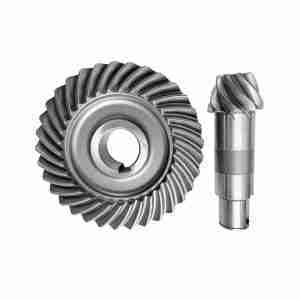
In heavy-duty lifting heavy machinery, crane bevel gears serve as the mechanical backbone for changing torque direction—typically at a 90-degree angle—between intersecting shafts. Whether driving the main hoist drum, trolley travel mechanisms, or massive slewing rings, these gears must endure intense bidirectional loads and frequent reversing cycles.
To withstand these severe conditions, commercial-grade crane bevel gears are never made from standard carbon steel. At Belon, we utilize premium high-strength alloy steels like 20CrMnTi, 18CrNiMo7-6, or AISI 4320. These materials undergo rigorous carburizing and quenching to achieve a case hardness of HRC 58-62 , balancing a wear-resistant outer shell with a resilient, shock-absorbing core capable of surviving sudden dynamic braking.
How Do Crane Bevel Gears Work?
Crane bevel gears work by meshing with a mating gear to transfer rotational power between shafts that intersect at an angle. Their conical tooth geometry allows motion to be redirected efficiently while maintaining reliable torque transmission under heavy loads.
The primary functions of crane bevel gears include:
 Power transmission– transferring mechanical power from the motor or gearbox to the driven components.
- Direction change– redirecting rotational motion between intersecting shafts, most commonly at 90°.
- Torque transfer– delivering the torque required for lifting, slewing, or moving heavy loads safely and efficiently.
 Power transmission– transferring mechanical power from the motor or gearbox to the driven components.
Generally speaking, in a crane gearbox, the bevel gear set converts the input power into the desired output direction before transmitting it to the hoisting drum, trolley drive, or slewing system. This design can efficiently optimize space utilization while ensuring smooth and dependable operation in demanding industrial environments.
Why Are Bevel Gears Important in Crane Systems?
Crane systems aim to help users lift, move, and position heavy loads safely and efficiently. To achieve this, power must often be transmitted between shafts arranged at different angles while maintaining high torque and reliable performance.
Compared with parallel-shaft gears, bevel gears enable power transmission between intersecting shafts, allowing crane gearboxes to efficiently redirect motion within compact spaces. Their ability to handle heavy loads, withstand shock forces, and maintain accurate motion control makes them an essential component in many crane drive systems. Without properly designed bevel gears, cranes are likely to experience reduced efficiency, increased wear, and compromised operational reliability.
Key Functions of Crane Bevel Gears
Crane bevel gears perform several important functions that directly affect the performance and safety of lifting equipment:
- Change Shaft Direction
Bevel gears transmit power between intersecting shafts, usually at a 90° angle, allowing engineers to optimize gearbox layouts and space utilization. - Transmit High Torque
Cranes frequently operate under heavy loads and demanding conditions. Bevel gears are designed to transfer high levels of torque required for lifting, rotating, and moving large loads. - Maintain Positioning Accuracy
Precise load handling is essential in crane operations. High-quality bevel gears help ensure smooth motion transfer and accurate positioning during lifting and slewing operations. - Improve Transmission Efficiency
Properly manufactured and aligned bevel gears minimize power losses, contributing to higher gearbox efficiency and reduced operating costs.
Together, these functions make cranes operate safely, reliably, and efficiently in industrial environments to meet users’ requirements.
Typical Crane Applications
Crane bevel gears are used in a wide range of lifting and material-handling equipment, particularly where high torque transmission and directional power transfer are required.
- Overhead Cranes
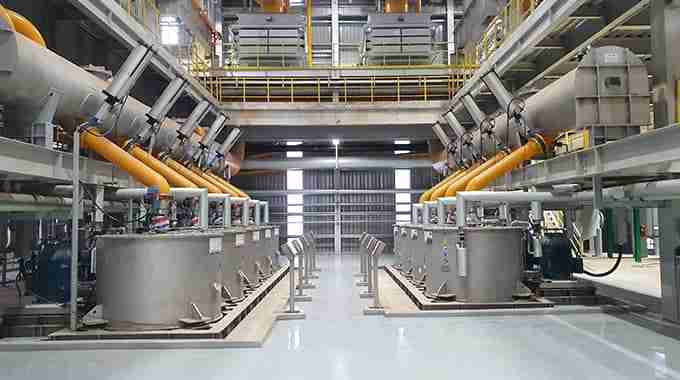
Used in manufacturing plants, warehouses, and workshops, overhead cranes rely on bevel gear systems to support hoisting and trolley movement.
- Gantry Cranes
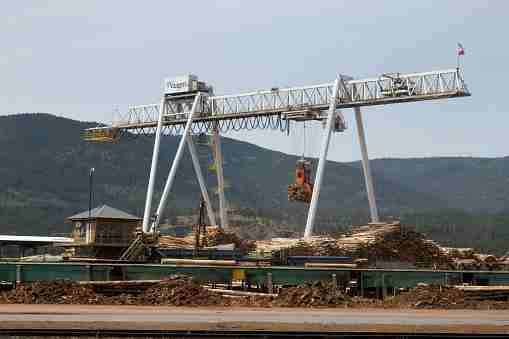
Commonly found in shipyards, construction sites, and container terminals, gantry cranes utilize bevel gears to handle heavy loads while maintaining stable and efficient operation.
- Port Cranes
Container handling cranes and harbor cranes require durable bevel gears capable of withstanding continuous operation, heavy loads, and harsh environmental conditions.

- Mining Cranes
Mining applications demand robust transmission systems that can endure shock loads, dust, and extreme operating environments. Bevel gears provide the strength and reliability needed for these demanding tasks. - Steel Mill Cranes
Steel production facilities use heavy-duty cranes to transport molten metal, coils, and large structural components. High-strength bevel gears ensure dependable performance under high temperatures and intensive workloads.
Because these crane types operate in demanding environments where downtime can be extremely costly, the durability, precision, and load-carrying capability of crane bevel gears are critical to overall system performance and reliability.
Common Types of Crane Bevel Gears
Depending on the lifting capacity, operational speeds, and duty cycles of your equipment, crane drive systems utilize different tooth geometries. Selecting or replicating the correct type is essential for managing noise, mechanical efficiency, and torque.
Straight Bevel Gears
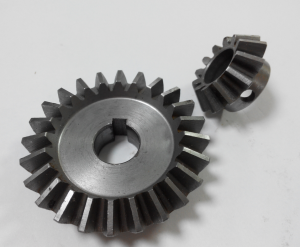
Straight bevel gears feature straight teeth that taper toward the apex. While they are highly cost-effective and simpler to manufacture, the teeth engage all at once along their entire length. This abrupt engagement can cause noise and vibration at higher pitch line velocities. Consequently, they are best suited for older crane models, auxiliary manual hoists, or low-speed, medium-duty crane applications.
Spiral Bevel Gears
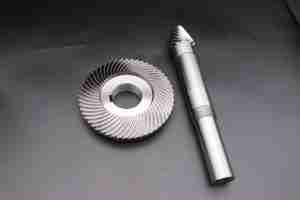
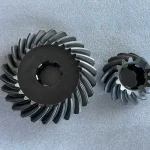
Spiral bevel gears are designed with curved, oblique teeth that engage gradually from one end to the other. This progressive tooth contact results in a significantly higher contact ratio, reducing dynamic shock loads and ensuring smoother, quieter operation. For modern heavy-duty overhead cranes, port container gantry cranes, and steel ladle cranes, spiral bevel gears are the industry standard due to their superior load-carrying capacity and high transmission efficiency.
Custom Crane Bevel Gears
When dealing with aging capital equipment or specialized foreign machinery, standard catalog gears will not fit. Custom crane bevel gears are engineered to bridge this gap. Whether you need to replace an obsolete OEM component or upgrade a gear set to handle a higher tonnage rating, custom manufacturing allows you to modify the tooth profile, upgrade the core metallurgy, or adjust tolerances to solve chronic gearbox issues.
Common Causes of Crane Bevel Gear Failure
Crane bevel gears operate under heavy loads, frequent start-stop cycles, and demanding environments. Understanding the main causes helps improve reliability and extend gearbox life.
1. Surface Degradation & Fatigue Micro-Cracks
Continuous operation under high contact pressure creates micropitting—microscopic craters caused by sub-surface shear stress. If your lubricant carries microscopic metal shavings or environmental dust, abrasive wear acts like sandpaper, destroying the tooth geometry. Under extreme localized heat, the oil film breaks down completely, leading to scuffing (adhesive wear) where metal literally welds and tears apart during meshing.
2. Severe Dynamic Shock Loads
Cranes are notorious for violent load fluctuations. Rapid acceleration, sudden lifting jerks, or emergency braking dump immense kinetic energy into the gear teeth. These shock forces exceed the material’s yield strength, resulting in plastic deformation, micro-cracking at the tooth root, or catastrophic tooth shearing.
3. Contact Pattern Misalignment
For bevel gears, proper backlash and contact patterns are non-negotiable. When housing foundations distort or shaft bearings wear down, the load shifts from a uniform distribution across the tooth flank to a localized concentration at the heel or toe. According to AGMA standards, even a few microns of misalignment will drastically accelerate localized pitting and induce bending fatigue.
4. Lubrication Film Breakdown
Without a consistent elastohydrodynamic lubrication (EHL) film, metal-to-metal contact is inevitable. This usually stems from:
- Using the wrong viscosity oil that thins out under high mill temperatures.
- Moisture, water, or particulate contamination in harsh outdoor ports.
- Neglecting oil replacement intervals, leading to additive depletion.
When Should Crane Bevel Gears Be Replaced?
Even with proper maintenance, crane bevel gears eventually reach the end of their service life unavoidably. Identifying the right time to install replacement crane bevel gears is essential for preventing unexpected downtime, maintaining lifting performance, and ensuring safe crane operation.
Signs That Replacement Is Needed
Regular inspections can help detect early signs of gear deterioration. Replacement should be considered when any of the following conditions are observed:
- Excessive noise during gearbox operation
- Increased vibration indicating abnormal gear contact
- Tooth breakage or visible cracks on gear teeth
- Severe wear patterns affecting tooth geometry
- Reduced transmission efficiency and power transfer performance
If these symptoms continue to worsen, the risk of gearbox failure increases significantly, making gear replacement the most reliable solution.
Repair vs Replacement
In some cases, minor gear damage can be repaired. However, severe structural damage usually requires complete replacement to restore safe and reliable operation.
| Condition | Repair | Replace |
| Minor wear | ✓ | |
| Surface polishing | ✓ | |
| Tooth cracking | ✓ | |
| Tooth breakage | ✓ | |
| Severe pitting | ✓ | |
| Major dimensional wear | ✓ |
As a general rule, repairs may be suitable for light surface damage that does not affect gear strength or tooth geometry. However, when cracks, broken teeth, severe pitting, or significant wear are present, installing replacement crane bevel gears is typically the most cost-effective and dependable long-term solution.
To maximize gearbox performance, replacement gears should match the original specifications, including gear ratio, tooth profile, material grade, and heat-treatment requirements. Proper installation and alignment are also critical to achieving optimal service life.
How to Select Right Replacement Crane Bevel Gears
When a gearbox fails, the fastest path to restoration requires precise technical verification. A minor sizing error can cause rapid gear tracking failure or severe backlash vibration within hours of installation.
Critical Engineering Parameters to Verify
- Module (m) or Diametral Pitch (DP): The fundamental metric for tooth sizing.
- Tooth Count (Pinion & Gear): Establishes the exact gear ratio and output speed.
- Pressure Angle & Helix/Spiral Angle: Must pair perfectly with the mating gear to prevent sliding friction.
- Shaft Angle & Hub Configuration: Ensures exact drop-in fitment inside the existing housing.
- Core Metallurgy & Heat Treatment Spec: Dictates whether the replacement can handle your actual duty cycles.
OEM Drawing vs Reverse Engineering
Finding original blueprints for 20-year-old steel mill cranes or imported European gearboxes is often impossible. That is where Belon’s aftermarket support comes in. You do not need the drawings; you only need to ship us the worn or broken gear sample.
- 3D Laser Scanning & CMM Analysis: We map the exact physical dimensions, coordinate geometries, and current backlash states.
- Tooth Profile Reconstruction: Our engineers calculate the original, unworn tooth profile and geometry using specialized gear design software.
- Metallurgical Analysis: We test the sample’s core hardness, case depth, and material composition to replicate or upgrade the steel grade.
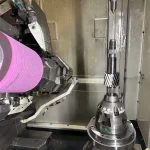
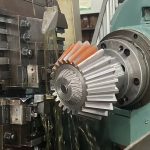
- Precision Re-Manufacturing: We cut the new gear set using Gleason CNC spiral bevel gear shaping machines and finish with precision grinding to meet high ISO/AGMA accuracy classes.
Direct OEM Replacement vs. Redesigning New Gear Sets
When managing a crane maintenance program or a capital upgrade, it is critical to distinguish between a drop-in aftermarket replacement and a clean-sheet gear design. Your choice directly impacts your lead time, engineering costs, and crane modifications.
| Feature | New Crane Bevel Gears | Replacement Crane Bevel Gears |
| Application | New equipment | Existing equipment |
| Design Freedom | High | Limited by original design |
| Lead Time | Moderate | Depends on reverse engineering |
| Cost | Project dependent | Usually lower than redesign |
| Customization | Extensive | Match original specifications |
Drop-In Replacement Crane Bevel Gears
The primary objective of a replacement gear is exact interchangeability. Whether fabricated from original blueprints or reverse-engineered from a worn sample, the new gear set must replicate the exact mounting dimensions, keyway positions, spline configurations, and tooth alignment of the original part. This ensures the gear fits into the existing housing with the correct backlash, requiring zero modifications to the surrounding shafting or bearings. This is the fastest, most economical choice for emergency repairs and standard maintenance overhauls.
Custom New Bevel Gears for Equipment Upgrades
Developing a completely new gear design is typically reserved for crane modernization projects, system speed increases, or structural capacity upgrades. For example, if a steel mill plans to increase a crane’s lifting rating from 50 tons to 65 tons, the existing gear geometries may no longer satisfy AGMA safety factors. In this scenario, engineers redesign the gear set from scratch—optimizing the pressure angles, increasing the face width, or specifying premium materials like 18CrNiMo7-6 to deliver higher power density within the same physical space.
Which Option Is Right for Your Project?
- Choose new crane bevel gears for new crane manufacturing projects or when a complete drivetrain redesign is planned.
- Choose replacement crane bevel gears for gearbox repairs, maintenance programs, equipment upgrades, and refurbishment projects where compatibility with the existing system is essential.
Crane operators and OEM manufacturers need to select the proper solution and then can achieve optimal performance, reliability, and cost efficiency throughout the equipment lifecycle.
How Belon Manufactures Crane Bevel Gears
Belon manufactures high-performance crane bevel gears for demanding lifting and material-handling applications. From engineering design to final inspection, every production stage is carefully controlled to ensure reliable performance, long service life, and compliance with customer specifications.
Engineering and Gear Design
The manufacturing process begins with detailed engineering analysis and gear design. Our engineering team works closely with customers to determine the optimal gear geometry based on load requirements, operating conditions, gearbox configuration, and service life expectations.
Capabilities include:
- Bevel gear design and optimization
- Gear ratio and load capacity calculation
- Contact pattern analysis
- Reverse engineering of existing gears
- Custom solutions for OEM and aftermarket applications
For replacement projects, Belon can accurately reproduce original gear geometry from samples, drawings, or inspection data.
Material Selection and Heat Treatment
Material quality matters in crane bevel gear durability. Belon selects high-strength alloy steels according to application requirements and performance targets.
Common processes include:
- Carburizing and quenching
- Nitriding
- Induction hardening
- Through hardening
Proper heat treatment improves tooth surface hardness, wear resistance, fatigue strength, and impact resistance, helping gears withstand heavy crane operating loads.
Precision Machining and Inspection
To make the high performance and good quality gear, Belon utilizes advanced manufacturing and quality-control systems to ensure consistent gear accuracy and performance.
Key manufacturing and inspection capabilities include:
- Gleason spiral bevel gearcutting technology
- CNC gear machining
- Precision gear grinding
- Tooth profile and lead inspection
- Tooth contact inspection
- Coordinate measuring machine (CMM) verification
- Noise and backlash evaluation
Each gear undergoes comprehensive dimensional and functional inspection before delivery to ensure compliance with customer requirements and international quality standards.
Custom Manufacturing Capabilities
Belon specializes in both new and replacement crane bevel gears, supporting a wide range of industries and crane types.
Our custom manufacturing services include:
- OEM and aftermarket gear production
- Large-size bevel gears
- Low-volume and prototype manufacturing
- Reverse-engineered replacement gears
- Matched gear-set production
- Emergency replacement solutions for critical equipment
To further ensure product reliability, Belon also performs advanced quality verification procedures such as:
- Metallurgical testing
- Hardness testing
- Microstructure analysis
- Heat-treatment verification
- Material certification review
By combining advanced gear engineering, precision manufacturing, and rigorous inspection processes, Belon delivers crane bevel gears that provide excellent load capacity, smooth operation, and long-term reliability in demanding lifting applications.
Need New or Replacement Crane Bevel Gears?
Belon manufactures custom crane bevel gears for overhead cranes, gantry cranes, port cranes, and heavy-duty lifting equipment. Whether you need new crane bevel gears for OEM projects or replacement crane bevel gears based on existing samples or drawings, our engineering team can support design, reverse engineering, crane gear manufacturing, and inspection.
Contact Belon today for a custom crane gear solution.
FAQ
Q1: What is a crane bevel gear?
A crane bevel gear is a gear used to transmit power between intersecting shafts, typically at a 90° angle, in crane hoisting, trolley, and slewing systems. It helps transfer torque efficiently while maintaining reliable operation under heavy loads.
Q2: How long do crane bevel gears last?
The service life of crane bevel gears depends on load conditions, operating hours, lubrication, alignment, and maintenance practices. With proper maintenance, high-quality gears can operate reliably for many years before requiring replacement.
Q3: What causes crane bevel gear failure?
Common causes of crane bevel gear failure include excessive wear, overloads, shock loads, misalignment, poor lubrication, contamination, and inadequate maintenance. Early inspection can help prevent costly gearbox damage.
Q4: Can damaged crane bevel gears be repaired?
Minor wear, polishing marks, or light surface damage can often be repaired. However, gears with tooth cracks, tooth breakage, severe pitting, or significant dimensional wear typically require replacement crane bevel gears to ensure safe and reliable operation.
Q5: How do I order replacement crane bevel gears without drawings?
If OEM drawings are unavailable, Belon can instead supply replacement crane bevel gears through reverse engineering. By using gear inspection, precision measurement, and 3D scanning, we can reproduce the original gear geometry and manufacture a compatible replacement gear for you.