

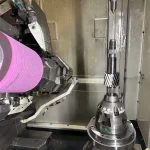
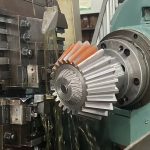
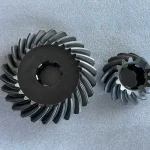
Straight bevel gears are widely used in crane gear systems because they provide reliable 90° torque transmission, high load capacity, and simplified maintenance. This guide explains material options, design standards, and how to select the right gear set for hoist, trolley, and slewing applications.
The Critical Role of Straight Bevel Gears in Cranes
Requirements of Modern Crane Transmission Systems
Modern industrial cranes, including overhead, gantry, and tower cranes, operate under demanding conditions that require high load capacity, stable torque transmission, and precise directional power transfer. Since these systems handle heavy loads, gearbox components must withstand significant radial and axial forces while maintaining long-term reliability. At the same time, compact gearbox designs require optimized gear geometry to ensure both transmission efficiency and structural safety.
Straight Tooth Bevel Gear Components

Straight tooth bevel gears are essential for 90-degree power transmission in crane gear systems. Their conical design enables efficient torque transfer between intersecting shafts, making them ideal for compact gearbox configurations. A typical gear set consists of a pinion and mating gear with straight tapered teeth. Compared with spiral bevel gears, straight bevel gears are easier to manufacture, align, and maintain, making them a cost-effective and reliable solution for hoist and trolley drive applications.
Impact on Operational Safety and Efficiency
Gear selection directly impacts crane safety and operational efficiency. High-quality straight bevel gears provide stable and predictable torque transmission, which is essential for frequent start-stop lifting operations. Their simple tooth geometry minimizes axial thrust, simplifying gearbox design and improving braking reliability. In addition, proper lubrication helps reduce friction and energy loss, ensuring efficient power transmission with lower heat generation during continuous operation.
Why Straight Bevel Gears Are Essential for Crane Mechanisms
Efficient 90° Torque Transfer and Directional Power

The primary advantage of straight bevel gears in crane systems is their ability to deliver precise 90-degree torque transfer. In hoist and trolley drives, where motors are typically mounted horizontally while output shafts require perpendicular power transmission, straight bevel gears provide an efficient mechanical connection. Their geometry enables compact right-angle gearbox designs, allowing easy integration into limited installation spaces without compromising torque capacity.
Heavy-Duty Load-Bearing Capacity of Straight Cut Bevel Gears
Cranes demand resilient gear components to handle immense weight. The straight tooth bevel gear profile is engineered to endure both high static loads during lifts and dynamic loads during acceleration. With high-strength alloy steels and precise heat treatment, these gears achieve the surface hardness and core toughness required to withstand the heavy impacts and repetitive stress cycles of shipyard and construction environments.
Cost-Effectiveness and Manufacturing Simplicity
In the competitive world of industrial manufacturing, bevel gears with straight cut teeth offer a significant cost advantage. Their simpler geometry makes them more economical to machine than spiral variants, reducing both initial purchase prices and lead times for custom replacements. For standard crane applications where extreme speeds are not required, these straight bevel gears provide the best ROI by delivering reliable performance without the unnecessary complexity and cost of specialized gearing.
Ease of Installation and Maintenance in Industrial Environments
Maintenance teams prioritize components that simplify field service. Straight bevel gears are significantly more tolerant of minor axial mounting variations than spiral designs, streamlining the assembly of crane gearboxes and reducing alignment time during repairs. Given that crane downtime can cost thousands of dollars per hour, the ability to rapidly inspect and maintain straight cut bevel gears provides a vital operational advantage, ensuring systems return to service with minimal delay.
Key Specifications: Material and Design Standards
Optimal Material Selection: Alloy Steels and Heat Treatment
The foundation of a high-performance straight tooth bevel gear lies in the uncompromising quality of its base metal. At Belon, our material selection process strictly adheres to ASTM A29/A 29M standards, ensuring that every gear blank possesses the required chemical purity and mechanical integrity. For heavy-duty crane applications, we prioritize standard alloy grades such as ASTM 4140, 4340, or 8620, which are engineered for superior hardenability and fatigue resistance. By utilizing steels with a fine austenitic grain size (number 5 or higher), we significantly enhance the impact toughness of our straight bevel gears, a critical factor in preventing tooth breakage during the sudden “start-stop” cycles of crane lifting.
To achieve the necessary durability, our straight bevel gears undergo advanced thermal processing. We follow the rigorous Quenched and Tempered protocols outlined in specifications like ASTM A434, ensuring the material reaches an optimal balance of surface hardness and core ductility. For instance, by controlling the manganese content (up to 1.90% in certain 41xx series) and maintaining strict limits on phosphorus and sulfur (typically <= 0.035% and <=0.040% respectively), we minimize internal impurities that could lead to premature gear failure. This adherence to global quality norms ensures that each straight tooth bevel gear not only meets but exceeds the performance expectations of the international lifting and mining industries.
Design Parameters: Module, Tooth Count, and Pressure Angle
Precision engineering is vital, with modules typically ranging from M2 to M15 and a standard 20° pressure angle. Our design optimizes tooth root strength to combat bending fatigue. For straight bevel gears, we utilize advanced CAD/CAM software to ensure localized tooth contact patterns, compensating for housing deflections under full load and minimizing vibration through high contact ratios.
Performance Standards: Torque Capacity and Speed Range
Straight cut bevel gears must deliver consistent performance in environments ranging from salt spray to high-heat mills. These gears are rated for high torque and intermittent overloads during emergency braking. With mechanical efficiency reaching 98% per pair, energy loss is minimized. Optional surface treatments like phosphating or black oxide further enhance corrosion resistance in unheated outdoor gearboxes.
Compliance with International Quality Norms (ISO/DIN)
Quality assurance is non-negotiable in the lifting industry. Our manufacturing process for straight bevel gears strictly adheres to international standards such as ISO 1328 or DIN 3965. Each gear set undergoes comprehensive testing, including coordinate measuring machine (CMM) inspection for pitch and profile accuracy, as well as ultrasonic or magnetic particle testing to ensure zero internal defects. By maintaining a quality level of AGMA 10-12 or better, our gear products guarantee the long-term reliability required by global crane manufacturers and mining enterprises.
Common Applications of Straight Bevel Gears in Crane Types
Hoist Gearboxes
As the most critical crane component, the hoisting mechanism relies on straight bevel gears for vertical load movement. Their robustness handles high initial torque without tooth deformation, providing the predictable performance essential for preventing catastrophic load drops.
Trolley Drive Systems
For horizontal travel, straight bevel gears ensure even power distribution across drive wheels. Their high efficiency at lower speeds and direct engagement allow for the crisp start-and-stop control necessary for precise load positioning on factory floors.
Slewing Mechanisms: Precision Rotation for Tower & Gantry Cranes
Slewing drives in tower and gantry cranes utilize straight cut bevel gears to manage massive radial loads. The design’s simplicity allows for easy backlash adjustment, preventing “wobble” and ensuring high-precision bevel gear rotation with millimeter accuracy.
Auxiliary Safety and Secondary Transmission Systems
The compact nature of straight cut bevel gears makes them ideal for tight enclosures in limit switches, emergency overrides, and braking systems. Whether for manual cranks or sensor drives, the consistent ratio of a gear ensures safety systems respond accurately every time.
Straight Bevel Gears vs. Spiral Bevel Gears
Performance and Cost Analysis for Crane Applications
The choice between gear types depends on operational speed and budget. Straight cut bevel gears are significantly more cost-effective due to simpler tooth geometry, requiring less specialized tooling and shorter machining cycles. While spiral gears excel at high velocities, the moderate speeds of crane hoisting and slewing make the high mechanical efficiency and lower price of a straight bevel gear an attractive proposition for industrial OEMs.
When to Choose Straight Cut Bevel Gears Over Other Types
Opt for straight cut bevel gears when prioritizing maintenance ease and high static load capacity. Unlike spiral designs, straight bevel gears do not produce significant axial thrust, allowing for simplified bearing arrangements that reduce overall system weight and complexity. In standard overhead or gantry cranes, they provide a reliable, “no-nonsense” power transmission solution that is easy to align during field assembly.
Load Requirements and Budgetary Considerations
For heavy-duty operations in mines or shipyards, the budgetary benefits of straight bevel gears are substantial during large-scale replacements. Adhering to ASTM A29 standards and utilizing high-quality alloys like 4140 or 8620 ensures a straight tooth bevel gear reaches the necessary hardness (HRC 58-62) for repetitive heavy lifting. Unless ultra-silent rotation is required, straight cut bevel gears offer the optimal balance of durability and investment value.
| Feature | Straight Bevel Gears | Spiral Bevel Gears |
| Manufacturing Complexity | Lower | Higher |
| Production Cost | Cost-effective | Higher |
| Axial Thrust Load | Minimal | Significant |
| Assembly & Alignment | Simpler / Higher tolerance | Precise alignment required |
| Operational Noise | Standard industrial level | Low noise / Ultra-quiet |
| Ideal Application | Low-to-medium speed, heavy-duty lifting, easy-maintenance systems | High-speed rotation, heavy-duty, low-vibration requirements |
Custom Straight Bevel Gear Solutions for Crane Projects
Engineering for different types
Different crane systems require customized gear solutions, and the gearing must reflect the specific kinematics of the machine. For overhead bridge cranes in steel mills, we engineer straight bevel gears capable of enduring extreme ambient temperatures and continuous duty cycles. For tower cranes used in high-rise construction, our straight tooth bevel gear solutions prioritize a high strength-to-weight ratio to minimize the deadweight on the jib. By customizing the tooth profile and gear ratio, straight cut bevel gears can be integrated perfectly into your existing gearbox housing, regardless of the crane’s configuration.
Manufacturing Capabilities for High-Precision Custom Gears
As a premier industrial manufacturer, Belon’s facility is equipped to produce straight cut bevel gears from a wide range of materials specified in ASTM A29/A 29M, such as 4140 and 4340 alloy steels. We offer flexibility in manufacturing, ranging from small modules for precision auxiliary drives to large-scale straight bevel gears for heavy-duty main hoists. Our production capabilities include:
| Types | Supply Status | Module (M) | Diameters (mm) | Accuracy (DIN) |
| Straight Bevel Gears | Forging | M0.5-M15 | Φ10~Φ500 | DIN8-9 |
| Planning | M0.5-M15 | Φ10~Φ500 | DIN7-9 | |
| Grinding | M0.5-M15 | Φ10~Φ600 | DIN5-6 | |
| 5 Axis Machining | M35 Max. | Φ2500 Max. | DIN3-6 |
Choosing the Right Gear Manufacturing Partner
Selecting an experienced manufacturer ensures:
- Proper material selection
- Precision heat treatment
- Strict dimensional control
- Reliable delivery schedules
A qualified gear partner helps optimize gearbox performance while reducing lifecycle costs.
Conclusion
Straight bevel gears remain a highly reliable solution for crane gear systems due to their high load capacity, cost-effective manufacturing, and ease of maintenance.
For overhead, tower, and gantry crane applications, properly engineered straight bevel gears provide long-term transmission reliability and operational safety.
If your project requires custom straight bevel gear solutions, contact our engineering team now to assist with material selection, design optimization, and manufacturing feasibility analysis.
FAQ
Q1: What materials are best for crane straight bevel gears?
The best materials are typically 20CrMnTi, 8620 alloy steel, and 42CrMo / 4140 steel, offering excellent wear resistance and load capacity.
Q2: How can gearbox noise be reduced?
Noise can be minimized through proper tooth alignment, precision machining, and regular lubrication.
Q3: Can straight bevel gears replace spiral bevel gears?
Yes, for most low-to-medium speed crane applications. Spiral bevel gears are generally preferred only for high-speed or ultra-low-noise environments.
Q4: What accuracy grade is recommended for crane applications?
Most crane applications require DIN 6–8, depending on speed and load requirements.