

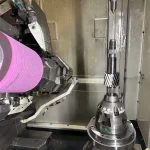
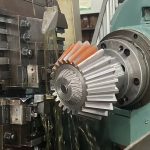
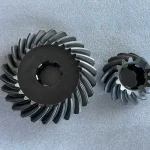
Abstract: Choosing the wrong spur gear supplier can lead to premature failures, unexpected downtime, inconsistent quality, and higher lifecycle costs. Whether you’re sourcing standard gears or custom precision spur gears, evaluating a manufacturer’s engineering capabilities is just as important as comparing prices. This guide explains the key factors buyers should assess before selecting a long-term manufacturing partner.
Why Choosing the Right Spur Gear Manufacturer Matters
 Selecting the right spur gear manufacturer is about much more than finding the lowest quotation among the gear market. The supplier you choose will directly affect gear performance, service life, production efficiency, and even the reliability of your final product.
Many companies listed online as spur gear suppliers are actually trading companies. While trading companies can simplify sourcing by offering products from multiple factories, they often have limited control over engineering, manufacturing processes, quality inspection, and delivery schedules. When technical issues arise, communication typically passes through multiple parties, which can slow problem-solving and increase project risk.
A true spur gear manufacturer, on the other hand, controls the entire production process—from engineering design and material selection to machining, heat treatment, inspection, and final testing. This level of control helps ensure consistent quality, shorter lead times, and faster technical support throughout the project.
For standard off-the-shelf gears, either option may be sufficient. However, if your project requires custom dimensions, tight tolerances, special materials, or high-performance applications, working directly with a manufacturer is usually the safer and more cost-effective choice.
Spur Gear Supplier vs. Spur Gear Manufacturer: What’s the Difference?
| Capability | Trading Company / Supplier | Spur Gear Manufacturer |
| Own production facility | Usually outsourced | In-house manufacturing |
| Engineering design support | Limited | Design optimization & DFM support |
| Material selection recommendations | Limited | Based on application requirements |
| Gear manufacturing processes | Outsourced | Full process control (hobbing, shaping, grinding, skiving, etc.) |
| Heat treatment capability | Depends on subcontractors | In-house or qualified controlled processes |
| Precision inspection equipment | Rare | Gear measuring center, CMM, hardness testing, etc. |
| Quality traceability | Limited | Material certificates, inspection reports, process records |
| Custom gear manufacturing | Limited flexibility | Prototype to mass production |
| Technical problem solving | Indirect communication | Direct access to engineers |
| Production lead time | Less predictable | Better scheduling and delivery control |
| Cost optimization | Additional intermediary margin | Lower total cost for custom projects |
Why Manufacturing Capability Matters
A spur gear’s performance depends not only on its design but also on how it is manufactured. In fact, even gears produced from the same drawing can perform very differently if manufacturing quality is inconsistent.
When evaluating a manufacturer, buyers should look beyond price and consider questions such as:
- Does the company manufacture gears in-house or outsource production?
- What gear manufacturing processes are available (hobbing, shaping, grinding, skiving, honing)?
- Can they recommend suitable materials and heat treatment for your application?
- What AGMA or DIN accuracy grades can they consistently achieve?
- What inspection equipment is used to verify tooth profile, lead, runout, and backlash?
- Can they provide material certificates, heat treatment reports, and dimensional inspection reports?
- Do they have experience producing gears for industries such as automotive, robotics, mining, marine, or industrial gearboxes?
A manufacturer with strong engineering and quality control capabilities is more likely to deliver gears that meet both drawing requirements and real-world operating conditions. In many cases, this reduces downtime, minimizes warranty risks, and lowers the total cost of ownership over the life of the equipment.
What Makes a Reliable Spur Gear Manufacturer?
Not all spur gear manufacturers offer the same level of engineering expertise, production capability, or quality control. A reliable manufacturing partner should be able to support your project from initial design through mass production while maintaining consistent quality, competitive lead times, and full process traceability.
The following capabilities are among the most important factors to evaluate before selecting a spur gear manufacturer.
Engineering Design Capability
Many buyers assume that providing a complete engineering drawing is enough for a manufacturer to start production. In reality, even well-prepared drawings may contain design choices that increase manufacturing costs or reduce gear life.
For example, we’ve seen projects where a small modification to the root fillet or face width significantly improved fatigue performance without increasing production cost.
This is where engineering capability becomes valuable.
Instead of simply machining according to a drawing, experienced manufacturers can evaluate whether the design is optimized for both manufacturing and long-term operation.
When assessing a manufacturer, ask whether they can support:
- Gear geometry calculation (module, pressure angle, tooth count, center distance, backlash)
- Gear strength analysis based on application loads
- Design optimization to improve load capacity, efficiency, and service life
- Design for Manufacturability (DFM) to reduce machining complexity and production cost
- AGMA and ISO/DIN design standards compliance
- Reverse engineering and design improvements for replacement gears
- Technical support during prototype development
Rather than simply manufacturing according to a drawing, experienced manufacturers often identify potential design improvements that enhance durability, reduce noise, or simplify production without compromising performance.
Manufacturing Processes
Two manufacturers may quote exactly the same drawing, yet produce gears with very different performance.
The reason often lies in how the gear is manufactured.
For example, differences in gear hobbing accuracy, heat treatment control, grinding quality, and inspection standards can all influence noise, backlash, and service life.
A reliable manufacturer should therefore have control over every critical manufacturing stage rather than relying on multiple subcontractors.
Depending on the application, additional processes such as gear shaving, skiving, lapping, or CNC machining may be incorporated to achieve tighter tolerances or improved tooth surface quality.
Manufacturers capable of performing multiple operations in-house generally maintain better quality consistency and shorter production lead times.
Material Selection
One of the most common mistakes buyers make is choosing gear material based solely on price.
For light-duty automation equipment, medium-carbon steels may be sufficient.
However, for mining equipment or heavy industrial gearboxes, carburizing steels such as 20MnCr5 or AISI 8620 are often preferred because they combine a hard wear-resistant surface with a tough core.
An experienced manufacturer should recommend materials according to torque, operating conditions, lubrication, and expected service life—not simply offer the cheapest available steel.
Common materials adopted by users include:
| Material | Typical Applications | Key Advantages |
| 20MnCr5 | Automotive transmissions, industrial gearboxes | Excellent carburizing properties and high fatigue strength |
| AISI 8620 | Heavy-duty industrial gears | Tough core with excellent case-hardening performance |
| AISI 4140 | Medium-duty machinery | Good strength without requiring deep case hardening |
| Stainless Steel | Food processing, marine, medical equipment | Corrosion resistance |
| Bronze | Worm gears and low-speed transmission | Excellent wear resistance and anti-seizure properties |
Experienced manufacturers should recommend reasonable gear materials based on actual operating conditions rather than selecting solely by cost.
Heat Treatment Capability
Heat treatment significantly influences gear hardness, wear resistance, fatigue strength, and service life. Even a precisely machined gear may fail prematurely if the heat treatment process is not properly controlled.
Common heat treatment processes include:
- Carburizing– Produces a hard wear-resistant surface while maintaining a tough core, making it ideal for heavily loaded transmission gears.
- Nitriding– Improves surface hardness with minimal distortion and is suitable for high-precision gears.
- Induction Hardening– Hardens selected tooth surfaces quickly and efficiently, often used for medium-sized production runs.
- Tempering– Relieves internal stresses and improves toughness after hardening.
Manufacturers should also be able to verify hardness depth, case depth, and heat treatment quality through standardized testing and provide corresponding inspection reports.
Precision and Quality Control
A gear may meet every dimension shown on a drawing yet still perform poorly in operation. Why? Because dimensional accuracy alone cannot fully describe gear quality.
Parameters such as tooth profile deviation, lead deviation, runout, and surface roughness all influence how smoothly two gears mesh together.
Typical inspection capabilities include:
- Coordinate Measuring Machine (CMM)
- CNC gear measuring center
- Tooth profile and lead measurement
- Pitch deviation inspection
- Runout measurement
- Backlash verification
- Surface roughness testing
- Hardness testing
- Material composition verification
Quality systems should comply with internationally recognized standards such as AGMA, DIN, or ISO 1328, depending on customer requirements.
Manufacturers should also be able to provide:
- Material certificates
- Heat treatment certificates
- Dimensional inspection reports
- Gear inspection reports
Comprehensive inspection documentation provides full traceability and gives buyers greater confidence in product quality.
Customization Capability
Many industrial applications require gears that cannot be sourced from standard catalogs. A manufacturer capable of producing custom spur gears tailored to specific operating requirements will be undoubtedly your preferred choice.
Customization capabilities may include:
- OEM and ODM manufacturing
- Prototype development and validation
- Low-volume and high-volume production
- Large-diameter spur gears
- Precision ground gears
- Internal and external spur gears
- Special tooth modifications
- Custom shafts or integrated gear assemblies
- Surface coatings and corrosion protection
- Special materials for high-temperature, corrosive, or heavy-duty environments
The ability to customize products enables manufacturers to support a wide range of industries, from robotics and automation to mining, marine, aerospace, and heavy machinery.
Production Capacity
Manufacturing capability extends beyond technical expertise. Reliable suppliers must also demonstrate stable production capacity and dependable delivery performance.
Important factors to evaluate include:
- Standard production lead times
- Prototype turnaround time
- Minimum Order Quantity (MOQ)
- Flexible batch production
- Emergency manufacturing capability
- Inventory management support
- Export packaging and international shipping experience
- Supply chain stability for raw materials and heat treatment
A manufacturer with efficient production planning and flexible capacity can respond more effectively to urgent orders, engineering changes, and fluctuations in demand, helping customers minimize downtime and maintain stable production schedules.
10 Questions to Ask Before Choosing a Spur Gear Supplier
In order to choose a right spur gear supplier, before placing an order, buyers should verify whether a supplier has the engineering expertise, manufacturing capabilities, and quality management systems required for their application.
The following questions can help you evaluate potential suppliers and reduce sourcing risks before production begins.
Do You Manufacture Spur Gears In-House?
Not every company advertising spur gears actually manufactures them. Some are trading companies that outsource production to third-party factories.
Working directly with a manufacturer generally provides better control over production quality, engineering communication, delivery schedules, and technical support. It also reduces the risk of inconsistent quality caused by multiple subcontractors.
Why it matters: Direct manufacturers typically offer better traceability, faster problem-solving, and more consistent quality.
What Manufacturing Processes Are Available?
Different applications require different manufacturing methods. Ask whether the supplier can perform processes such as gear hobbing, shaping, grinding, honing, skiving, or lapping, and whether these operations are completed in-house or outsourced.

Manufacturing capability directly influences gear accuracy, surface finish, and production flexibility.
Why it matters: A broader range of manufacturing processes allows the supplier to recommend the most suitable production route instead of forcing every project into the same process.
What Gear Accuracy Can You Consistently Achieve?
Rather than asking whether a manufacturer can produce “high-precision gears,” request measurable specifications.
Useful questions include:
- What AGMA or DIN quality grades do you regularly manufacture?
- What tolerances can you consistently maintain?
- How are profile, lead, and runout verified?
Why it matters: Consistent accuracy is more valuable than claiming the ability to achieve an exceptionally high grade on only a few parts.
You Recommend the Appropriate Material and Heat Treatment?
Material selection and heat treatment should be based on the gear’s operating conditions—not simply copied from previous projects.
A knowledgeable manufacturer should explain:
- Which material is most suitable for the application?
- Whether carburizing, nitriding, or induction hardening is recommended?
- How the selected process will improve wear resistance and fatigue life?
Why it matters: Incorrect material or heat treatment is one of the leading causes of premature gear failure.
What Inspection Equipment and Reports Do You Provide?
Quality should be supported by measurable inspection data rather than visual inspection alone.
Ask whether the supplier can provide:
- Gear inspection reports
- Material certificates
- Heat treatment certificates
- CMM reports
- Tooth profile and lead inspection data
- Runout measurements
Why it matters: Inspection reports provide objective evidence that the finished gear meets the specified requirements.
Can You Produce Prototypes Before Mass Production?
For custom gears, prototype manufacturing helps verify fit, performance, and manufacturability before committing to volume production.
Ask whether the supplier can support:
- Prototype machining
- Small-batch production
- Design modifications based on testing results
Why it matters: Early validation reduces the risk of costly design changes during mass production.
Do You Perform Gear Meshing or Functional Testing?
Dimensional inspection alone does not always guarantee satisfactory gear performance.
Some manufacturers also offer:
- Gear meshing tests
- Contact pattern inspection
- Noise and vibration evaluation
- Backlash verification under assembly conditions
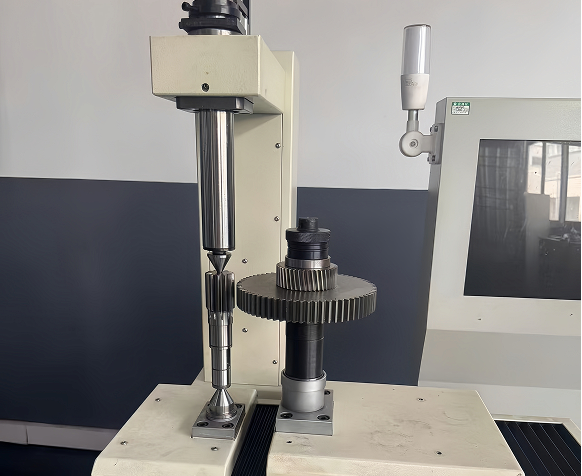
These tests are particularly valuable for high-speed, precision, or low-noise applications.
Why it matters: Functional testing helps identify potential assembly or transmission issues before the gears reach the customer.
What Is Your Typical Lead Time and Production Capacity?
Reliable delivery is just as important as manufacturing quality.
Questions to ask include:
- What is the standard production lead time?
- Can urgent orders be accommodated?
- What is the minimum order quantity (MOQ)?
- Can production be scaled as demand increases?
Why it matters: A supplier with flexible production capacity is better equipped to support changing project requirements and avoid supply chain disruptions.
Can You Support Reverse Engineering or Design Optimization?
Many replacement gear projects begin with worn components rather than complete engineering drawings.
Experienced manufacturers should be able to:
- Reverse engineer existing gears
- Optimize designs for improved performance
- Recommend manufacturing improvements
- Reduce production costs through Design for Manufacturability (DFM)
Why it matters: Engineering support can improve gear performance instead of simply reproducing an existing design.
Do You Have Experience in My Industry?
Manufacturing a gear is one thing; understanding its application is another.
Ask whether the supplier has experience in industries such as:
- Automotive transmissions
- Robotics and automation
- Mining equipment
- Marine propulsion systems
- Agricultural machinery
- Industrial gearboxes
- Renewable energy equipment
Application-specific experience often helps manufacturers anticipate operating conditions, recommend suitable materials, and identify potential design risks.
Why it matters: Industry experience reduces the learning curve and increases the likelihood of selecting the right manufacturing solution from the beginning.
Avoid These Common Mistakes When Sourcing Spur Gears
While price is an important consideration, many sourcing problems arise because critical technical factors are overlooked during supplier evaluation.
Below are some of the most common mistakes buyers make—and how to avoid them.
Choosing the Lowest Price Without Evaluating Total Cost
It’s natural to compare quotations, but the lowest unit price doesn’t always result in the lowest overall cost.
A lower-priced gear may use different materials, simplified machining processes, or less stringent quality control. These cost reductions may not be obvious during purchasing but can lead to premature wear, increased maintenance, unexpected downtime, or even complete gearbox failure after installation.
Instead of asking “Who offers the lowest price?”, buyers should also ask:
- What manufacturing processes are included?
- What material and heat treatment are specified?
- Are inspection reports included?
- What quality grade is guaranteed?
Best practice: Compare the total value of the manufacturing solution rather than the purchase price alone.
Assuming All Spur Gear Suppliers Are Manufacturers
Many companies promote themselves as gear suppliers, but not all own manufacturing facilities. Some source gears from multiple factories and act primarily as intermediaries.
While trading companies can be suitable for standard products, custom gears often require direct communication with engineers, process adjustments, and rapid technical feedback—areas where manufacturers typically have an advantage.
Before placing an order, confirm:
- Do you manufacture gears in-house?
- Which processes are outsourced?
- Who is responsible for quality control?
- Can I communicate directly with your engineering team?
Best practice: Understand the supplier’s role in the supply chain before evaluating quotations.
Ignoring Heat Treatment Specifications
Many buyers focus on gear dimensions while paying little attention to heat treatment.
However, heat treatment determines critical properties such as surface hardness, wear resistance, fatigue strength, and service life. Two gears produced from the same material may perform very differently if their heat treatment processes differ.
For example, an industrial gearbox operating under heavy loads may require carburizing with a controlled case depth, while a precision positioning system may benefit more from nitriding because it minimizes distortion.
A buyer selected the lowest quotation for a batch of industrial spur gears. After six months of operation, excessive tooth wear led to unexpected downtime. An investigation showed that the gears had been manufactured from the specified steel, but the carburized case depth was significantly shallower than required. The initial savings were quickly outweighed by replacement costs and production losses.
Best practice: Ask the manufacturer not only what heat treatment will be used, but also why it is recommended for your application.
Overlooking Inspection and Quality Documentation
Receiving a gear that matches the drawing does not always guarantee satisfactory performance.
Without proper inspection, deviations in tooth profile, lead, runout, or hardness may remain undetected until assembly or field operation.
A reliable manufacturer should be able to provide objective quality documentation, such as:
- Gear inspection reports
- Material certificates
- Heat treatment certificates
- CMM reports
- Tooth profile and lead measurements
Best practice: Request inspection reports before shipment rather than relying solely on visual inspection or supplier assurances.
Not Confirming the Required Gear Accuracy Grade
Many RFQs specify dimensions but omit the required gear quality grade.
Without defining an AGMA, DIN, or ISO accuracy requirement, different manufacturers may interpret the same drawing differently, leading to inconsistent quotations and product performance.
Higher accuracy is not always necessary—but the required quality level should match the application’s speed, load, noise requirements, and operating conditions.
Best practice: Specify the required gear grade whenever possible, or ask the manufacturer to recommend an appropriate accuracy level based on the intended application.
Choosing a Supplier Without Industry Experience
Manufacturing a spur gear is only part of the challenge. Understanding how that gear operates in its intended application is equally important.
A supplier experienced in mining equipment, robotics, marine propulsion, or automotive transmissions is more likely to recommend suitable materials, heat treatment, lubrication, and inspection methods for those environments.
For example, a gear used in a high-speed gearbox has very different design priorities from one operating in heavy-duty mining machinery.
Best practice: Ask whether the manufacturer has completed similar projects in your industry and request examples or case studies where appropriate.
Failing to Evaluate Long-Term Technical Support
Supplier evaluation should not end when the gears are delivered.
Engineering changes, replacement parts, quality improvements, and troubleshooting may all arise during the product lifecycle. Manufacturers with responsive engineering teams can often resolve these issues much faster than suppliers that rely entirely on subcontractors.
Questions worth asking include:
- Can you support engineering modifications?
- Do you offer reverse engineering services?
- Can replacement gears be manufactured years later using the same quality standards?
- How do you handle quality issues after delivery?
Best practice: View your gear manufacturer as a long-term engineering partner rather than a one-time supplier.
How to Choose the Right Spur Gear for Different Applications
Selecting a spur gear is more than a matter of matching the correct module or number of teeth. Every application places different demands on load capacity, operating speed, positioning accuracy, environmental conditions, and expected service life.
A gear that performs well in an agricultural machine may not be suitable for a high-speed robotic system, while a gear designed for mining equipment could be unnecessarily expensive for light-duty automation.
Instead of choosing a standard gear by specification alone, buyers should consider the application’s operating conditions and work with a manufacturer that can recommend the most appropriate material, manufacturing process, heat treatment, and accuracy grade.
The following examples illustrate how spur gear requirements vary across industries.
Robotics and Automation
Robotics places a strong emphasis on positioning accuracy, repeatability, compact design, and low operating noise. Even minor gear errors can affect motion precision and reduce the overall performance of the system.
When selecting spur gears for robotics projects, buyers should prioritize:
- High gear accuracy (DIN 6–7 or equivalent, depending on application)
- Precision grinding or honing for smoother tooth engagement
- Low backlash where positioning accuracy is critical
- Lightweight materials or compact gear designs
- Stable heat treatment with minimal distortion
- Consistent inspection of tooth profile and lead
For collaborative robots, automated production lines, and precision positioning equipment, choosing a manufacturer with experience in high-precision gears is often more important than selecting the lowest-cost supplier.
Mining and Heavy Equipment
Mining equipment operates under heavy loads, continuous shock, abrasive environments, and demanding service conditions.

Key selection priorities include:
- High-strength alloy steels such as 20MnCr5 or AISI 8620
- Deep carburizing for improved wear resistance
- Optimized tooth geometry to increase load capacity
- High core toughness to resist impact loading
- Strict quality inspection to minimize the risk of unexpected failures
In these applications, durability and reliability generally outweigh cosmetic appearance or ultra-high precision.
Automotive and Transmission Systems
Automotive gears must achieve an effective balance between strength, efficiency, noise control, and production consistency.
Important considerations include:
- Tight dimensional tolerances
- Controlled tooth profile modifications
- Low transmission noise
- High fatigue resistance
- Consistent quality in large production volumes
- Compliance with automotive quality standards
For transmission components, even small deviations in profile or lead can influence NVH (Noise, Vibration, and Harshness) performance.
Agricultural Machinery
Agricultural equipment often operates outdoors in dusty, muddy, and humid environments while experiencing frequent load variations.

Suitable spur gears typically require:
- Good wear resistance
- Corrosion protection where necessary
- Cost-effective materials for high-volume production
- Reliable heat treatment
- Robust tooth design capable of handling intermittent shock loads
Ease of maintenance and replacement is also an important consideration for equipment operating in remote locations.
Wind Energy Equipment
Wind turbines demand long service life and exceptional reliability because maintenance is expensive and often difficult.
When selecting gears for renewable energy applications, manufacturers should be capable of providing:
- High-strength materials
- Advanced heat treatment
- Excellent fatigue resistance
- Comprehensive inspection documentation
- Stable manufacturing consistency
- Full material and process traceability
Although many wind turbine gearboxes primarily use helical or planetary gears, spur gears are still employed in auxiliary drive systems and supporting transmission mechanisms.
Food Processing Equipment
Food industry applications require gears that not only transmit power efficiently but also meet strict hygiene and corrosion-resistance requirements.
Selection criteria often include:
- Stainless steel or food-grade engineering plastics
- Smooth surface finishes for easier cleaning
- Corrosion-resistant materials
- Lubrication compatible with food-processing environments
- Reliable dimensional accuracy for continuous operation
Manufacturers supplying food machinery should also understand the industry’s cleanliness and material compliance requirements.
Application Selection Summary
The optimal spur gear depends on the operating environment rather than a single “best” material or manufacturing process. Working with an experienced manufacturer allows buyers to balance precision, durability, cost, and production efficiency according to their specific application.
| Application | Primary Requirements | Recommended Manufacturing Focus |
| Robotics & Automation | High precision, low backlash, low noise | Precision grinding, strict inspection, controlled heat treatment |
| Mining Equipment | Heavy loads, wear resistance, impact strength | Alloy steel, carburizing, optimized tooth strength |
| Automotive | Noise reduction, fatigue life, production consistency | Profile modification, precision machining, quality traceability |
| Agricultural Machinery | Durability, cost-effectiveness, outdoor reliability | Robust design, reliable heat treatment, corrosion protection |
| Wind Energy | Long service life, reliability, traceability | High-strength materials, comprehensive inspection, fatigue resistance |
| Food Processing | Hygiene, corrosion resistance, clean operation | Stainless steel or engineering plastics, precision finishing |
Why Choose Belon as Your Spur Gear Manufacturing Partner
How to choose a spur gear manufacturer is ultimately about finding a partner that can consistently deliver reliable products—not just competitive quotations. Throughout this guide, we’ve discussed the factors that matter most when evaluating a supplier, including engineering expertise, manufacturing capability, quality control, material selection, and production reliability.
At Belon, these principles are integrated into every stage of the manufacturing process to help our customers reduce sourcing risks and achieve consistent gear performance.
Engineering Support Beyond Manufacturing
In many projects, customers require engineering support to improve manufacturability, optimize gear performance, or solve issues identified during production. Belon works closely with customers during the early stages of product development by providing support for:
- Design for Manufacturability (DFM)
- Material recommendations based on operating conditions
- Heat treatment selection
- Gear geometry optimization
- Reverse engineering of replacement gears
- Prototype development before mass production
Rather than simply manufacturing to print, our engineering team aims to identify practical improvements in order to help customers achieve better performance, longer service life, and lower manufacturing costs.
Comprehensive Manufacturing and Inspection Capabilities
Reliable gear quality depends on maintaining control throughout the manufacturing process.
Belon’s production capabilities cover the complete manufacturing workflow, including gear cutting, CNC machining, heat treatment coordination, precision finishing, and final inspection.
To verify product quality, inspection equipment and quality procedures are used throughout production, including:
- Gear measuring systems for profile, lead, pitch, and runout inspection
- Coordinate Measuring Machines (CMM)
- Hardness testing
- Material verification
- Dimensional inspection
- Complete inspection reports upon request

These inspection processes provide traceability and help ensure that finished gears meet customer specifications before shipment.
Material and Heat Treatment Expertise
Different applications require different combinations of strength, wear resistance, toughness, and corrosion resistance.
Belon supports a wide range of gear materials, including carburizing steels, alloy steels, stainless steels, bronze, and engineering plastics, while recommending suitable heat treatment processes according to the application’s operating conditions.
Depending on project requirements, available heat treatment solutions may include:
- Carburizing
- Nitriding
- Induction hardening
- Through hardening
- Tempering
Rather than applying a standard process to every gear, material and heat treatment recommendations are selected to balance performance, service life, manufacturability, and cost.
Flexible Production from Prototype to Volume Manufacturing
Every project has different production requirements.
Some customers require a single prototype for validation, while others need stable, high-volume production with repeatable quality.
Belon supports a wide range of production needs, including:
- Prototype manufacturing
- Low-volume production
- Medium and large production batches
- Custom gear assemblies
- Urgent production requests, where feasible
This flexibility enables customers to move efficiently from product development to full-scale manufacturing while working with a single manufacturing partner.
Experience Across Multiple Industries
Different industries present different engineering challenges.
Over the years, Belon has supplied custom gears for a variety of industrial applications, including:
- Industrial gearboxes
- Construction and mining equipment
- Agricultural machinery
- Robotics and automation
- Marine transmission systems
- Energy equipment
Experience across multiple industries enables the engineering team to better understand application-specific requirements, recommend appropriate manufacturing processes, and anticipate potential performance challenges during product development.
Global Export Experience and Quality Assurance
Supplying gears internationally requires more than manufacturing capability. It also demands consistent communication, reliable documentation, and quality systems that meet customer expectations.
Belon supports international customers by providing:
- Material certificates
- Heat treatment reports
- Inspection documentation
- Export packaging
- Technical communication in English
- Support throughout the manufacturing process
Depending on customer requirements, quality management systems and manufacturing procedures are implemented to ensure products meet applicable international standards and project specifications.
A Manufacturing Partner Focused on Long-Term Cooperation
Rather than acting solely as a component supplier, Belon aims to build long-term partnerships by combining engineering support, manufacturing expertise, and consistent quality throughout the product lifecycle.
Whether you’re developing a new transmission system, replacing an existing gear, or sourcing a reliable manufacturing partner for future production, our team is ready to discuss your project and recommend a manufacturing solution tailored to your application.
Ready to Discuss Your Spur Gear Project?
To help us recommend the most suitable manufacturing solution, please prepare the following information when requesting a quotation:
- Gear drawing or 3D model
- Module and number of teeth
- Material requirements (if known)
- Heat treatment requirements
- Required quantity
- Application and operating conditions
- Accuracy grade (AGMA/DIN/ISO)
- Expected delivery schedule
FAQ
Q1: What is a spur gear?
A spur gear is the simplest and most widely used type of cylindrical gear. It features straight teeth cut parallel to the gear shaft and transmits power between two parallel shafts with high efficiency and a constant speed ratio.
Because of their simple geometry, spur gears are easy to manufacture, cost-effective, and capable of transmitting high torque under moderate operating speeds. They are commonly used in industrial gearboxes, machine tools, conveyors, agricultural equipment, robotics, and automotive systems.
However, as the teeth engage suddenly during operation, spur gears generally generate more noise and vibration than helical gears, particularly at high rotational speeds.
Related guide: If you’re selecting a supplier for custom spur gears, engineering capability, manufacturing precision, and quality inspection are just as important as the gear design itself.
Q2: How are spur gears manufactured?
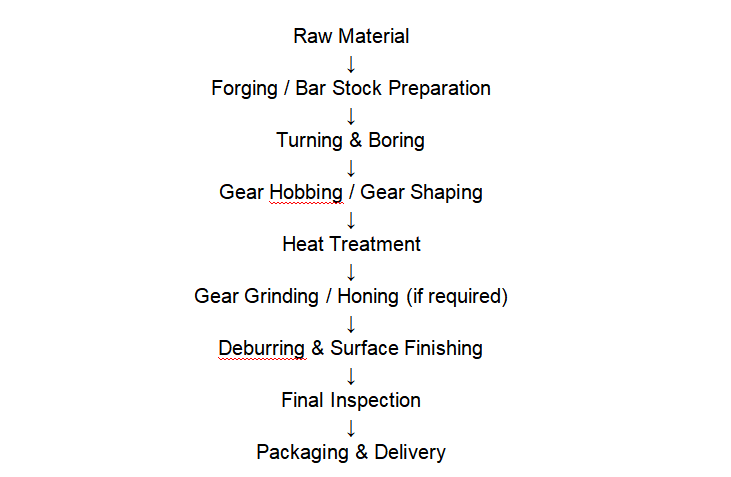
Spur gears are manufactured through a series of precision machining and finishing processes designed to achieve the required strength and accuracy.
A typical manufacturing workflow includes:
- Material preparation (forging or bar stock)
- Turning and boring
- Gear hobbing or gear shaping
- Heat treatment (such as carburizing or nitriding)
- Gear grinding or honing (when higher precision is required)
- Quality inspection
- Final cleaning and packaging
The exact process depends on factors such as gear size, accuracy grade, material, production volume, and application.
For high-performance gears, manufacturers also perform inspections such as tooth profile measurement, lead measurement, runout testing, hardness testing, and dimensional verification to ensure the finished gear meets design specifications.
Q3: Are spur gears stronger than helical gears?
Not necessarily. The strength of a gear depends on multiple factors, including material, heat treatment, tooth geometry, manufacturing quality, and operating conditions.
In general:
- Spur gears have higher mechanical efficiency because there is no axial thrust during power transmission.
- Helical gears usually provide greater load-carrying capacity because multiple teeth are engaged simultaneously.
- Helical gears also operate more smoothly and quietly, making them better suited for high-speed applications.
Spur gears remain an excellent choice for applications requiring simple construction, high efficiency, easy maintenance, and cost-effective manufacturing, while helical gears are often preferred where noise reduction and heavy-load operation are priorities.
The best choice depends on your specific application rather than one gear type being universally stronger.
Q4: What causes spur gear failure?
Spur gear failure is usually the result of several interacting factors rather than a single defect.
Some of the most common causes include:
- Inadequate lubrication
- Incorrect material selection
- Improper heat treatment
- Excessive loading or shock loading
- Poor gear alignment
- Manufacturing inaccuracies
- Surface fatigue and pitting
- Tooth bending fatigue
- Contamination or abrasive wear
Many failures that appear to be “gear problems” actually originate from poor installation, insufficient lubrication, or operating conditions beyond the original design limits.
Working with an experienced manufacturer that provides appropriate material selection, heat treatment recommendations, and inspection reports can significantly reduce the likelihood of premature gear failure.
Q5: Where are spur gears commonly used?
Spur gears are widely used wherever reliable power transmission between parallel shafts is required.
Typical applications include:
- Industrial gearboxes
- Robotics and factory automation
- Automotive transmission components
- Agricultural machinery
- Construction and mining equipment
- Machine tools
- Packaging machinery
- Material handling systems
- Food processing equipment
- Pumps and conveyors
Their simple design, high transmission efficiency, and relatively low manufacturing cost make spur gears one of the most versatile gear types across a wide range of industries.
When selecting a spur gear for a specific application, factors such as operating speed, torque, noise requirements, environmental conditions, and expected service life should all be considered to ensure optimal performance.
Q6: How do I choose a reliable spur gear manufacturer?
Choosing a reliable spur gear manufacturer involves much more than comparing prices. The best supplier should combine strong engineering expertise, proven manufacturing capabilities, rigorous quality control, and the ability to support your project throughout its entire lifecycle.
When evaluating potential manufacturers, consider the following factors:
- Engineering expertise– Can they optimize your design, recommend suitable materials, or provide reverse engineering support?
- Manufacturing capabilities– Do they perform key processes such as gear hobbing, grinding, heat treatment, and finishing in-house or through controlled partners?
- Quality assurance– Can they provide AGMA, DIN, or ISO-compliant inspection reports, material certificates, and heat treatment documentation?
- Customization– Are they capable of producing prototypes, low-volume orders, and fully customized gears to meet your application requirements?
- Industry experience– Have they manufactured spur gears for applications similar to yours, such as robotics, automotive, mining, or industrial gearboxes?
- Delivery and technical support– Can they offer reliable lead times, responsive engineering communication, and long-term support after delivery?
Rather than selecting a supplier based solely on the lowest quotation, evaluate their ability to consistently deliver gears that meet your performance, quality, and reliability requirements. A manufacturer with strong technical capabilities can often reduce long-term operating costs by improving gear performance, minimizing downtime, and ensuring consistent product quality.
For a more detailed evaluation process, refer to the “10 Questions to Ask Before Choosing a Spur Gear Supplier” checklist earlier in this guide. It provides a practical framework for comparing manufacturers before requesting a quotation.