

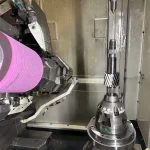
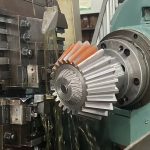
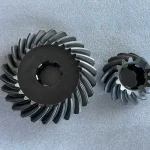
Abstract: Recently, Belon welcomed a professional gearbox maintenance and transmission service company from Southeast Asia. The visit focused on discussing worm gear meshing performance, gearbox repair challenges, and quality verification methods for replacement worm gear sets.
Common Technical Challenges in Worm Gear Repair Projects
During the visit, the technical teams from both Belon and our Thai partner engaged in an in-depth discussion regarding the common pain points encountered in industrial gearbox maintenance and worm gear repair projects. When industrial gearboxes operate under heavy loads, high temperatures, and continuous duty cycles, the worm gear set becomes a critical wear component.
By analyzing real-world failure modes brought up by our Thai partner, both engineering teams summarized four major technical challenges that must be addressed during any replacement or repair project to ensure long-term transmission reliability:
1. Abnormal Tooth Wear on Worm Wheels
Worm gear drives naturally experience substantial sliding friction during operation. In many repair cases, excessive or premature wear is frequently observed on the copper worm wheel teeth.
- The Root Cause: This abnormal wear is often accelerated by localized high stress, misaligned assembly, or the degradation of the lubricant film between the mating surfaces.
- The Impact: Excessive wear alters the original tooth profile geometry, leading to a rapid drop in load-carrying capacity and severely shortening the gearbox’s residual service life.
2. Uneven Tooth Contact Patterns
Achieving an optimal worm gear contact pattern is one of the most sophisticated aspects of gearbox assembly, and it was a primary focus of our technical exchange.
- The Root Cause: In broken or poorly maintained gearboxes, the contact area between the worm shaft and worm wheel often shifts away from the center, becoming highly localized at the tooth edges or ends. This is typically caused by housing deformation, manufacturing deviations, or cumulative assembly errors.
- The Impact: Instead of distributing the torque evenly across the entire tooth surface, localized contact creates extreme stress concentrations. This mismatch dramatically accelerates surface pitting, tooth deformation, and premature gear failure.
3. Excessive Backlash Control
Backlash is a critical parameter in worm gear drives, required to accommodate thermal expansion and allow space for lubricating oil films. However, controlling excessive backlash is a major challenge in rebuild projects.
- The Root Cause: Backlash typically increases due to progressive tooth thickness wear over long-term operations, or because replacement gears were not machined to precise pitch and lead tolerances.
- The Impact: Excessive clearance leads to rotational slop, vibration, and severe impact loading during start-stops or reversals. For applications requiring precise positioning or smooth power transmission, uncontrolled backlash compromises the entire system’s stability.
4. Overheating and Transmission Efficiency Losses
Unlike spur or helical gears, worm gear sets rely heavily on sliding contact rather than rolling contact, making them inherently prone to heat generation.
- The Root Cause: When meshing conditions are poor—whether due to inaccurate center distance dimensions, mismatched tooth profiles, or improper material combinations—the sliding friction increases exponentially.
- The Impact: This extra friction leads to severe thermal buildup and overheating, which quickly thermal-degrades the gear oil and thins the protective lubricant film. Consequently, a vicious cycle of increased wear and reduced transmission efficiency occurs, leading to high energy losses for the end-user.
Critical Factors Affecting Worm Gear Performance
Achieving smooth and efficient worm gear operation depends on several critical design and manufacturing factors.
- Center Distance Accuracy: The center distance between the worm shaft and worm wheel directly affects the contact pattern and backlash. Even small deviations can alter load distribution and reduce meshing quality.
- Tooth Profile Accuracy: Accurate tooth geometry is essential for smooth engagement. Errors in tooth profile can create localized contact points, increasing stress concentration and reducing transmission efficiency.
- Lead Accuracy of the Worm Shaft: Because the worm shaft acts similarly to a screw mechanism, lead accuracy plays a vital role in achieving consistent tooth engagement. Precision-ground worm shafts typically provide better meshing performance and longer service life.
- Material Matching: Material selection significantly influences wear resistance and durability. A common combination consists of a tin bronze worm wheel paired with a hardened alloy steel worm shaft, providing excellent anti-wear characteristics and reliable long-term operation.
- Lubrication Quality: Proper worm gear lubrication is essential because worm gear drives rely heavily on sliding contact. High-quality lubricants reduce friction, minimize heat generation, and help maintain a stable oil film between mating surfaces.
When these factors are properly controlled, a precision worm gear set can deliver smooth operation, high efficiency, and extended service life even in demanding industrial applications.
Inside Belon’s Worm Gear Manufacturing Process
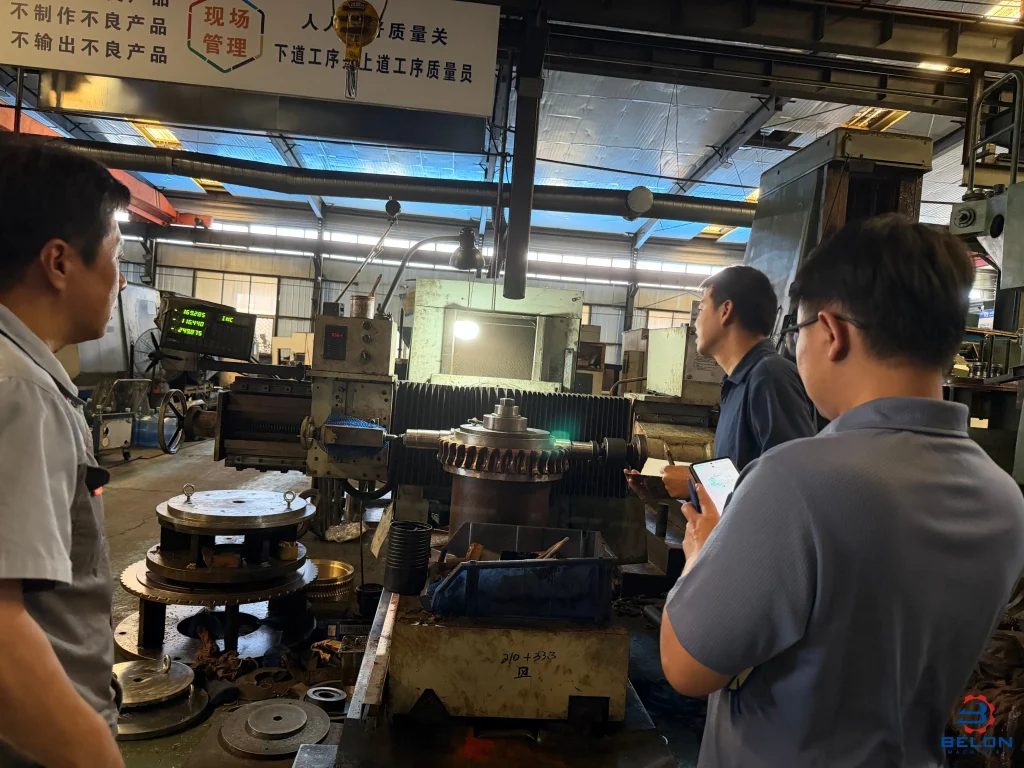
As part of the visit, the customer toured Belon’s production facility to gain a deeper understanding of our worm gear manufacturing process, quality control procedures, and machining capabilities. The discussion focused on how manufacturing accuracy, material selection, and inspection standards contribute to reliable worm gear meshing performance.
From Raw Material to Finished Worm Gear
Producing a high-quality worm gear set requires strict control throughout the entire manufacturing process. Every step influences the final meshing accuracy, load distribution, and service life of the gearbox.
At Belon, the typical production process includes:
Raw Material Selection → Rough Machining → Heat Treatment → Finish Machining → Grinding → Final Inspection


For worm wheel production, material quality and dimensional stability are carefully monitored from the beginning. After rough machining, critical components undergo heat treatment to achieve the required mechanical properties. Precision finish machining and grinding operations are then performed to ensure the accuracy of the final gear geometry.

By maintaining strict process control, we are able to provide reliable custom worm gear manufacturing solutions for industrial gearbox repair and replacement projects.

Precision Grinding of Worm Shafts
The worm shaft is one of the most critical components in a worm gear set, directly affecting tooth contact, transmission efficiency, and operating smoothness.
At Belon, worm shafts are manufactured from high-quality alloy steel and undergo precision grinding after heat treatment. This process significantly improves:
- Lead accuracy
- Tooth profile accuracy
- Surface finish quality
- Meshing consistency
Depending on application requirements, ground worm shafts can typically achieve ISO 6–7 accuracy, ensuring stable engagement with the mating worm wheel.
High-precision worm shaft grinding helps minimize transmission errors, reduce vibration, and improve gearbox reliability, especially in demanding industrial applications.
Heat Treatment and Material Control
Material selection and heat treatment play a vital role in the performance and durability of worm gear systems.
A common material combination consists of:
Worm Wheel
- High-strength tin bronze
- Excellent anti-friction properties
- Superior wear resistance
- Good compatibility with hardened steel worms

Worm Shaft
- 8620 alloy steel or equivalent
- High core toughness
- Excellent carburizing capability
- Suitable for precision grinding

To achieve the desired hardness and wear resistance, alloy steel worm shafts typically undergo carburizing, quenching, and tempering processes. Strict hardness control helps ensure both surface durability and core strength, allowing the gear set to withstand long-term operating loads.
Combined with precision machining and inspection, proper gear heat treatment significantly improves service life and meshing performance.
Quality Inspection and Meshing Verification
Reliable worm gear performance depends not only on precision manufacturing but also on comprehensive inspection and testing. During the factory tour, the customer visited Belon’s quality control center to observe how critical dimensions, tooth geometry, and meshing performance are verified before shipment.
Through advanced inspection equipment and strict quality procedures, every worm gear set is thoroughly evaluated to ensure it meets design specifications and application requirements.
Dimensional Inspection
Accurate dimensions are the foundation of proper worm gear meshing. Even small deviations in tooth geometry or shaft dimensions can affect contact patterns, backlash, and transmission efficiency.
At Belon, precision inspection is performed throughout the manufacturing process using advanced measurement equipment, including:
- Coordinate Measuring Machine (CMM)
- Gear Measuring Center
- Profile and Lead Measurement Systems
- Hardness Testing Equipment

These inspection systems verify critical parameters such as:
- Tooth profile accuracy
- Lead accuracy
- Pitch accuracy
- Runout control
- Center distance dimensions
By combining precision machining with comprehensive gear inspection procedures, we ensure that every component meets the required tolerance standards before proceeding to final assembly and testing.
Worm Gear Meshing Test Before Delivery
Dimensional accuracy alone cannot fully guarantee transmission performance. For this reason, Belon places special emphasis on worm gear meshing tests before shipment.
Every worm gear set undergoes meshing verification to evaluate the actual interaction between the worm shaft and worm wheel under assembly conditions.
The meshing verification process typically includes:
- Contact pattern inspection
- Backlash verification
- Rotational smoothness assessment
- Noise and vibration evaluation
- Functional running test
Because worm gear drives rely heavily on sliding contact, proper tooth engagement is critical for achieving high efficiency and long service life. Meshing tests help identify potential issues before delivery and provide additional assurance that the gear set will perform reliably in service.
For gearbox repair and replacement projects, this verification step is especially important because it helps reduce installation risks and ensures compatibility with the customer’s operating requirements.
Every worm gear set undergoes meshing verification before shipment, reflecting our commitment to product quality and transmission reliability.
Strengthening Future Cooperation
The visit provided an excellent opportunity for both teams to exchange technical knowledge and discuss practical solutions for gearbox repair and worm gear replacement projects. Through in-depth discussions on worm gear meshing performance, manufacturing processes, and quality verification methods, both parties gained valuable insights into improving gearbox reliability and long-term operating performance.
During the factory tour, the customer had the opportunity to observe Belon’s integrated production capabilities, including machining, heat treatment, precision grinding, inspection, and meshing verification. The visit also allowed for a deeper understanding of how strict process control contributes to consistent product quality and dependable transmission performance.
As industrial equipment continues to demand higher reliability and longer service life, close cooperation between gearbox service providers and gear manufacturers becomes increasingly important. Technical collaboration helps ensure that replacement gears are not only manufactured to specification but also optimized for actual operating conditions and maintenance requirements.
Belon remains committed to supporting customers worldwide with custom gear solutions, precision manufacturing expertise, and comprehensive engineering support. We look forward to continuing technical exchanges and working together to develop reliable transmission solutions for future gearbox repair, maintenance, and upgrade projects.

Need Custom Worm Gear Solutions?
Belon specializes in custom worm gears, worm wheels, and complete gear transmission solutions for gearbox repair and industrial equipment applications. Contact our engineering team for technical consultation, manufacturing support, or replacement gear development.
FAQ
Q1: What causes worm gear meshing problems?
Worm gear meshing problems are typically caused by improper tooth contact, excessive backlash, inaccurate center distance, manufacturing errors, or inadequate lubrication. Over time, wear on the worm wheel and worm shaft can also affect load distribution and transmission efficiency. At Belon, we minimize these risks through precision machining, controlled assembly tolerances, and pre-shipment meshing verification to ensure smooth and reliable gear engagement.
Q2: How do you check a worm gear contact pattern?
A worm gear contact pattern is inspected by applying marking compound to the gear teeth and rotating the gear set under controlled conditions. The resulting contact area shows how the load is distributed across the tooth surface. An ideal contact pattern should be centered and evenly distributed. At Belon, contact pattern inspection is performed together with backlash measurement and meshing tests to verify proper gear engagement before delivery.
Q3: Why is a worm gear meshing test necessary?
A worm gear meshing test verifies the actual interaction between the worm shaft and worm wheel under assembly conditions. It helps identify potential issues such as poor contact patterns, excessive backlash, abnormal noise, or vibration before installation. At Belon, every worm gear set undergoes meshing verification before shipment to ensure smooth operation, reliable load transfer, and long service life in gearbox applications.
Q4: What is the best material for a worm gear and worm shaft?
A common material combination is a tin bronze worm wheel paired with a carburized and ground 8620 alloy steel worm shaft. The bronze gear provides excellent wear resistance and anti-friction properties, while the hardened steel worm offers high strength and durability. At Belon, worm wheels are typically manufactured to ISO 8 accuracy, while worm shafts are precision ground to ISO 6–7 accuracy for optimal meshing performance and transmission efficiency.