

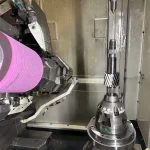
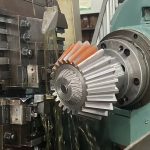
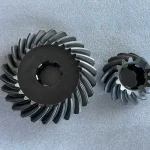
Abstract: Forged gears are widely used in demanding industrial applications because of their superior strength, fatigue resistance, and long service life. This guide explains how forged gears are made, compares forging with casting and machining, explores suitable materials, and highlights why forging remains the preferred solution for high-performance transmission systems.
What is gear forging?

Forged transmission gear production process shapes solid metal blanks into high-strength gears using localized compressive forces, which aligns the internal grain flow to provide superior fatigue resistance compared to casting or machining.
Definition of the Forging Process
Gear blank forging is a manufacturing method where metal is shaped through localized compressive forces. Unlike cutting, this process reformats the metal in a solid, heated state to achieve the desired gear geometry. The mechanical deformation of the steel eliminates internal porosities, resulting in a dense, metallurgically sound gear blank engineered for high-stress environments.
How does gear forging work?
See the actual gear forging process in action below, where heated steel blanks are shaped under controlled compressive force to form high-strength gear preforms with optimized grain flow.
Forging vs. Casting: Which is better for gears?
For industrial applications, forging is the superior choice over casting for durability and safety. While casting can lead to internal defects like shrinkage, forging maintains the metal’s solid state, ensuring higher structural integrity. The key advantage is grain flow alignment; in a precision forged gear, the internal structure follows the tooth contour, significantly increasing resistance to impact and fatigue.
| Feature | Gear Forging | Gear Casting |
| Strength | Superior; aligned grain flow for high fatigue. | Moderate; random structure; lower impact resistance. |
| Complexity | Low; limited to simpler geometries. | High; ideal for intricate shapes and internal voids. |
| Size | Limited; best for compact, uniform parts. | Unlimited; best for massive and heavy components. |
| Cost | Higher initial tooling; best for mass production. | Lower initial cost; economical for small/medium runs. |
| Material | Ductile metals only (e.g., carbon/alloy steel). | Broad variety (e.g., iron, SS, nickel alloys). |
How are forged gears made? (Step-by-Step Process)
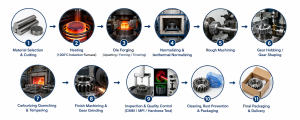
Forged gears are manufactured through a controlled thermal and mechanical process: first, a metal billet is heated to its optimal forging temperature to increase plasticity; then, it is subjected to immense pressure between precision-engineered dies to create the gear form; finally, the component undergoes trimming and finishing to remove flash and achieve exact dimensional tolerances.
Figure 1. Step-by-step industrial gear forging workflow
Selecting High-Quality Steel per ASTM Standards
Selecting the right gear material is a critical engineering decision based on three primary factors: Load requirements (torque and impact), Operating environment (temperature and corrosion), and Performance goals (noise reduction and service life).
Here is the breakdown of the best materials based on specific applications:
Heavy-Duty & High-Load Applications
- Best Choice: Alloy Steels (e.g., AISI 8620, 4140, 4340)
- Why: These materials offer the ultimate combination of surface hardness and internal toughness. When carburized or induction-hardened, they provide maximum fatigue resistance and durability under extreme stress.
High-Wear & Low-Friction Applications (Worm Gears)
- Best Choice: Bronze or Brass
- Why: These “yellow metals” are ideal for sliding contact applications, such as worm gear sets. They provide superior wear resistance and non-seizing properties, significantly reducing friction between mating surfaces.
General-Purpose & Cost-Effective Manufacturing
- Best Choice: Medium Carbon Steels (e.g., AISI 1045, S45C)
- Why: For moderate loads and high-volume production, carbon steels offer excellent machinability and sufficient strength at a lower price point than high-alloy alternatives.
Corrosion-Resistant & Sanitary Environments
- Best Choice: Stainless Steel
- Why: Essential for food-grade, medical, or chemical processing environments where gears are exposed to moisture, cleaning agents, or corrosive substances.
Low-Load, Quiet, & Lightweight Applications
- Best Choice: Engineering Plastics (Nylon, Acetal/Delrin, PEEK)
- Why: Ideal for consumer electronics or office equipment where silent operation and low weight are prioritized over strength. These materials are highly efficient for injection molding or 3D printing.
High-Impact & Shock Loading
- Best Choice: Ductile Iron or Hardened Steel
- Why: These materials are engineered to absorb energy without fracturing, making them critical for machinery that undergoes sudden “start-stop” cycles or intermittent overloads.
Understanding the 4 main types of forging
To answer a common industry question—”What are the 4 types of forging?”—the process is categorized by temperature and tooling:
- Hot Forging: The most common gear manufacturing process, where metal is heated above its recrystallization temperature for maximum plasticity.
- Cold Forging: Performed at room temperature; it offers excellent surface finish and dimensional accuracy for smaller gears.
- Open Die Forging: Uses flat or simple-shaped dies to deform the metal, ideal for large, custom gear blanks.
- Closed Die Forging: The metal is trapped within a die cavity, producing complex gear geometries with high precision and minimal waste.
Finishing touches: Heat treatment and grinding
Heat treatment optimizes final mechanical properties after forging. It eliminates residual stress, refines microstructure, and ensures long-term fatigue resistance.
Key processes include:
- Quenching and Tempering: Performed per ASTM A434 to balance strength and ductility.
- Property Control: Precise cooling ensures a HRC 58-62 surface hardness while maintaining a tough core to absorb shock loads.
- Precision Grinding: Removes thermal distortion from heat treatment. This achieves DIN 3-6 accuracy, ensuring smooth, low-noise operation and high efficiency.
Why are forged gears stronger than machined or welded gears?
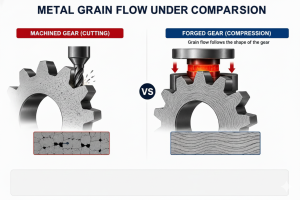
Forged gears are stronger because the process creates a continuous, uninterrupted grain flow that follows the tooth contour, whereas machining cuts through these metal fibers and welding creates inconsistent heat-affected zones prone to cracking.
Better fatigue resistance and grain flow
Forged gears derive their strength from uninterrupted grain flow. Unlike machining, which cuts through metal fibers and creates weak points, forging mechanically deforms the crystal structure to follow the gear’s tooth contour.
By maintaining continuous fibers, forged gears provide:
- Superior Fatigue Resistance: The aligned structure resists cracking under the repetitive, cyclic loading of industrial hoist systems.
- High Torque Impact Strength: Oriented fibers at the tooth root absorb sudden torque peaks without failure.
- Structural Integrity: The process eliminates internal voids, ensuring a dense, uniform part that outperforms machined or welded alternatives.
What metals can and cannot be forged?
Best steel alloys for forging high-precision gears
The suitability of a metal for gear forging is defined by its ductility and hardenability. For high-precision applications, alloy steels are the industry standard because they can undergo significant plastic deformation without fracturing.
Key characteristics of ideal forging alloys include:
- Fine Grain Structure: Allows for uniform deformation and superior strength after heat treatment.
- High Ductility: The ability to flow into complex die cavities under pressure.
- Optimal Hardenability: Supports deep, consistent hardening (e.g., AISI 4140, 4340, or 8620) to handle extreme tooth-contact pressure.
Materials that are not suitable for the forging process
Not all metals can withstand the intense compressive forces of the forging press. Materials that lack the necessary “plasticity” will crack or shatter rather than flow.
Common materials unsuitable for forging include:
- Gray Cast Iron: Its high carbon content in the form of graphite flakes makes it extremely brittle; it will snap under impact rather than deform.
- Highly Brittle Alloys: Certain high-carbon or specialty steels that are prone to “hot shortness” (cracking at forging temperatures).
- Specialized Superalloys: While some can be forged, many require vacuum environments or extreme temperatures that make standard forging commercially unviable.
For these materials, casting or additive manufacturing are typically used to achieve the desired geometry.
Are forged gears worth the extra cost? (ROI Analysis)
Long-term durability vs. Initial investment
While the initial purchase price of a forged gear may be higher due to tooling and specialized equipment, the Total Cost of Ownership (TCO) is significantly lower. The superior fatigue resistance of forged components directly translates to a longer service life, often outlasting cast or machined gears by a factor of 2:1 or more in high-load environments.
The true Return on Investment (ROI) comes from:
- Reduced Downtime: High-strength forged gears minimize the risk of tooth breakage, preventing catastrophic equipment failure and expensive production halts.
- Maintenance Savings: Greater wear resistance means fewer replacements and less frequent maintenance cycles for heavy-duty transmission systems.
- Safety Assurance: In mission-critical lifting applications like cranes, the structural integrity of forging provides an invaluable “safety margin” that cast parts cannot match
Reducing lead times for custom gear replacements
Forging can be a strategic advantage for urgent, custom gear replacements. For large-diameter or specialized gears, sourcing a massive solid steel plate or waiting for a complex casting mold can take weeks.
In contrast, open-die forging allows for the rapid creation of a “near-net-shape” gear blank. This process:
- Accelerates Production: Quickly produces a dense, high-strength blank that is ready for immediate precision machining.
- Reduces Material Waste: Forging the blank close to the final dimensions means less time is spent on heavy material removal (rough machining).
- Enhances Availability: For custom industrial repairs, utilizing forged blanks ensures the replacement part is not only delivered faster but also exceeds the performance of the original component.
Request a Custom Forged Gear Engineering Review
At Belon, we provide:
- Custom forged gear blanks
- Material certifications per ASTM / EN standards
- Heat treatment and hardness validation
- DIN 3–6 precision finishing
- Rapid turnaround for replacement gears
Send your drawings or application parameters for an engineering feasibility review.
FAQ
Q1: Are transmission gears always forged?
In high-performance and heavy-duty vehicles, yes. Forging provides the high fatigue strength and impact resistance required to handle rapid torque changes, which standard cast gears cannot withstand.
Q2: Can any metal be forged into a gear?
No. Forging requires materials with good ductility. While alloy steels like 4140 and 8620 are ideal, brittle materials like gray cast iron will crack under pressure and are better suited for casting.
Q3: Is forging stronger than welding for gear manufacturing?
Yes. Forging creates a continuous grain structure throughout the entire part. Welding creates heat-affected zones (HAZ) that act as weak points, making forged gears far more reliable for mission-critical applications.
Q4: How do I know if I need a forged gear or a cast gear?
If your application involves high loads, shock impacts, or requires a long service life (e.g., cranes, mining), forging is necessary. If the gear has a highly complex internal geometry and operates under low stress, casting may be more cost-effective.
Q5: What is the difference between forged and machined gears?
The main difference is how the gear blank is formed.
Forged gears are shaped by compressing heated metal under high pressure, which aligns the internal grain flow and improves strength, fatigue resistance, and impact durability.
Machined gears are cut directly from solid steel using material-removal processes such as hobbing or milling. They offer excellent dimensional accuracy and design flexibility but do not benefit from the grain-flow strengthening created by forging.
In practice, many high-performance industrial gears combine both methods: the blank is first forged for structural strength, then precision-machined and ground to achieve final tooth accuracy.